The New Oil (Part 2): How the 2026 lithium and graphite bottleneck could stall global EV growth
By Cygnus | 12 Jan 2026
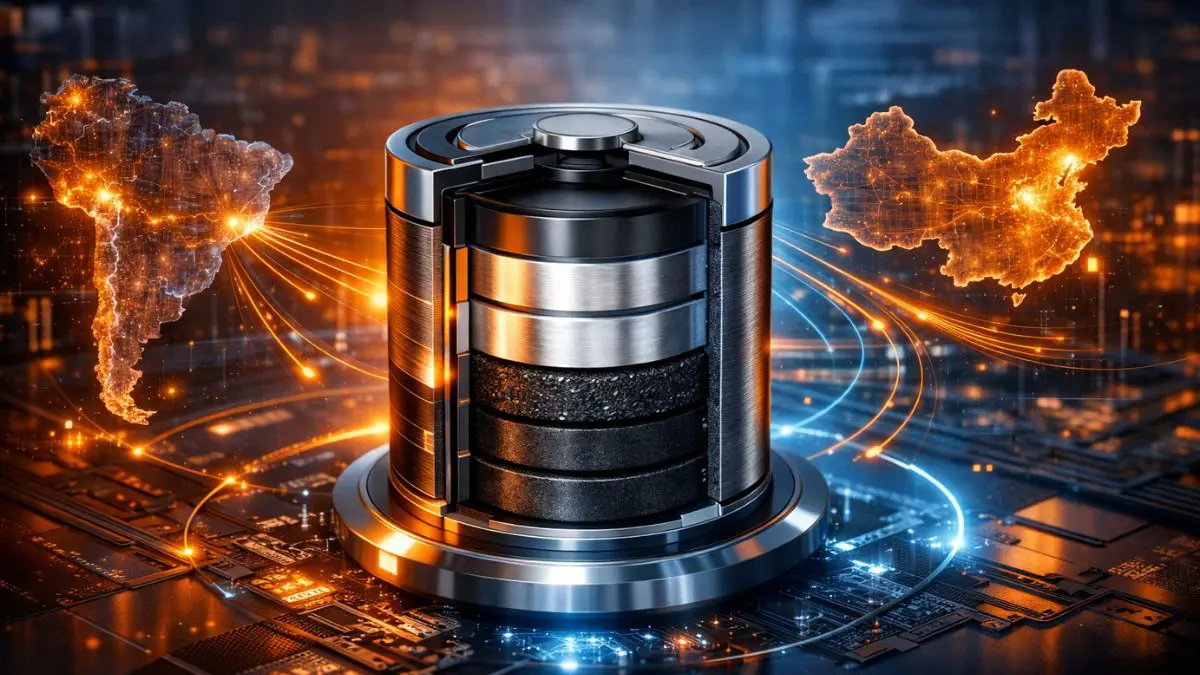
If rare earths are the strategic choke point of modern geopolitics, lithium and graphite are the industrial heart of the clean-energy economy. The 2026 Rare Earth Shock has made one message unavoidable: the race to electrify transportation is not merely a race to build electric vehicles—it is a race to control the refined chemistry that powers them.
In boardrooms from Detroit to Stuttgart, the supply chain anxiety triggered by China’s export controls has spilled into the battery domain. EVs cannot roll off assembly lines without lithium compounds, graphite anodes, and high-purity nickel. Yet as of early 2026, the world’s battery supply chain remains highly concentrated. While mining is geographically diversified, the chemical processing and component manufacturing—the steps that determine pricing power—remain heavily anchored in Asia.
The result is a growing bottleneck risk. Even as automakers announce new models, the physical reality of mineral supply is forcing a recalibration. Industry executives increasingly describe the battery market as the next “oil market,” where supply shocks ripple across inflation, industrial output, and national security.
The battery economy has its own geopolitics
Lithium is often called “white gold,” but the phrase hides a deeper truth: supply is not simply about who owns the deposits—it is about who controls chemical conversion. Battery-grade lithium carbonate and lithium hydroxide require complex refining and high-quality inputs.
Recent lithium carbonate pricing has stabilised compared with the extreme volatility of earlier years, but analysts note that rising demand from grid-scale Energy Storage Systems (ESS) is helping support prices. That dynamic is important for EV markets because sustained strength in lithium chemicals can keep battery costs higher than pre-2025 expectations, delaying mass-market affordability targets.
While the Lithium Triangle—Chile, Argentina, and Bolivia—dominates global reserves and brine-based resource potential, China holds a structural edge in conversion capacity. This advantage is reinforced by industrial clustering: cathodes, anodes, separators, and electrolytes exist within tightly integrated ecosystems. That scale reduces cost, increases speed, and gives Chinese players leverage over global battery material pricing.
Graphite adds another layer of dependency. Every lithium-ion EV battery requires large quantities of graphite—often many times the weight of lithium—because graphite forms the dominant anode material. While natural graphite mining is diversifying into Africa and other regions, the biggest vulnerability lies in spherical graphite purification and the energy-intensive production of synthetic graphite. Here, China’s dominance is so deep that Western supply-chain planners increasingly refer to it as the “quiet choke point.”
Editor’s note: With export licensing and restriction regimes under discussion across key battery inputs, Western OEMs are no longer just planning—they are stockpiling, treating critical mineral inventories with the urgency once reserved for semiconductor chips.
South America’s leverage, China’s processing power
Nowhere is the value-chain imbalance clearer than in the Lithium Triangle. These nations sit at the upstream end of the energy transition but are increasingly pushing for deeper value addition—moving from raw exports toward domestic processing, cathode production, and strategic industrial clustering.
Argentina has emerged as one of the fastest-growing lithium producers globally, supported by investment incentives and a pipeline of new projects. Some operations are now ramping toward sustained high utilisation as new capacity comes online, strengthening Argentina’s position as a swing-growth supplier into the second half of this decade.
Bolivia, long viewed as a future lithium superpower due to the vast scale of the Salar de Uyuni, is also moving through a pivotal phase. Policymakers have signalled renewed interest in attracting technology partners and accelerating commercial development, with Direct Lithium Extraction (DLE) increasingly seen as a potential enabler. However, industry observers note that technical execution, investment frameworks, and infrastructure readiness remain key constraints.
For China, South America has become a strategic theatre. Chinese battery and materials firms have secured long-term offtake agreements and upstream stakes that effectively lock supply into China-centered processing chains. This has created a new tension: South American governments want domestic cathode and conversion plants, while China’s long-term model remains securing upstream inputs to feed its industrial core.
Industrial policy and the hybrid pivot
The scramble for batteries has pushed governments into open industrial policy—and increasingly divergent strategies.
In the United States, the focus is “battery security,” with policy frameworks designed to encourage refining and conversion inside domestic or allied supply chains. That approach aims to reduce strategic dependence while building industrial resilience for EVs, grid storage, and defence-linked applications.
Europe’s challenge is cost competitiveness. European leaders want supply-chain independence, but high energy prices and slower permitting timelines make it difficult to match the speed and economics of Asia-based ecosystems. As a result, Europe’s battery strategy remains ambitious but uneven in implementation.
This divergence is shaping corporate behaviour. Several manufacturers are increasingly positioning hybrids as a “bridge technology”—not as a retreat from electrification, but as a pragmatic response to mineral bottlenecks. Smaller batteries reduce exposure to lithium and graphite volatility, allowing automakers to spread constrained inputs across a larger number of vehicles while EV supply chains scale.
In 2026, the EV transition is no longer defined only by charging networks and consumer incentives. It is being shaped—more quietly but more powerfully—by chemistry.
Executive summary & key takeaways
- The bottleneck risk: EV scale depends on lithium chemicals and graphite anodes, creating fragile points in the battery supply chain.
- The power split: South America holds strategic reserves, but global markets remain heavily dependent on Chinese conversion and processing capacity.
- Graphite vulnerability: Spherical graphite purification and synthetic graphite processing remain concentrated and difficult to replace quickly.
- Technology pivot: Direct Lithium Extraction (DLE) may unlock new supply, but commercial scalability remains uncertain.
- Strategic hedge: The hybrid pivot is emerging as a corporate risk-management strategy to reduce battery-material exposure during supply constraints.
Read Part 3: The New Oil: Inside the Processing Gap — Why Mining Alone Won’t Fix the Critical Minerals Crisis