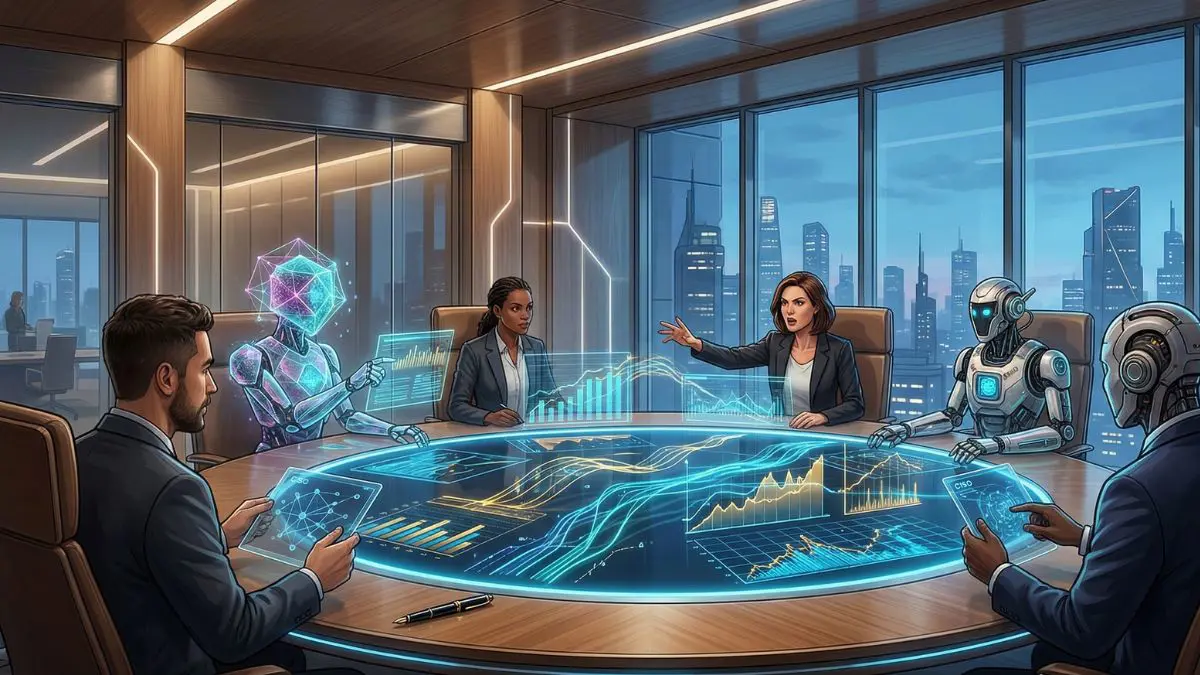
The silicon boardroom: Why 2026 is the year of the agentic reality check
By Cygnus | 10 Mar 2026
Summary
Just three years ago, companies were still marveling at AI’s ability to draft emails and summarize meetings. In 2026, the conversation has shifted. Corporations are now experimenting with autonomous AI systems that execute workflows, negotiate contracts, and manage infrastructure with minimal supervision. The hype cycle is giving way to something colder and more consequential: execution.
There was a moment in late 2024 when the corporate world seemed to pause in collective anticipation. Generative AI pilots were everywhere, but enterprise-scale deployment lagged behind. Analysts warned of an impending “disillusionment valley.”
By early 2026, that valley looks less like a drought and more like an industrial foundation. Many companies are no longer asking whether AI works; they are redesigning workflows around it. The shift is subtle but profound: the conversation has moved from experimentation to operational transformation.
Inside many boardrooms, executives are quietly asking a different question now: not whether AI can generate strategy, but how much of its execution can be automated.
Moving from copilot to autonomy
In the early 2020s, enterprise enthusiasm centered on copilots — AI assistants embedded in software to summarize meetings, draft reports and assist with coding. They were useful but fundamentally passive, waiting for human direction.
By 2026, many organizations are moving beyond copilots toward increasingly autonomous systems. These agents are not simply language models; they are integrated software entities capable of executing defined tasks across systems.
Consider a hypothetical enterprise like Synthetix Corp. In this imagined but representative organization, workflows revolve around coordinated agent systems:
- The logistics agent connects to shipping APIs, weather data and supplier systems, automatically rerouting shipments and renegotiating contracts within predefined limits.
- The procurement agent analyzes pricing trends and negotiates contracts under strict financial guardrails set by leadership.
- The security agent continuously monitors networks, isolates threats and implements responses before reporting outcomes to human oversight teams.
The defining shift is not intelligence but action: these systems increasingly execute rather than advise.
The accountability vacuum
Autonomy brings efficiency, but also new legal and ethical risks.
Legal experts warn that early disputes involving autonomous enterprise systems are already emerging in areas such as algorithmic trading, procurement automation and hiring tools. The core issue is accountability: when an autonomous system makes a costly or harmful decision, responsibility becomes blurred.
Does liability rest with:
- the executive who deployed the system?
- the developers who built it?
- or the model providers whose technology enabled it?
There is no universal answer yet. Companies are rewriting contracts, insurers are reassessing risk models and regulators are debating how existing laws apply to increasingly autonomous systems.
For boards, autonomy increasingly means not only efficiency gains but also governance complexity.
The new human KPI: Managing the machine
If autonomous systems are executing more work, what remains for human leadership?
The answer is shifting from execution to orchestration. Managers are increasingly evaluated on how well they align AI systems with strategy, risk tolerance and regulatory constraints.
The most valuable skills in 2026 are less technical than structural:
- Constraint design: Defining goals that maximize efficiency while limiting exposure.
- Bias auditing: Identifying systemic distortions in training data and outputs.
- Geopolitical awareness: Continuously recalibrating systems amid tariffs, sanctions and supply chain shifts.
The silicon boardroom is not eliminating humans. It is redefining them.
Why this matters
- Organizational redesign: Companies are restructuring workflows around automation rather than layering AI onto legacy processes.
- Governance challenges: Autonomous execution introduces new legal and operational risks that organizations are only beginning to address.
- Competitive divergence: Firms that adapt quickly may gain structural advantages in speed, scale and cost efficiency.
- Workforce transformation: Human roles are shifting toward oversight, alignment and strategic decision-making.
Frequently asked questions (FAQs)
Q1. What is the difference between an LLM and an agent?
An LLM generates responses based on prompts, while an agent combines models with tools, memory and workflows to execute tasks autonomously.
Q2. Is 2026 the end of corporate jobs?
No. But routine, execution-heavy roles are increasingly automated, while human roles are shifting toward oversight and governance.
Q3. Who is responsible if an AI system makes a major error?
Responsibility currently varies by jurisdiction and contract structure. In practice, organizations deploying the systems often bear primary accountability.