The 35-minute revolution: How China’s electric trucks outpaced the West
By Cygnus | 10 Mar 2026
Summary
For decades, European truckmakers dominated global freight. In 2026, that dominance is being challenged by Chinese electric truck manufacturers offering faster charging, competitive pricing and strong performance metrics. Their arrival in Europe is reshaping the industry’s economics — and forcing legacy brands to rethink how they compete.
In the industrial outskirts of Antwerp, the shift in freight transport is visible in quiet, practical ways. Where diesel once defined heavy logistics, electric trucks are beginning to reshape the daily rhythm of distribution hubs across Europe.
By 2026, the story of Chinese electric vehicles has moved from passenger cars to freight corridors. While European manufacturers focused on gradual electrification, companies such as Windrose, BYD and SuperPanther targeted the operational metrics fleet operators value most: cost, uptime and charging efficiency.
The speed question
Heavy-duty truck development cycles have traditionally stretched close to seven years, reflecting the sector’s engineering complexity and safety requirements.
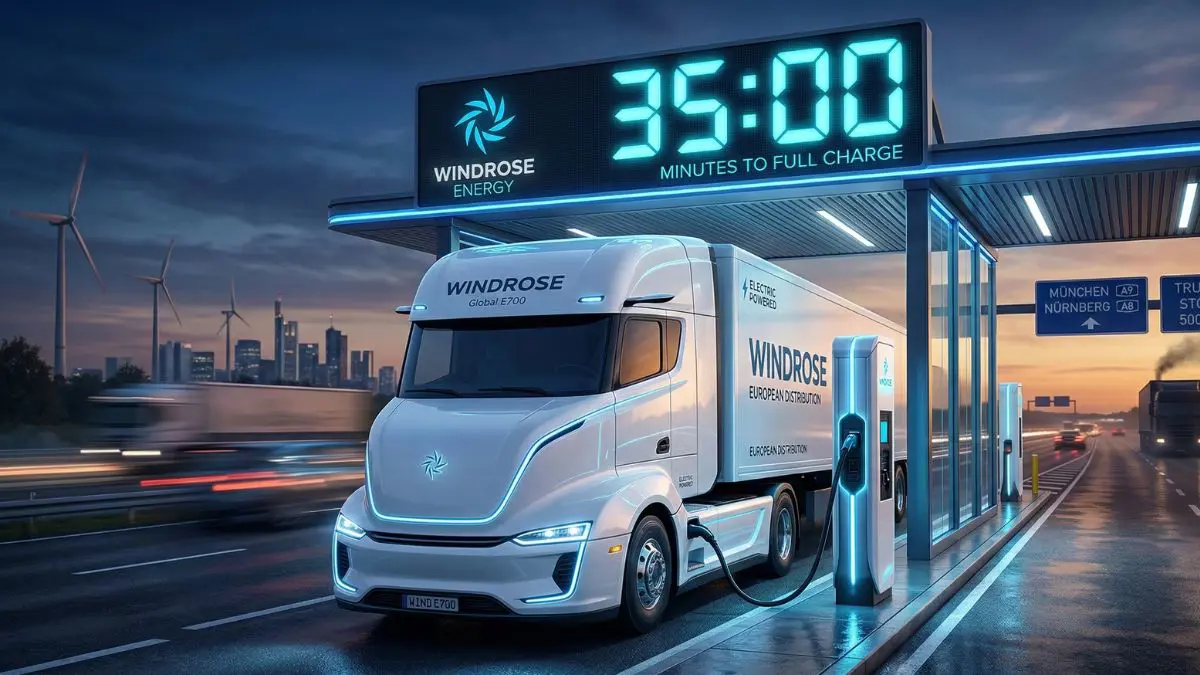
Newer entrants are compressing those timelines. Windrose, founded in 2022, introduced its Global E700 electric truck with a claimed charging time of roughly 35 minutes under megawatt-class charging conditions.
For comparison, many European electric heavy-duty trucks currently require around 70 minutes or more under similar conditions. For logistics operators, faster charging directly translates into improved utilization and lower downtime.
The result is not just incremental progress but a shift in how fleets calculate productivity.
The pricing equation
Chinese electric trucks are also entering Europe with price points estimated around €225,000–€250,000, compared with roughly €320,000 for many European models.
| Metric | European incumbent (avg.) | Chinese challenger (avg.) |
|---|---|---|
| Price | ~€320,000 | ~€225,000 |
| Development cycle | ~7 years | ~3–4 years |
| Charging time* | ~70 minutes | ~35 minutes |
| Range (approx.) | ~300–400 km | ~600 km |
*Under optimal charging infrastructure conditions.
This cost advantage reflects China’s scale in battery production and a domestic market where zero-emission heavy trucks already account for about 29% of sales. Analysts say vertical integration across batteries, components and manufacturing has accelerated development and lowered costs.
Europe adapts
European manufacturers — including Volvo Group, Daimler Truck and Traton Group — are responding with a mix of investment and strategic adjustment.
Scania, part of Traton, committed roughly €2 billion to a factory near Shanghai to strengthen its presence in China and improve development speed.
Volvo Group CEO Martin Lundstedt acknowledged the growing competition, noting that Chinese entrants are moving quickly on innovation and scale.
At the same time, Chinese firms are building European operations — including BYD’s planned production in Hungary and partnerships such as SuperPanther’s service agreements with Alltrucks — to build trust and avoid trade friction.
The loyalty test
Fleet buyers have traditionally favored established brands, but economics increasingly outweigh brand loyalty.
In early 2026, strong demand for electric-truck subsidies in markets such as the Netherlands highlighted the shift. Operators facing rising fuel costs and regulatory pressure are prioritizing total cost of ownership over legacy relationships.
For many fleet managers, electrification is no longer theoretical — it is operational.
Why this matters
- Decarbonization pressure: Lower-cost electric trucks could accelerate Europe’s climate targets for freight.
- Industrial competition: Heavy truck manufacturing remains central to Europe’s industrial base.
- Supply chain leverage: Battery dominance gives Chinese manufacturers structural advantages.
- Global ripple effects: Increased competition may reshape markets beyond Europe, including North America.
Frequently asked questions (FAQs)
Q1. Are Chinese electric trucks safe for European roads?
Yes. Vehicles must meet EU regulatory and safety standards before sale.
Q2. What about charging infrastructure?
Megawatt Charging Systems (MCS) are still expanding across Europe, which will determine how quickly fleets scale adoption.
Q3. Will the EU impose tariffs?
Debate is ongoing. Policymakers face pressure both to protect industry and to support decarbonization goals.

























