Gulf businesses face sweeping disruption as Iranian strikes rattle regional hubs
By Axel Miller | 02 Mar 2026
Summary
Iran’s retaliatory strikes across the Gulf have triggered widespread business disruption, forcing airport closures, halting port activity and sending regional financial markets lower. The escalation — the most significant shock to Gulf commercial activity since the pandemic — is testing the region’s reputation as a stable global hub for trade, finance and tourism.
DUBAI, March 1, 2026 — Iranian retaliatory strikes across the Gulf have disrupted business activity across multiple sectors, shutting airports, suspending port operations and weighing on financial markets, according to officials, market data and Reuters reporting.
The attacks, launched after joint U.S.-Israeli strikes on Iranian territory, have shaken a region long viewed as a safe haven for global trade, investment and tourism. In the United Arab Emirates, authorities reported fatalities and injuries following explosions in Dubai and Abu Dhabi over several days.
Dubai — which transformed itself from a regional trading port into a global logistics, tourism and financial centre — faces one of the most severe shocks in its modern history as transport, hospitality and finance sectors absorb the impact.
“Elevated oil prices provide a fiscal cushion for producers such as Saudi Arabia and Qatar,” said Vijay Valecha, chief investment officer at Century Financial. “However, trade, logistics and tourism — particularly in the UAE — would face pressure if shipping risks rise or regional sentiment weakens.”
Markets tumble, trading suspended
Gulf equities declined sharply as trading resumed after the strikes. Saudi Arabia’s benchmark index dropped more than 4% at the open on Sunday before closing down about 2.2%. Oman ended 1.4% lower and Egypt fell roughly 2.5%, trimming earlier losses, while Qatar’s index declined in early Monday trade.
The United Arab Emirates took the unusual step of closing its stock exchange for two days, while Kuwait suspended trading temporarily, reflecting heightened volatility and operational disruption.
Global markets also reacted to the escalation. Brent crude rose above $78 a barrel after closing near $72.87 on Friday, while Asian equities declined, with Japan’s Nikkei, Hong Kong’s Hang Seng and Taiwan’s benchmark index all posting losses.
“Markets will remain fragile and volatile while military operations continue,” said Mohammed Ali Yasin, chief executive of Ghaf Benefits in Abu Dhabi, noting that foreign institutional investors often lead initial sell-offs during geopolitical crises.
Infrastructure and tourism hit
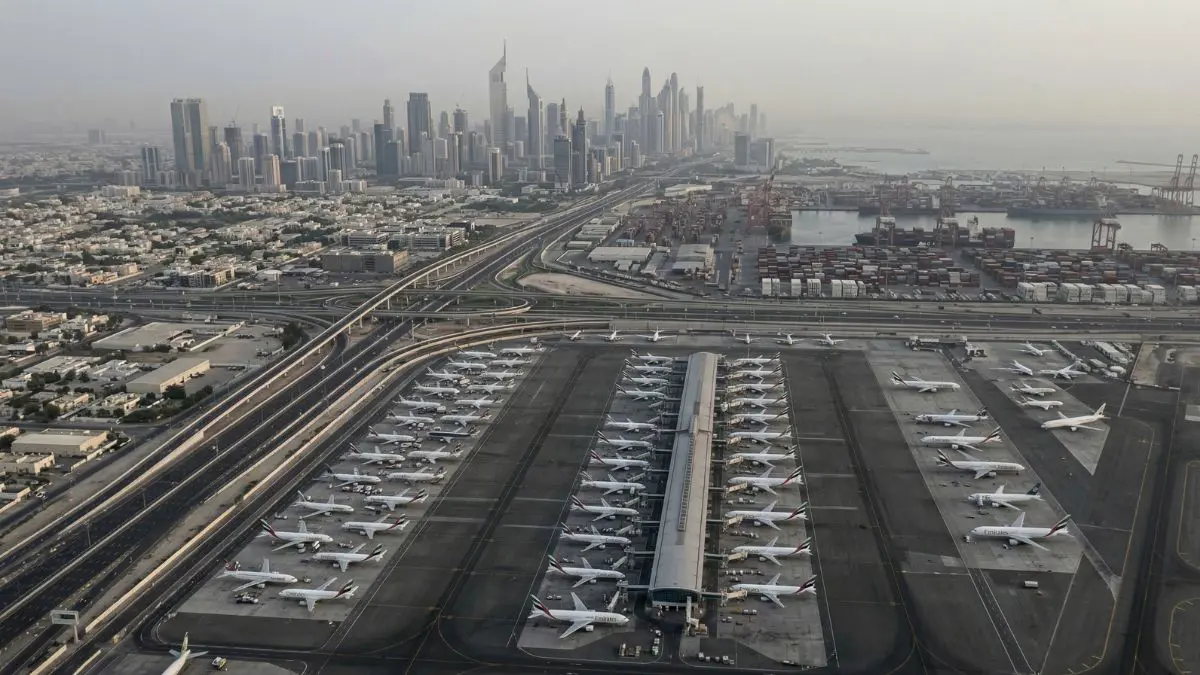
Strikes affected transport and commercial infrastructure, including airports, ports and hospitality assets. Dubai International Airport and Zayed International Airport in Abu Dhabi reported disruptions and damage, with casualties reported across the two locations.
At Jebel Ali Port, a fire broke out at a berth following an aerial interception, highlighting risks to one of the world’s busiest logistics hubs.
Residential and tourism districts were also affected, with incidents reported near Dubai Marina and Palm Jumeirah. Damage was reported at several properties, including luxury hospitality assets.
The Fairmont The Palm hotel — which had recently changed ownership in a deal reflecting strong Gulf tourism demand — became a symbol of the potential economic impact on the sector.
The UAE hosts major regional companies including developer Emaar Properties and retail group Majid Al Futtaim, and has attracted global banks and hedge funds in recent years alongside sovereign wealth investors such as ADIA and Mubadala.
Ramadan networking season disrupted
The escalation coincides with Ramadan, traditionally one of the most important periods in the Gulf business calendar when corporate iftars and suhoors serve as key networking forums.
Corporate events hosted by major organisations, including airlines, investment funds and government entities, were cancelled or postponed, according to communications reviewed by Reuters.
In a relationship-driven business environment, the disruption to Ramadan gatherings adds a less visible but meaningful economic impact.
Travel advisories and airspace closures
The United States, United Kingdom and European authorities updated travel guidance following the strikes, urging caution and in some cases advising against non-essential travel.
Major transit hubs — including Dubai, Abu Dhabi and Doha — faced closures or severe restrictions as sections of Gulf airspace were shut, disrupting one of the world’s busiest aviation corridors and raising concerns about knock-on effects for global travel and cargo flows.
Why This Matters
- Global trade risk: The Gulf is a critical logistics corridor linking Asia, Europe and Africa, so disruptions ripple across supply chains.
- Oil price volatility: Higher crude prices may support fiscal balances but increase inflation risks globally.
- Tourism and aviation shock: Airport closures threaten one of the region’s largest non-oil growth sectors.
- Investor confidence: Prolonged instability could slow capital inflows that have supported Gulf diversification strategies.
FAQs
Q1. What triggered the disruption?
Iran launched retaliatory strikes following U.S.-Israeli attacks on Iranian territory, escalating regional tensions.
Q2. Which sectors are most affected?
Aviation, tourism, logistics, ports and financial markets have seen the most immediate impact.
Q3. How did markets react?
Regional equities fell, some exchanges suspended trading, and oil prices rose on supply-risk concerns.
Q4. Are flights operating normally?
Many airports faced closures or restrictions due to airspace controls and security concerns.
Q5. Could the disruption be prolonged?
That depends on the duration of military operations and whether tensions escalate further.

























