India’s Data Center Arms Race: The Battle for Power, Cooling, and AI Real Estate
By Cygnus | 22 Jan 2026
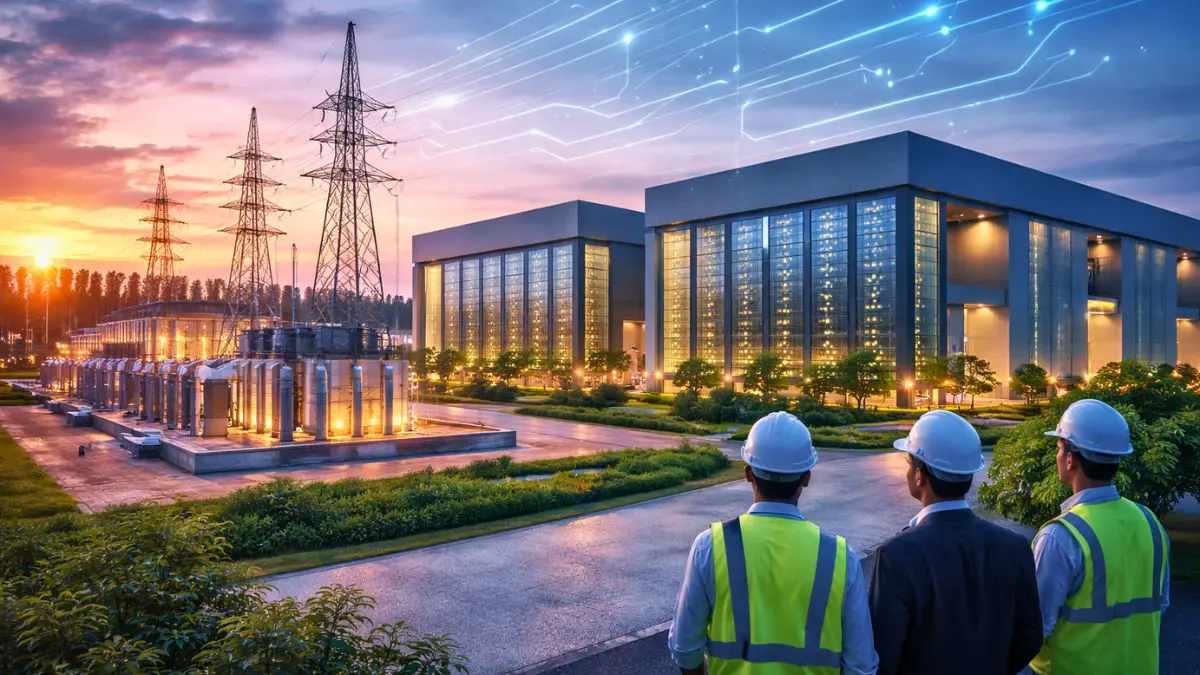
India’s next infrastructure boom is not being built on highways, airports, or ports. It is rising behind reinforced concrete walls, atop anti-vibration flooring, and adjacent to high-voltage substations.
The era of the AI-ready data center has arrived.
Over the last 18 months, India’s data center narrative has shifted from a steady colocation expansion into a high-stakes race to build the digital backbone of artificial intelligence. In this new landscape, the decisive advantage is no longer just the building — it is the power contract, the cooling architecture, and the speed of commissioning.
And in 2026, those three factors are turning data centers into something closer to industrial megaprojects than real estate.
The new constraint: Power is the new land
In the traditional data center model, the primary bottleneck was real estate. In the AI era, the hard ceiling is electricity and grid readiness.
AI workloads demand exponential energy density. While a standard enterprise rack may require modest power, AI compute racks — driven by heavy GPU clusters — can push beyond 50 kW, often scaling toward 100 kW+ and sometimes higher in next-generation deployments. That is triggering a sharp rise in engineering complexity.
The power challenge now includes:
- Grid stability: high-volume continuous availability with near-zero downtime tolerance
- Redundancy: N+1 (or higher) architecture to prevent catastrophic downtime
- Infrastructure proximity: faster access to substations, transmission nodes, and right-of-way approvals
- Sustainability pressure: long-term PPAs and renewable sourcing to meet ESG and client compliance requirements
Industry insight: In 2026, competitive advantage is no longer measured in square feet. It is measured in megawatts (MW), time-to-power, and thermal efficiency.
The strategic triad: India’s emerging AI zones
India’s data center clusters are converging around three infrastructure logic points, increasingly mirroring the nation’s industrial map:
1) Mumbai & Navi Mumbai: The connectivity + financial hub
Mumbai remains India’s dominant data center market, accounting for a significant share of national capacity according to multiple industry estimates. Its biggest edge is not land — it is the ecosystem:
- dense enterprise and BFSI demand
- strong connectivity providers
- proximity to major subsea cable networks and landing infrastructure
- mature colocation and cloud demand
Navi Mumbai has evolved into a campus-style expansion corridor, backed by multiple large developers and corporate groups. Industry estimates suggest over $10 billion in announced investments are linked to the wider digital infrastructure buildout in the region over recent years.
2) Chennai: The capacity + gateway play
Chennai has solidified its position as India’s other major data center gateway:
- lower cost structure compared to Mumbai
- strong role in enterprise disaster recovery (DR)
- expanding hyperscaler interest due to scale availability
- improving connectivity benefits
3) Hyderabad: The scalable domestic AI hub
Hyderabad’s edge is scale, policy momentum, and the enterprise ecosystem:
- tech-ready land parcels and execution capacity
- high density of GCCs and engineering talent
- growing demand from AI-first companies and platform teams
Taken together, these hubs represent a clear conclusion: compute has become industrial infrastructure — and Indian cities are now competing on compute readiness the way they once competed on manufacturing zones.
The tech shift: Cooling is now competitive advantage
AI compute turns electricity into heat at a rate traditional air cooling can no longer handle.
That is why the industry is pivoting quickly toward:
- Direct-to-chip liquid cooling
- liquid-cooled loops
- and, in the most dense scenarios, immersion systems
This cooling transition matters because it changes what data centers are:
In the AI era, data centers behave like power + thermal management plants.
AI-ready infrastructure: what is different?
| Feature | Legacy Colocation | AI-Ready Data Centers (2026) |
|---|---|---|
| Primary compute | Standard enterprise servers | High-density GPU clusters |
| Heat management | Forced air / HVAC | Liquid cooling / direct-to-chip |
| Rack density | ~5–10 kW | ~50–150+ kW (case dependent) |
| Networking | Standard ethernet | AI fabrics / ultra high-speed backbones |
This is why liquid cooling is not a marketing gimmick. It is increasingly a fundamental requirement for high-density AI compute.
The three bottlenecks: land, power, and time-to-live
In 2026, the arms race is shaped by three hard constraints:
1) Land parcels with clean execution
It’s not about land availability — it’s about titles, zoning, and approvals. Large campuses require multi-acre parcels and predictable compliance pathways.
2) Power contracts and substation readiness
A data center without secured power is not infrastructure — it’s a plan on paper.
The most valuable players are increasingly those who can lock in:
- long-duration PPAs
- grid capacity allocations
- redundancy feeds
- and substation-linked development timelines
3) Time-to-live
This is now a deal-making metric.
Hyperscalers and AI clients care less about brochures and more about:
- commissioning timelines
- phase-by-phase delivery
- predictable activation schedules
In the AI era, whoever goes live first wins anchor tenants — and anchor tenants create moats.
The investor playbook: why capital is flooding into Indian data centers
Earlier cycles treated data centers as:
- real estate + infra yield assets
- predictable long-term lease platforms
Now they are being valued more like:
- strategic AI infrastructure
- power-linked industrial parks
- digital resilience assets
That has pulled in:
- infrastructure funds
- sovereign-linked capital
- global DC operators
- asset managers treating AI compute as a durable growth theme
The shift is structural: data centers are no longer peripheral infrastructure — they are core national productivity infrastructure.
Geopolitics and ‘sovereign compute’
A critical narrative is emerging: sovereign compute.
Governments and regulated sectors are increasingly recognizing that:
- AI models depend on compute access
- compute access depends on data center availability
- data center availability depends on domestic power and infrastructure
This makes AI-ready data centers strategic assets in areas such as:
- financial system continuity
- cybersecurity and resilience planning
- public-sector infrastructure modernization
- sensitive enterprise and national data governance
In India, the broader compliance environment—including the Digital Personal Data Protection Act (DPDPA) and sectoral security expectations—is strengthening the long-term case for domestic hosting and regulated cloud demand.
Winners vs losers in the AI data center boom
Winners
- developers with pre-secured power capacity
- players building liquid-ready AI campuses
- cooling and power equipment supply chains
- cities with fast approvals and substation readiness
Losers
- legacy low-density colocation without AI retrofit readiness
- markets where power approvals are slow
- campuses dependent on uncertain grid upgrades
Bottom line: AI-ready data centers are India’s next capex war
Industry estimates suggest India’s installed data center IT load is moving rapidly toward ~1.7–2.0 GW by early 2026, roughly doubling in under three years.
But the key story is not the number. It is the transformation:
India’s data center sector has evolved from a real-estate play into a specialized, high-performance computing (HPC) infrastructure race.
Compute capacity is no longer just a service.
It is becoming an economic multiplier — and a strategic advantage.
Summary
India’s data center expansion has entered an AI-driven arms race where the decisive advantage is no longer real estate. The key battleground is power capacity, liquid cooling readiness, and commissioning speed. Mumbai/Navi Mumbai, Chennai, and Hyderabad are emerging as India’s core compute hubs, while “sovereign compute” is becoming an important policy and strategic theme.
FAQs
Q1: Why is AI fundamentally changing data center demand in 2026?
AI runs on GPU clusters that consume far more electricity and generate far more heat than traditional enterprise workloads. This forces structural changes in design — from simple HVAC buildings to industrial-scale power and thermal systems.
Q2: What is a “NeoCloud” player?
NeoClouds are AI-first cloud providers focused on GPU compute as a service (GPUaaS), designed for model training and inference workloads. They differ from traditional hyperscalers by being specialized and AI-native in architecture and pricing.
Q3: Why has Navi Mumbai emerged as a major battleground?
Navi Mumbai offers proximity to Mumbai’s enterprise demand, scalable land parcels for campus development, and strong connectivity access, making it a natural hub for hyperscale and AI-ready infrastructure growth.
Q4: What is “sovereign compute” and why does it matter?
Sovereign compute refers to the ability to host, run, and govern critical AI and digital systems on domestic infrastructure, reducing reliance on external policy shocks or foreign compute bottlenecks.
Q5: Is the industry facing a “power ceiling”?
Yes. In 2026, “time-to-power” is often the critical metric. Land may be available, but grid capacity at the 100+ MW campus scale is scarce and slow to unlock.