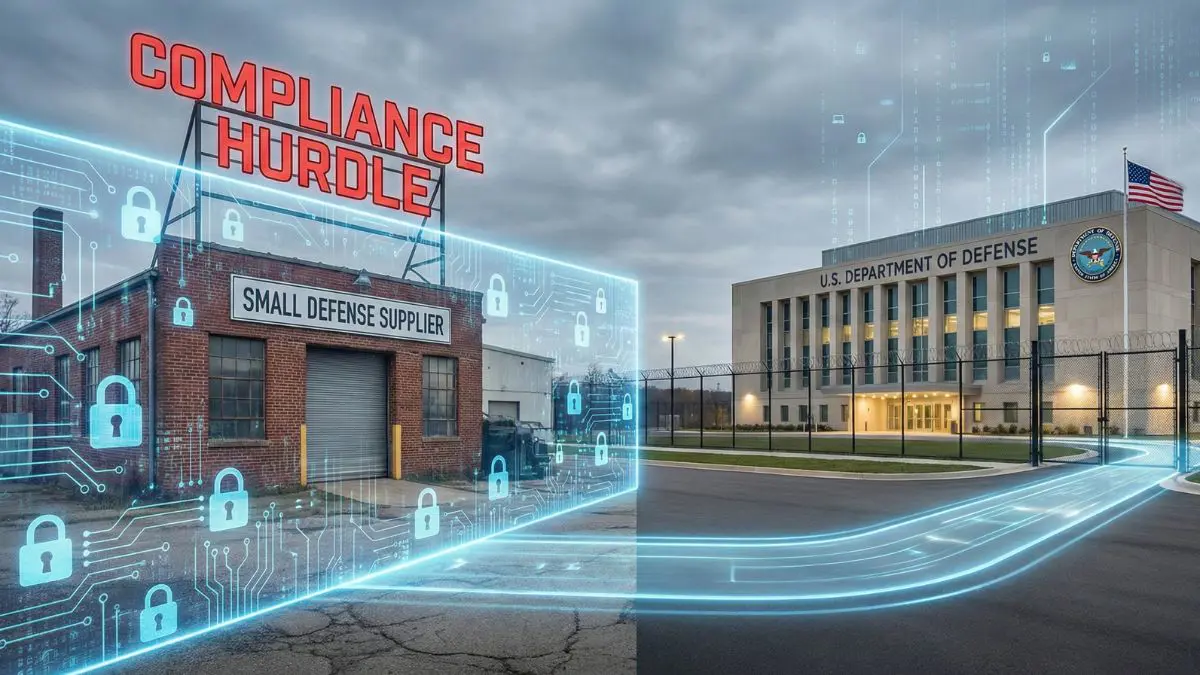
New U.S. cybersecurity rules raise compliance hurdles for small defense suppliers
By Axel Miller | 20 Feb 2026
Summary
New cybersecurity requirements tied to the Pentagon’s CMMC framework are increasing compliance costs for defense contractors, with industry groups warning the rules could discourage participation from smaller suppliers.
New cybersecurity requirements for companies working with the U.S. military are prompting some smaller suppliers to reassess their role in defense programs, as compliance costs and regulatory complexity rise.
The rules are part of the U.S. Department of Defense Cybersecurity Maturity Model Certification (CMMC) framework, aimed at strengthening protection of sensitive government data. Industry executives and advisers say the measures could inadvertently strain smaller firms even as policymakers seek to expand defense production capacity.
Compliance costs weigh on smaller firms
The CMMC program is being rolled out in phases, beginning with basic cybersecurity self-assessments and progressing toward more rigorous third-party audits for higher certification levels.
Executives cited uncertainty over requirements — including what qualifies as controlled unclassified information — as well as audit timelines as key challenges. In some cases, suppliers said prime contractors are requesting higher security standards than required, adding to compliance burdens.
Industry estimates suggest compliance expenses can reach hundreds of thousands of dollars per company, a significant cost for smaller manufacturers.
Risk of reduced competition in defense supply chain
Small businesses represent a substantial portion of the aerospace and defense industrial base, and policymakers have closely monitored their financial health following recent supply-chain disruptions.
Industry groups warn that cumulative regulatory demands could lead some firms to scale back or exit defense contracts, potentially reducing competition and increasing supply-chain concentration.
Legal and compliance advisers also say certification requirements may narrow the supplier pool if smaller firms determine the costs outweigh the benefits.
International suppliers face added complexity
Foreign suppliers face additional hurdles as they align U.S. cybersecurity requirements with regional data-protection rules. Differences between jurisdictions can require parallel compliance processes, increasing costs and operational complexity.
Strategic implications for the defense industry
While the new rules aim to enhance cybersecurity and safeguard sensitive information, they also highlight the challenge of balancing stronger protections with supply-chain resilience.
If participation declines among smaller firms, large contractors could face higher costs and longer lead times, potentially affecting procurement timelines.
Why this matters
Cybersecurity standards are becoming a central factor shaping the structure of the defense industrial base. Stricter requirements can strengthen protection against cyber threats but may also reshape supplier dynamics by raising barriers to entry.
For policymakers, the key challenge will be maintaining robust security while preserving competition and production capacity across the supply chain.
FAQs
Q1. What is the CMMC program?
It is a cybersecurity certification framework developed by the U.S. Defense Department to ensure contractors protect sensitive government information.
Q2. Why are small suppliers concerned?
Compliance can require significant investment in systems, audits, and monitoring, raising costs for smaller firms.
Q3. Could this affect defense production?
If some suppliers exit the market, it could reduce competition and create supply-chain constraints.
Q4. When do stricter requirements take effect?
More advanced certification and audit requirements are being phased in as the program expands.
Q5. How are international suppliers impacted?
They must reconcile U.S. rules with local data-privacy laws, increasing compliance complexity.
Q6. What is the broader industry risk?
A smaller supplier base could increase costs and reduce flexibility in defense procurement.