The $250 billion pivot: how 2026 became the year AI paid the rent
By Cygnus | 18 Feb 2026
Summary
For three years, the AI story was about possibility. In 2026, it is increasingly about profitability. As infrastructure spending peaks and revenue metrics begin to surface, the industry is shifting from a capex-heavy land grab to a new phase defined by monetization, discipline, and sovereign compute strategies — with India emerging as a critical hub in the global build-out.
The end of “experimental AI”
Since 2023, investors have poured hundreds of billions into chips, cloud capacity, and data centers, betting that intelligence would eventually translate into income.
By early 2026, that transition is beginning to show up in earnings.
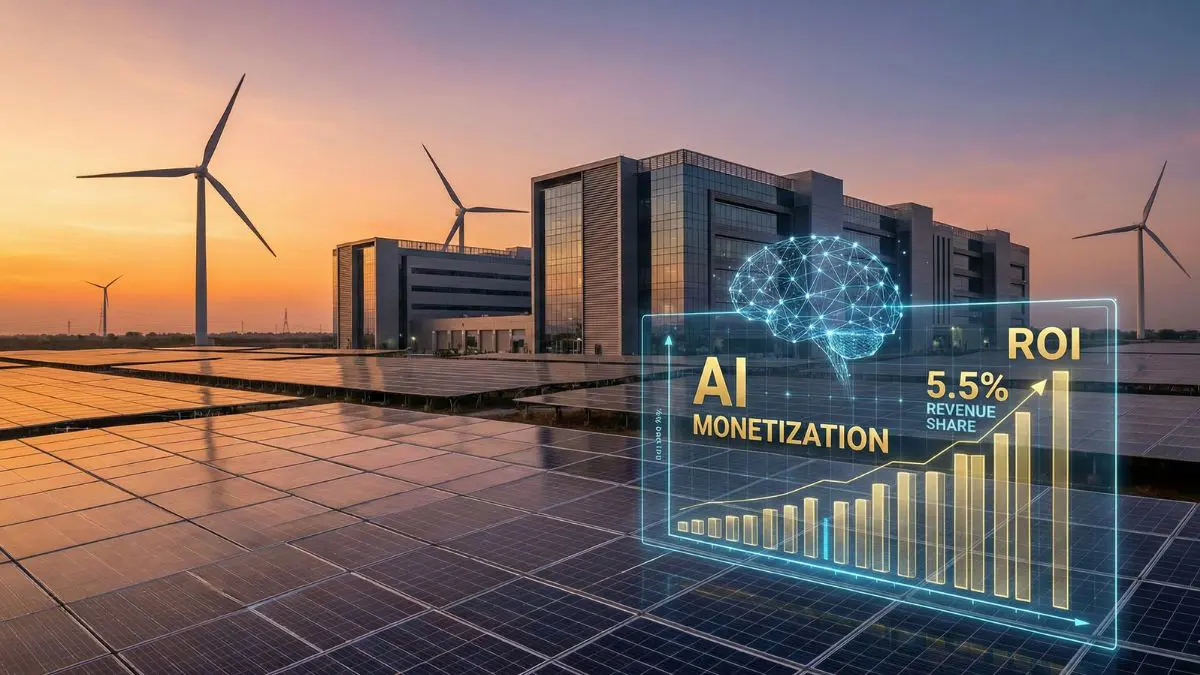
Infosys’ disclosure that AI services now account for about 5.5% of revenue — roughly $275 million in a single quarter — stands as one of the clearest early signals that generative AI is evolving from pilot programs into a meaningful business line.
India and the rise of sovereign compute
While the United States continues to lead in frontier models, a growing share of the world’s infrastructure expansion is happening elsewhere — particularly in India.
Recent announcements illustrate the scale of the shift:
- Adani Group’s long-term plan to build gigawatt-scale, renewable-powered AI data centres
- Microsoft’s multibillion-dollar regional investments, part of a broader Global South expansion
- A wider push toward vertically integrated “sovereign stacks,” spanning energy, cloud, and local data governance
Together, these commitments — alongside related ecosystem spending — point to an AI infrastructure cycle measured in the hundreds of billions of dollars this decade.
The “uber-bullish” paradox
Investor sentiment reflects both excitement and caution. Fund manager surveys show optimism about growth prospects, yet a rising share of investors worry that corporations may be overspending on infrastructure before returns fully materialize.
The market mood has shifted: growth alone is no longer enough — margins and capital efficiency now matter just as much.
The three pillars of the 2026 AI economy
Monetization — revenue share
Metrics like Infosys’s AI contribution are becoming key benchmarks for investors assessing real adoption.
Sovereignty — local infrastructure
Countries are prioritizing domestic compute capacity to control data, costs, and strategic capabilities.
Discipline — capex vs ROI
Markets are increasingly rewarding companies that can convert AI investment into predictable cash flow.
Why this matters
The shift underway in 2026 marks a turning point in how the AI revolution is evaluated.
For investors, it means valuations will increasingly depend on earnings visibility rather than technological promise alone.
For governments, the rise of sovereign compute underscores the strategic importance of controlling digital infrastructure alongside physical supply chains.
For businesses, the message is clear: AI is no longer a speculative upgrade — it is becoming a core operating layer that must justify its costs through measurable productivity gains.
The bottom line
The defining shift of 2026 is not that AI investment has slowed — it hasn’t — but that expectations have changed.
The era of building at any cost is giving way to an era of proving value.
For the first time, the AI revolution is being measured not just in model performance or GPU shipments, but in margins, revenue share, and return on capital.
The companies that will lead the next decade will be those that can turn infrastructure scale into sustainable earnings — converting gigawatts of compute into percentage points of profit.
FAQs
Q1. Why is 2026 seen as a turning point for AI economics?
Because companies are beginning to disclose measurable revenue from AI services, signaling a shift from experimentation to monetization.
Q2. What does “sovereign compute” mean?
It refers to countries building and controlling their own AI infrastructure — including data centres, cloud platforms, and energy supply — to ensure strategic independence.
Q3. Are investors still bullish on AI?
Yes, but they are increasingly focused on returns and capital discipline rather than just growth narratives.
Q4. Why is India important in the global AI landscape?
India combines large-scale infrastructure investments, talent availability, and policy support, making it a key hub for regional AI deployment.
Q5. What will determine the next phase of AI leadership?
The ability of companies to convert heavy infrastructure spending into consistent revenue, productivity gains, and sustainable profit margins.