The concrete cloud: India’s $250 billion bet on the physical foundations of AI
By Cygnus | 23 Feb 2026

Summary
India is positioning itself as a global hub for the infrastructure powering artificial intelligence, with more than $250 billion in pledged investments aimed at semiconductors, data centers, and energy systems. The strategy reflects a shift in the AI race from purely software innovation to control over the physical computing backbone required for next-generation applications.
New Delhi - As the global artificial intelligence race is often framed as a battle of algorithms and ever-larger models, India is placing an equally large wager on something more tangible: the physical infrastructure that powers AI.
At the conclusion of the India AI Impact Summit on February 20, Information Technology Minister Ashwini Vaishnaw said infrastructure pledges tied to AI ecosystems exceeded $250 billion, alongside roughly $20 billion in deep-tech commitments, underscoring the scale of capital being mobilized around compute, chips, and energy.
The message from policymakers and industry leaders was clear: the next phase of AI will be defined not only by software breakthroughs but by who builds — and controls — the underlying infrastructure.
From generative AI to agentic systems
A central theme of the summit was the transition from generative AI toward more autonomous, task-oriented systems, often described by industry executives as “agentic AI.”
Speakers framed this shift as moving beyond tools that primarily generate content toward systems capable of executing workflows, coordinating transactions, and supporting real-time decision-making across industries.
Such applications require far greater reliability, low-latency connectivity, and continuous compute availability — intensifying demand for localized data centers, edge infrastructure, and resilient power supplies.
Building the sovereign AI stack
Government officials and companies described India’s ambition as creating a full-stack sovereign AI ecosystem spanning semiconductors, compute infrastructure, and domestically developed models.
India has approved multiple semiconductor manufacturing projects, with authorities reiterating that initial commercial production is expected to begin in 2026. While these facilities are unlikely to immediately rival global leaders in scale, policymakers see them as a critical step toward supply-chain resilience.
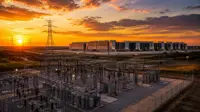
Parallel investments in hyperscale data centers — many designed to integrate renewable energy — reflect the growing recognition that compute capacity and electricity availability are becoming strategic economic assets.
AI as public infrastructure
India’s approach draws on its experience building digital public platforms that expanded access to financial and identity services.
A prominent example is Bharat-VISTAAR (Virtually Integrated System to Access Agricultural Resources), an agricultural AI initiative that uses voice-based assistance to help farmers access information and services.
While sector-specific, the program illustrates a broader policy direction: treating AI capabilities as shared infrastructure that can be accessed by smaller businesses and public institutions rather than only large corporations.
A capital-intensive strategy
Investing heavily in physical infrastructure carries risks. Large-scale industrial projects face long timelines, execution challenges, and the need for sustained policy support.
At the same time, other major economies are pursuing similar strategies to secure semiconductor supply chains and expand AI computing capacity, intensifying global competition for capital, talent, and energy resources.
Supporters of India’s approach argue that building the physical backbone of AI could provide durable advantages, positioning the country as a key node in the global AI supply chain even as software innovation remains globally distributed.
Why this matters
The global AI race is increasingly shifting from software leadership alone to control over computing capacity, chips, and energy. Countries that can build reliable AI infrastructure may gain long-term economic and strategic leverage, influencing where companies deploy workloads and invest capital.
For India, the push represents both an industrial policy bet and a digital-economy strategy — one that could shape its role in global technology supply chains for decades.
FAQs
Q1. What does the $250 billion figure represent?
It reflects infrastructure investment pledges linked to AI ecosystems, including data centers, semiconductors, and energy projects discussed at the India AI Impact Summit.
Q2. What is meant by “agentic AI”?
Agentic AI refers to systems that can autonomously perform tasks, make decisions, and execute workflows rather than simply generating content or responding to prompts.
Q3. Why is infrastructure becoming central to the AI race?
Advanced AI systems require enormous computing power, reliable electricity, and low-latency networks, making physical capacity a key competitive factor.
Q4. What is the sovereign AI stack concept?
It refers to building domestic capabilities across the entire AI value chain — from chips and data centers to models — to reduce reliance on external suppliers.
Q5. How does Bharat-VISTAAR fit into the strategy?
It demonstrates how AI infrastructure can be applied to public-sector use cases, in this case agriculture, showing how shared AI tools could broaden access.
Q6. What are the main risks to this strategy?
Execution challenges, funding continuity, global competition, and the long timelines associated with infrastructure projects could affect outcomes.