Europe’s e-waste could boost critical raw material supply
By Axel Miller | 24 Aug 2026
Summary
Europe’s growing electronic waste stream contains critical materials that could help strengthen supply security, but much of that value is still lost during conventional recycling.
Projects such as Denmark’s CIRCUIT are exploring component reuse, circular design and lower-temperature recovery methods as the EU seeks to increase recycling of strategic raw materials.
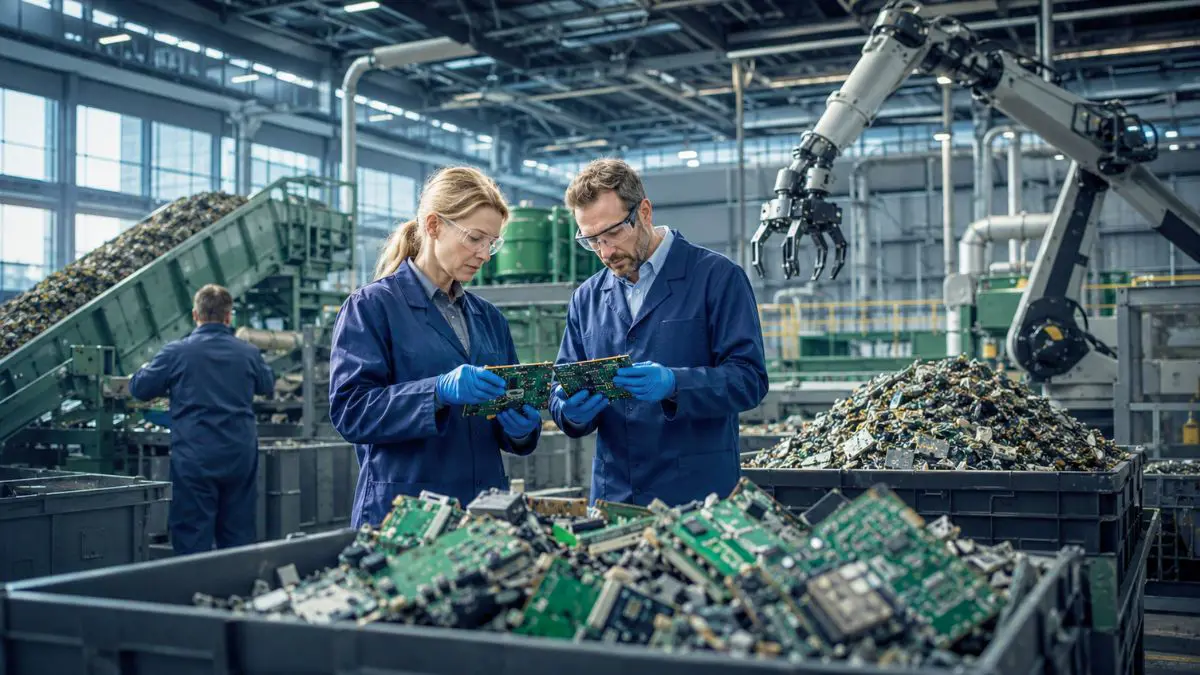
BRUSSELS, August 12, 2026 — Europe is facing a growing electronic waste challenge at a time when access to critical raw materials is becoming increasingly important for its green transition and industrial resilience. While discarded electronics contain valuable materials and functional components, much of that value is not recovered effectively.
Global electronic waste generation reached 62 million tonnes in 2022, up 82% from 2010, according to the Global E-waste Monitor. Less than one-quarter of global e-waste was documented as properly collected and recycled that year. The original analysis cited for Europe says less than 20% of its e-waste is recycled appropriately.
The supply challenge is compounded by the concentration of critical-material processing. China accounted for about 91% of global refined output of magnet rare earths in 2024, according to the International Energy Agency, while OECD data shows that export restrictions on critical raw materials increased fivefold between 2009 and 2024.
Demand is also expected to rise substantially. The Draghi report cited in the original analysis warned that demand for critical minerals could quadruple by 2040. That makes the recovery of materials already present in Europe’s waste stream increasingly relevant to supply-chain resilience.
Electronic waste also represents an economic and environmental opportunity. Printed circuit boards and electronic components can account for up to 70% of an electronic product’s carbon footprint despite representing a relatively small share of its physical weight.
The concentration of valuable materials in electronics can be significant. Apple has estimated that the amount of gold and copper in one tonne of used phones is equivalent to the amount that would need to be extracted from 2,000 tonnes of ore.
Conventional high-temperature recycling can recover metals such as copper and precious metals, but the process can also result in the loss of functional components and other valuable materials. This has increased interest in approaches that first identify components suitable for reuse before recovering materials from those that cannot be reused.
Europe’s recycling policy is changing
The European Union’s Critical Raw Materials Act sets 2030 benchmarks for strategic raw materials. The bloc aims to have capacity to extract at least 10% of its annual consumption of strategic raw materials, process at least 40% and recycle at least 25%. The 25% figure refers to EU recycling capacity for strategic raw materials relative to annual consumption, rather than a blanket requirement that 25% of all strategic materials must come from recycled sources.
The policy framework increases the importance of developing recycling infrastructure and technologies capable of recovering more value from end-of-life products.
However, meeting those objectives will require cooperation across the electronics value chain. Manufacturers, recyclers, waste operators and technology providers need to consider recovery and reuse alongside conventional collection and recycling.
CIRCUIT focuses on component reuse and material recovery
The CIRCUIT project in Denmark provides an example of this approach. Led by the Danish Technological Institute, the project brings together El Recycling, HJHansen Recycling Group, NCAB Group, DEIF, LINAK and Nordic Salt Cycle. It is focused on developing methods for reusing electronic components from end-of-life printed circuit boards and recovering critical raw materials from electronic waste.
The project is pursuing three areas of work: component reuse, responsible design and recovery of critical raw materials.
One focus is the gentle disassembly of printed circuit boards. Many boards are coated with epoxy-based materials that can make components difficult to remove without damage. CIRCUIT is developing methods for disassembly and quality assurance so that functional components can potentially be reused.
The second area is design. The project is examining ways to develop PCB design principles that support greater circularity and reduce the environmental impact associated with electronics production.
The third involves recovering critical raw materials that would otherwise be lost. Nordic Salt Cycle is developing molten salt technology intended to recover materials including tantalum and rare earth elements at lower temperatures than conventional melting processes. The project describes this as an alternative recovery approach for valuable materials in electronic waste.
CIRCUIT runs from 2026 to 2028 and has a total budget of DKK 9.2 million. It is supported by the Danish Environmental Protection Agency’s Environmental Technology Development and Demonstration Program.
The project illustrates a broader shift from treating electronic waste purely as a source of bulk metals toward recovering usable components and retaining materials within the production system for longer.
Scaling circular electronics
Europe’s dependence on imported critical raw materials cannot be addressed through recycling alone. New mining, processing and recycling capacity will all play a role in diversifying supply.
Recycling can nevertheless provide an additional source of materials without relying exclusively on newly extracted resources. The IEA expects secondary supply to become increasingly important, while noting that investment in collection and recycling infrastructure will be needed to realise its potential.
For manufacturers, better recovery could also create opportunities to reuse functional components and improve the material efficiency of future products. For recyclers, higher-value recovery could create new commercial opportunities, while technology companies can develop and validate processes for increasingly complex electronic waste streams.
The challenge is moving these approaches from individual projects into commercially scalable systems. That will require investment, suitable policy incentives and closer cooperation between companies across the electronics and recycling value chains.
Europe’s discarded electronics already contain materials that could contribute to future supply. Improving how those materials and components are recovered could therefore complement primary raw material production while supporting the EU’s broader push for more resilient and circular industrial supply chains.
Why this matters
- Critical material security: Recovering materials from electronic waste can provide an additional source of supply alongside mining and imported raw materials.
- EU recycling capacity: The Critical Raw Materials Act sets a 2030 benchmark for recycling capacity equivalent to at least 25% of the EU’s annual consumption of strategic raw materials.
- Supply-chain diversification: Greater use of secondary materials could help reduce exposure to highly concentrated global processing networks.
- Higher-value recycling: Recovering functional electronic components before material recycling could retain more value than treating all waste as bulk metal.
- Industrial opportunities: Component reuse and advanced recovery technologies could create new opportunities for manufacturers, recyclers and technology providers.
- Circular product design: Designing electronics with recovery and reuse in mind can make it easier to retain components and materials within the economy.
FAQs
Q1: How much has global electronic waste increased since 2010?
Global e-waste generation increased 82% between 2010 and 2022, reaching 62 million tonnes in 2022.
Q2: What is the EU’s 2030 recycling target for strategic raw materials?
The Critical Raw Materials Act sets a benchmark for EU recycling capacity to cover at least 25% of the bloc’s annual consumption of strategic raw materials by 2030.
Q3: Why are critical raw materials important for Europe?
Critical raw materials are important for technologies and industries including renewable energy, digital infrastructure, aerospace and defence. The EU considers their supply vulnerable because production and processing are concentrated in a limited number of countries.
Q4: What is the CIRCUIT project?
CIRCUIT is a Danish project running from 2026 to 2028 that focuses on reusing electronic components from end-of-life printed circuit boards, improving PCB design and recovering critical raw materials from electronic waste.
Q5: What does CIRCUIT’s molten salt technology aim to do?
Nordic Salt Cycle is developing molten salt technology within the project to recover valuable materials such as tantalum and rare earth elements at lower temperatures than conventional melting processes.

























