The battery race: who will control the future of electric vehicles?
By Axel Miller | 08 Apr 2026
Summary
- Batteries are emerging as the most critical component in the global EV transition
- Control over raw materials, manufacturing, and technology is shaping competition
- The outcome of the battery race could redefine the global automotive industry
LONDON / SHANGHAI / DETROIT — April 8, 2026 — The global transition to electric vehicles is often framed as a race between automakers. In reality, the decisive battle is unfolding deeper in the supply chain — inside the batteries that power them.
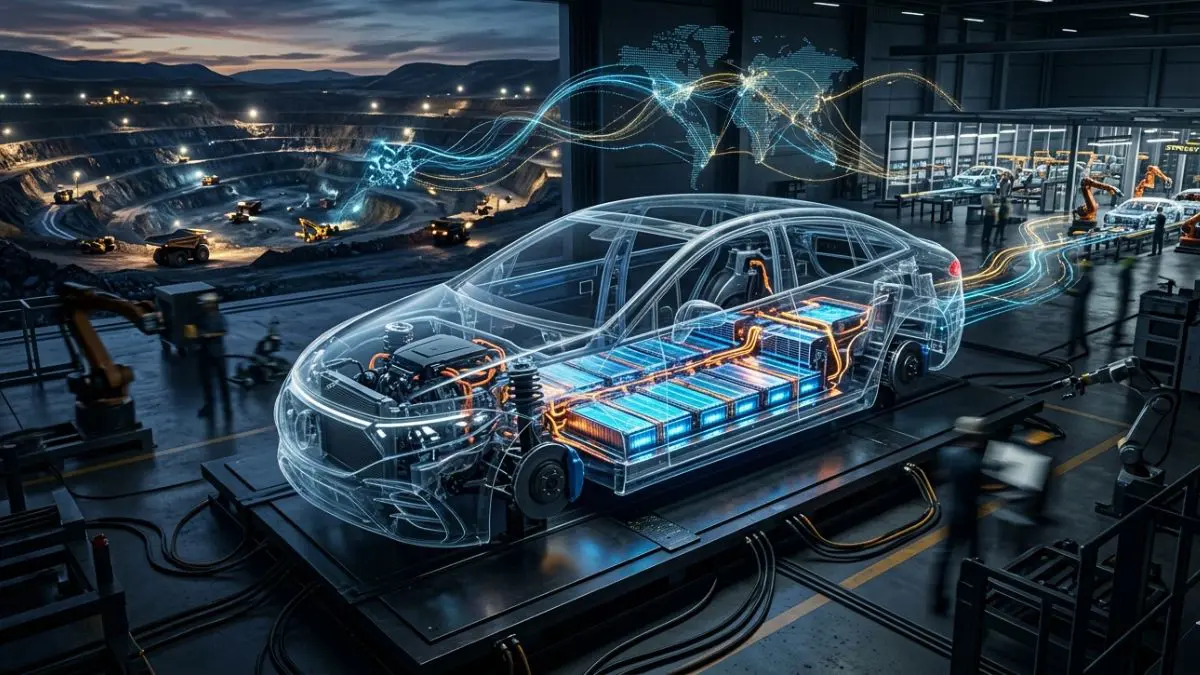
From raw materials to advanced cell technology, control over batteries is rapidly becoming the defining factor in the future of mobility. As demand for electric vehicles accelerates, governments and companies are competing not just to build cars, but to secure the systems that make them possible.
The heart of the EV revolution
At the core of every electric vehicle lies the battery — a complex system that determines range, performance, cost, and charging speed.
Unlike internal combustion engines, where decades of standardization created a level playing field, battery technology remains highly competitive and rapidly evolving. Improvements in energy density, durability, and charging efficiency can directly translate into market advantage.
This has elevated batteries from a component to a strategic asset.
China’s dominance in the supply chain
China has established a commanding position across the battery supply chain, from raw material processing to cell manufacturing.
Companies such as CATL and BYD have scaled production rapidly, supplying batteries to both domestic and international automakers.
Beijing’s long-term industrial strategy — including investments in lithium refining and battery technology — has created a vertically integrated ecosystem that is difficult for competitors to replicate.
For Western economies, this concentration raises concerns over supply security and strategic dependence.
The scramble for raw materials
The battery race begins far from factories — in mines producing lithium, cobalt, and nickel.
These materials are unevenly distributed geographically, often concentrated in regions with political and environmental challenges. Securing stable supply has become a priority for both governments and corporations.
Efforts to diversify sourcing, invest in recycling, and develop alternative chemistries are accelerating. However, scaling these solutions will take time, leaving the market exposed to supply constraints in the near term.
Recent market volatility has underscored the sensitivity of battery supply chains to global disruptions. Prices for key materials such as nickel and cobalt have risen in recent weeks, reflecting tighter supply conditions and logistical constraints. Such fluctuations can directly impact battery costs, highlighting the economic fragility of the EV transition.
Technology competition: beyond lithium-ion
While lithium-ion batteries dominate today’s market, the next phase of competition is already underway.
Research into solid-state batteries and alternative chemistries promises higher energy density, faster charging, and improved safety. Companies and governments are investing heavily in these technologies, aiming to leapfrog current limitations.
Recent developments are accelerating this transition. In April 2026, CATL introduced its second-generation “Shenxing” battery, highlighting progress toward ultra-fast charging technologies. The company said the system is capable of significantly reducing charging times, pointing to a future where charging convenience could approach that of traditional refueling.
At the same time, battery chemistry is undergoing a structural shift. Lithium iron phosphate (LFP) batteries have gained significant market share in recent years, driven by their lower cost, improved safety, and scalability. Companies such as BYD have played a key role in accelerating adoption, particularly in mass-market electric vehicles.
The challenge lies in moving from laboratory breakthroughs to scalable, cost-effective production — a transition that has historically taken years.
Automakers vs battery makers
Traditional automakers are increasingly aligning themselves with battery manufacturers, forming partnerships and joint ventures to secure supply.
Companies like Tesla have taken a more integrated approach, investing directly in battery production and technology development.
Meanwhile, legacy automakers are balancing between building in-house capabilities and relying on established suppliers — a decision that could shape their competitiveness in the years ahead.
Geopolitics and industrial policy
The battery race is no longer just industrial — it is geopolitical.
Governments in the United States and Europe are introducing policies to localize battery production, reduce reliance on imports, and strengthen domestic supply chains.
Subsidies, tax incentives, and regulatory frameworks are being deployed to attract investment and accelerate development. These efforts reflect a broader recognition that battery technology is central to economic and strategic competitiveness.
The economics of scale
Battery production is capital-intensive, requiring billions of dollars in investment and years of development.
Scale plays a critical role in reducing costs and improving efficiency. Companies that achieve large-scale production first can gain a significant advantage, lowering prices and expanding market share.
This dynamic reinforces the lead of established players while creating high barriers to entry for new competitors.
Who will control the future?
The outcome of the battery race will likely be determined by a combination of factors:
- Access to raw materials
- Manufacturing scale
- Technological innovation
- Government policy
Rather than a single winner, the future may be shaped by a network of regional ecosystems, each competing for leadership in different parts of the value chain.
What is clear is that batteries — not vehicles — are becoming the true battleground of the electric era.
Why this matters
- Batteries are the most critical component in electric vehicles
- Supply chain control is shaping global competition
- Geopolitics is influencing industrial strategy
- Technological breakthroughs could redefine market leadership
FAQs
Q1: Why are batteries so important in EVs?
They determine cost, range, performance, and charging efficiency.
Q2: Which country leads the battery race?
China currently dominates much of the global battery supply chain.
Q3: What materials are critical for batteries?
Lithium, cobalt, and nickel are key components.
Q4: What is the next big breakthrough?
Solid-state batteries are seen as a potential game changer.
Q5: Will automakers control battery production?
Some are investing directly, but partnerships remain common.