DexForce reaches $1.4 billion valuation with synthetic robot training
15 Oct 2026
Summary
- Series B funding: Shenzhen-based robotics company DexForce Technology reportedly raised 1 billion yuan (approximately $147 million) in a Series B round announced in June 2026, taking its valuation above 10 billion yuan (approximately $1.4 billion). Investors included Lens Technology and several Chinese investment funds. Reuters subsequently reported backing from Lenovo Capital and other investors.
- Synthetic data for robotics: Founded in 2021 and led by professor Kui Jia, DexForce develops simulation engines, 3D vision systems and embodied AI technologies designed to help robots learn tasks in virtual environments before operating in the physical world. Its approach aims to reduce dependence on costly real-world data collection and repeated human teleoperation.
- Industrial and commercial applications: Reuters reported that DexForce's technology is used by manufacturers including Toyota, Samsung and Foxconn, while the company's systems are also being deployed in commercial service settings. These applications illustrate its effort to translate simulation and perception research into practical robotics products.
SHENZHEN, October 15, 2026 — Chinese robotics startup DexForce Technology is using virtual simulations and synthetic data to address one of the main challenges in embodied artificial intelligence: teaching robots to perform complex physical tasks reliably without requiring extensive and expensive real-world training.
Founded in 2021, the Shenzhen-based company develops technologies spanning 3D perception, robot control, simulation and embodied AI. Its founder, Kui Jia, is a machine-learning professor whose research background informs the company's approach to connecting AI models with the physical world. DexForce describes its technology portfolio as a combination of simulation engines, world models, spatial intelligence systems and humanoid robotics.
The company reportedly closed a 1 billion yuan Series B funding round in June 2026, bringing its valuation above 10 billion yuan, equivalent to approximately $1.4 billion at the exchange rate used in contemporaneous reports. The financing included strategic investors such as Lens Technology and Chinese investment funds. Reuters' October report also identified Lenovo Capital among its backers.
The funding highlights investor interest in the software and data infrastructure needed to make robots more adaptable. While much of the public attention surrounding humanoid robotics has focused on hardware design, mobility and demonstrations, commercial applications also require robots to recognise objects, understand their surroundings and manipulate unfamiliar items with consistency.
How synthetic data changes robot training
Traditional robot training can involve repeated demonstrations by human operators. In teleoperation, a person remotely controls a robot to collect examples of movements and interactions. Although this provides useful real-world data, gathering enough examples across different objects, environments and tasks can require substantial time and labour.
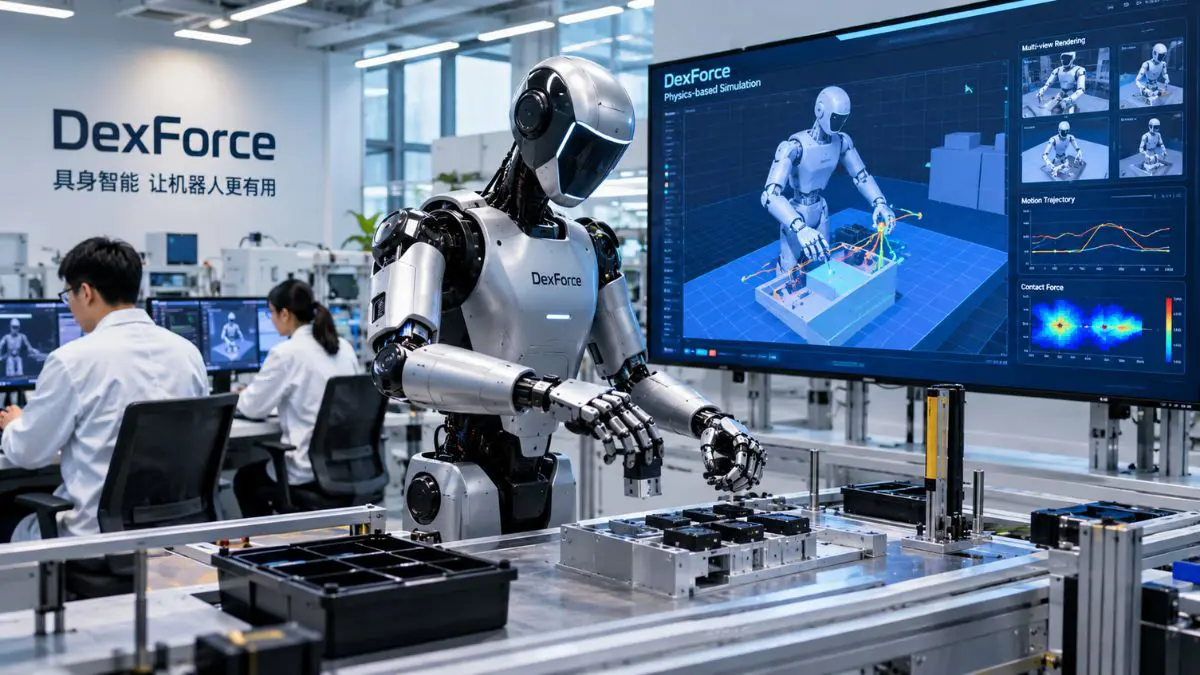
DexForce's approach uses simulation to generate training scenarios at scale. Virtual environments can vary object positions, lighting, camera perspectives and task conditions, allowing AI systems to encounter a broader range of situations than might be practical in a physical laboratory.
The company's technology includes the DexVerse simulation engine and EmbodiChain, a platform designed to support embodied AI development and synthetic-data generation. Its published materials describe simulation-based workflows that connect virtual training with real-world deployment.
Synthetic data can help robots learn perception and manipulation skills while reducing the need to collect every training example physically. It also enables developers to test unusual situations or repeat difficult tasks without repeatedly resetting a real robot and its environment.
However, simulation does not eliminate the need for physical testing. Its usefulness depends on how accurately the virtual environment represents the real world and whether the trained system can adapt when actual conditions differ from the simulation.
The challenge of transferring skills to the real world
The gap between simulated performance and real-world results is commonly known as the simulation-to-reality gap, or Sim2Real gap.
A virtual model may simplify friction, object deformation, lighting, sensor noise or mechanical tolerances. A robot trained under those assumptions can behave differently when handling a real object, particularly during delicate manipulation tasks involving contact, grip strength or irregular surfaces.
DexForce's published approach seeks to bridge that gap by combining simulation, visual perception and real-world feedback. Its technology is intended to help robots interpret three-dimensional scenes and execute tasks in environments that are less predictable than controlled laboratory demonstrations. (DexForce)
The approach is important because industrial robots must do more than repeat a fixed movement. For broader deployment, they need to recognise variations in objects, locate suitable grasp points and adjust their actions when the environment changes.
Even with advanced simulation, reliable performance must be established through physical trials. Claims that a model can transfer skills directly to factory operations without additional adaptation should therefore be assessed against independently documented deployment results.
Industrial and commercial applications
DexForce is pursuing industrial applications through its 3D vision, robot-guidance and embodied AI systems. Reuters reported that its technology is used by manufacturers including Toyota, Samsung and Foxconn. The company also lists industrial manufacturing and commercial operations among its deployment areas.
In manufacturing, 3D vision can help robots identify objects, estimate their positions and guide picking, placement or assembly tasks. Such capabilities are relevant in production environments where parts may arrive in different orientations or where conventional automation requires carefully controlled positioning.
DexForce also develops humanoid robots and commercial-service applications. Its product materials include a barista application, while Reuters reported that its robots were operating in public-facing service settings across more than 15 Chinese cities.
These applications provide potential opportunities to gather operational feedback beyond laboratory conditions. Nevertheless, the presence of a product at a customer site does not automatically establish its productivity, reliability or economic advantage at scale. Those outcomes depend on the task, operating environment and level of human supervision required.
Why the funding matters
DexForce's reported valuation reflects broader investment interest in embodied AI: systems designed to perceive, reason about and act within the physical world. The category combines advances in robotics hardware with AI models, computer vision, simulation and data-generation tools.
Synthetic data could lower some training costs and help developers cover more scenarios, but it is not a complete substitute for real-world data. The commercial test will be whether these systems can perform useful tasks safely, reliably and economically outside controlled demonstrations.
The company's reported funding and industrial relationships give it resources and opportunities to pursue that objective. Its longer-term prospects will depend on the quality of its technology, the repeatability of its deployments and its ability to turn research capabilities into products that customers can operate at scale.
Why this matters
- Reducing training costs: Virtual environments can generate large numbers of training scenarios without requiring a human operator to demonstrate every task on a physical robot.
- Bridging simulation and reality: The Sim2Real gap remains a central technical challenge. Physical testing is essential to verify whether simulated training translates into reliable real-world performance.
- Moving beyond hardware demonstrations: Industrial applications depend on perception, manipulation and adaptability, not just a robot's ability to walk or perform scripted movements.
- Investor interest in embodied AI: DexForce's reported valuation highlights the growing importance of software, simulation and data infrastructure in the robotics sector.
- Commercial deployment is the key test: Named industrial users and service applications offer evidence of market activity, but sustained productivity and cost advantages require further performance data.
FAQs
Q1: What is DexForce Technology?
DexForce is a Shenzhen-based robotics and AI company founded in 2021. It develops embodied AI systems, 3D vision technologies, simulation tools and humanoid robots designed for industrial and commercial applications.
Q2: How much funding has DexForce raised?
The company reportedly closed a 1 billion yuan Series B round in June 2026, equivalent to approximately $147 million at the reported exchange rate. The round took its valuation above 10 billion yuan, or approximately $1.4 billion.
Q3: How does synthetic data help train robots?
Synthetic data is generated through computer simulations rather than collected exclusively from physical demonstrations. It allows developers to vary conditions and create many training examples, helping robots learn perception and manipulation skills more efficiently. Physical testing is still necessary to validate performance.
Q4: What is the Sim2Real gap?
The Sim2Real gap is the difference between how a robot or AI model performs in a simulated environment and how it performs in the physical world. Differences in friction, object properties, sensor readings and mechanical behaviour can affect the transfer of learned skills.
Q5: Which companies use DexForce technology?
Reuters reported that DexForce's technology is used by manufacturers including Toyota, Samsung and Foxconn. The precise scope of each company's deployment and the performance outcomes have not been fully detailed in the sources cited here.