Adani Green operationalises 3.37 GWh battery storage system at Khavda
By Cygnus | 26 May 2026
Summary
- World-scale storage deployment: Adani Green Energy has operationalised a cumulative 3.37 GWh Battery Energy Storage System (BESS) at its Khavda renewable energy park in Gujarat, making it one of the world’s largest single-location battery storage projects outside China.
- Rapid execution timeline: The company said the large-scale battery infrastructure was commissioned within around 10 months from the start of on-site construction.
- Push towards dispatchable renewable power: The storage system strengthens AGEL’s ability to supply round-the-clock renewable electricity by balancing intermittent solar and wind generation at the Khavda complex.
AHMEDABAD, May 26, 2026 — Adani Green Energy (AGEL) has commissioned a cumulative 3.37 Gigawatt-hour (GWh) Battery Energy Storage System (BESS) at its Khavda renewable energy park in Gujarat, significantly expanding its grid-scale clean energy infrastructure.
The company said the project includes an additional 1.37 GWh of storage capacity integrated during 2026, taking the total operational BESS capacity at the site to 3.37 GWh. AGEL added that the project was completed within about 10 months of construction commencement.
Khavda is one of India’s largest renewable energy developments and forms a key part of AGEL’s long-term clean energy expansion strategy. The site currently has around 9.9 GW of operational renewable generation capacity, with a broader target of scaling up significantly over the coming years.
AGEL Khavda BESS infrastructure overview
| Metric | Scale | Purpose |
|---|---|---|
| Operational BESS capacity | 3.37 GWh | Grid balancing and storage |
| FY27 storage addition target | More than 10 GWh | Peak demand management |
| Long-term storage ambition | 50 GWh over five years | Round-the-clock renewable supply |
| Operational renewable capacity at Khavda | 9.9 GW | Solar and wind generation |
Supporting round-the-clock renewable power
The battery storage system is designed to help stabilise renewable energy supply by storing excess electricity generated during periods of high solar and wind output and releasing it during periods of peak demand.
This allows AGEL to improve power scheduling flexibility and support round-the-clock renewable energy supply contracts for industrial and utility customers.
Large-scale storage is increasingly becoming critical for India’s renewable energy transition as the country expands intermittent solar and wind generation capacity while attempting to maintain grid stability.
According to the company, the 3.37 GWh storage system can support electricity requirements equivalent to the daily consumption of a large urban population cluster depending on load conditions and discharge patterns.
Sagar Adani, Executive Director at AGEL, said energy storage will play an important role in the next phase of India’s clean energy transition as renewable capacity additions accelerate.
The company said it plans to add more than 10 GWh of battery storage capacity in FY27 and scale overall storage capacity to around 50 GWh over the next five years.
Why this matters
- Grid stability support: Battery storage systems help address renewable energy intermittency by balancing fluctuations in solar and wind power generation.
- Higher-value renewable contracts: Integrated storage infrastructure allows renewable developers to participate in round-the-clock and firm power supply agreements that typically command better tariffs than standalone renewable projects.
- Faster clean energy integration: Large utility-scale storage projects are expected to become increasingly important as India targets major renewable energy capacity expansion by 2030.
FAQs
Q1. What is the size of Adani Green’s Khavda battery storage project?
The operational Battery Energy Storage System at Khavda has reached a cumulative capacity of 3.37 GWh.
Q2. Why is battery storage important for renewable energy?
Battery storage helps store surplus renewable power and release it during high-demand periods, improving grid stability and enabling round-the-clock electricity supply.
Q3. What is AGEL’s long-term storage target?
The company aims to scale its total battery storage capacity to around 50 GWh over the next five years.
SEO assets
SEO Title: Adani Green commissions 3.37 GWh battery storage system at Khavda
Meta Description: Adani Green Energy operationalises a 3.37 GWh battery storage system at Khavda in Gujarat to strengthen round-the-clock renewable power supply.
Slug URL: adani-green-khavda-battery-storage-system-2026
Keywords: Adani Green Energy, Khavda battery storage, AGEL BESS project, Gujarat renewable energy, battery energy storage system India, round-the-clock renewable power
Visual assets
Hero image prompt
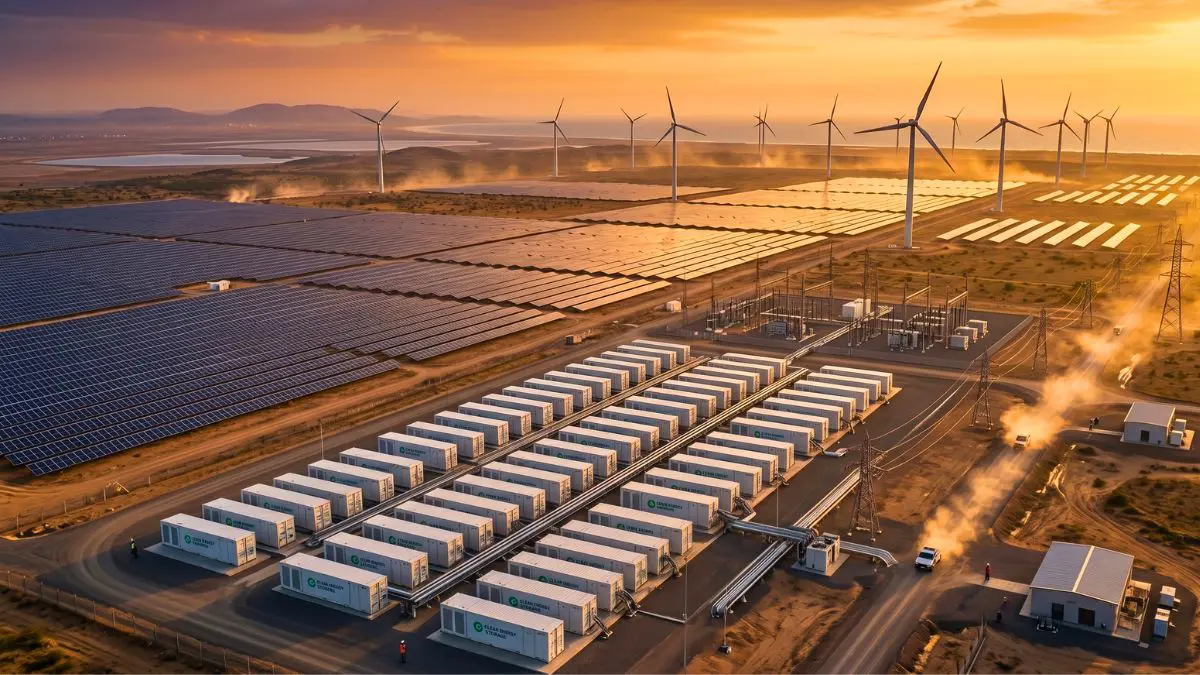
Cinematic aerial wide-angle shot of the Khavda renewable energy park in Gujarat at sunset; large-scale modular battery storage units aligned beside expansive solar panel fields and wind turbines under golden evening light; ultra-realistic industrial clean-energy atmosphere; 16:9.
Image caption
Adani Green’s Khavda battery storage system is designed to support large-scale renewable energy integration and grid stability in India. (AI generated)
Image file name
adani-green-khavda-battery-storage-system-2026.webp