Earth’s core affects length of day
05 Aug 2013
Research at the University of Liverpool has found that variations in the length of day over periods of between one and 10 years are caused by processes in the Earth's core.
 | |
| Researchers studied the variations and fluctuations in the length of day over a one to 10-year period between 1962 and 2012 |
The Earth rotates once per day, but the length of this day varies. A year, 300 million years ago, lasted about 450 days and a day would last about 21 hours.
As a result of the slowing down of the Earth's rotation the length of day has increased.
The rotation of the earth on its axis, however, is affected by a number of other factors – for example, the force of the wind against mountain ranges changes the length of the day by plus or minus a millisecond over a period of a year.
Professor Richard Holme, from the School of Environmental Sciences, studied the variations and fluctuations in the length of day over a one to 10 year period between 1962 and 2012.
The study took account of the effects on the Earth's rotation of atmospheric and oceanic processes to produce a model of the variations in the length of day on time scales longer than a year.
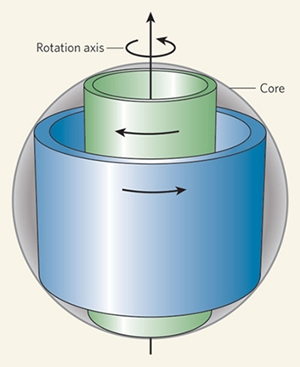 | |
| The form of core motions giving rise to variations in Earth's length of day |
Professor Holme says, ''The model shows well-known variations on decadal time scales, but importantly resolves changes over periods between one and 10 years.
''Previously these changes were poorly characterised; the study shows they can be explained by just two key signals, a steady 5.9 year oscillation and episodic jumps which occur at the same time as abrupt changes in the Earth's magnetic field, generated in the Earth's core.
He adds, ''This study changes fundamentally our understanding of short-period dynamics of the Earth's fluid core. It leads us to conclude that the Earth's lower mantle, which sits above the Earth's outer core, is a poor conductor of electricity giving us new insight into the chemistry and mineralogy of the Earth's deep interior.''
The research was conducted in partnership with the Université Paris Diderot and is published in Nature.

























