Double whammy of multi-fault ruptures can unleash stronger earthquakes, Stanford scientists say
21 Mar 2016
A deadly earthquake that rocked Southern California two centuries ago was likely caused by the slippage of one fault line that then triggered a second fault, according to a new study. The research not only offers a solution to a long-standing seismic "whodunit," it also demonstrates how the rupturing of multiple faults can trigger more powerful temblors.
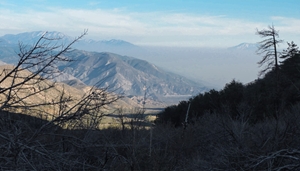 | |
| A view of Cajon Pass, where the San Andreas and San Jacinto fault lines run close together. According to a new study, a deadly earthquake that rocked Southern California two centuries ago was likely caused by the slippage of the San Jacinto Fault that then triggered the second fault. (Photo: Julian Lozos) |
Researchers have previously blamed the sole rumblings of the infamous San Andreas Fault for the 7.5-magnitude quake of December 8, 1812, one of the biggest in Golden State history. The new study implicates an accomplice, however: the lesser-known, nearby San Jacinto Fault, whose potential for provoking serious quakes in tandem with the San Andreas has been underestimated.
"This study shows that the San Jacinto Fault is an important player that can influence what the San Andreas Fault is doing and lead to major earthquakes," said Julian Lozos, the author of the study, who conducted the work as a postdoctoral fellow at Stanford. "It's important that we learn more about how activity on any single fault can affect other faults."
For the new study, published in Science Advances, Lozos took a multidisciplinary approach. He ran a series of physics-based computer simulations known as dynamic rupture models. The simulations involved crunching numbers for forces such as stress and friction across fault lines, which are fractures where vast, subterranean rock faces grind against each other. Key outputs from the simulation included how fast the faults move and the ground motion this movement causes, which helps in pegging the destructive power of an earthquake.
Lozos, who is now an assistant professor of geological sciences at California State University, Northridge, compared the simulations' results to geologic records of slip in prehistoric earthquakes on both faults. Because the 1812 quake occurred before instruments existed to record its severity, Lozos also looked to early 19th-century historical records, jotted down by Catholic missionaries from Spain.
The missionaries reported varying degrees of ground shaking and damage at their several outposts, including the collapse of a stone church at Mission San Juan Capistrano that killed 40 people. Lastly, Lozos accounted for present-day examples of boulders precariously balanced atop other rocks in the region, a phenomenon seismologists cleverly use to gauge where an earthquake's local shaking had not been violent enough to topple the delicate rocky arrangements.
Altogether, the evidence suggested that the San Jacinto Fault slipped first somewhere between the cities of Moreno Valley and San Jacinto. The rupture propagated north and crossed over to the San Andreas Fault near a location called the Cajon Pass, between the San Bernardino and San Gabriel mountains, where the two fault lines run as close as 1.5 kilometers. Together the ruptured faults set Southern California ashudder that early December day.
"Julian has offered a reasonable and physically plausible explanation for the 1812 earthquake," said geophysicist Greg Beroza, the Wayne Loel Professor at Stanford School of Earth, Energy & Environmental Sciences, who was Lozos' adviser. "Understanding this earthquake in particular, and complex earthquakes in general, is important to quantifying seismic hazard."
Lozos' research could help in future preparations of the Uniform California Earthquake Rupture Forecast, or UCERF. Spearheaded by the US Geological Survey, these reports project the likelihoods for major earthquakes occurring in the Golden State over several decades.
The most recent UCERF, which published a year ago, took into account some of the newer scientific appreciations of multi-fault ruptures. As a result, the estimated chance for a magnitude 8 or larger earthquake to jolt California by 2045 rose from about 4.7 percent in a previous UCERF report to about 7 percent in the latest forecast.
In addition to improving earthquake modeling, Lozos hopes his work will increase earthquake awareness in the general public – especially for the millions of Californians living in the Inland Empire, undercut by both the San Andreas and San Jacinto fault lines.
"People shouldn't just be thinking about the San Andreas Fault," Lozos said. "There are lots of other faults, so it's important for everyone in the regions at risk to have their earthquake kits ready."

























