India and Singapore look beyond comprehensive economic cooperation to strategic partnership
By Unnikrishnan | 04 Sep 2025
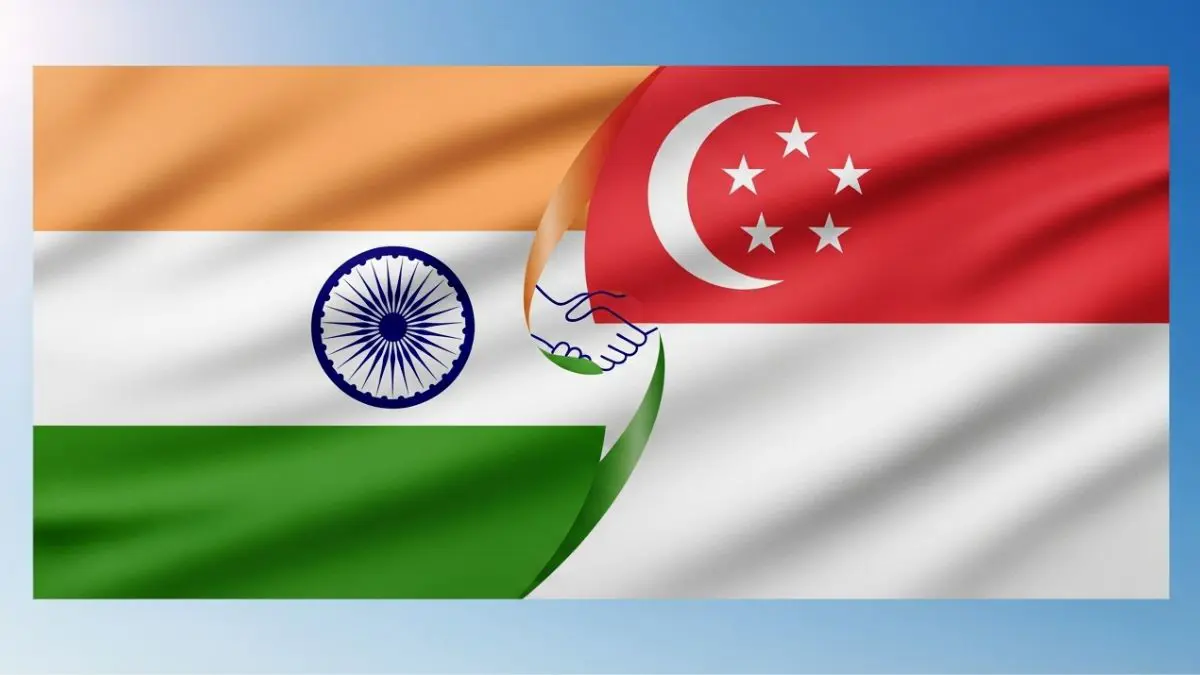
India and Singapore have decided to take their bilateral relations to a comprehensive strategic partnership with across-the-board collaboration, especially in new and emerging areas.
The two countries will deepen bilateral trade and market access, within and outside their Comprehensive Economic Cooperation Agreement (CECA), through the Joint Working Group on trade and investments, as per the trade priorities of the two countries.
Towards this, the two countries will continue to engage in dialogue aimed at reviewing (third review) of the ASEAN India Trade in Goods Agreement (AITIGA).
The decisions were announced on the occasion of the official visit of Lawrence Wong, Prime Minister of the Republic Of Singapore, to India. He also held wide-ranging discussions with Prime Minister Narendra Modi and external affairs minitser S Jaishankar.
India and Singapore will undertake a `Semiconductor Policy Dialogue’ to explore mutually beneficial research and development collaboration, including workforce development and business-to-business cooperation through information sharing, exchange of best practices, direct investments, and potential partnerships, for supporting growth of India’s semiconductor ecosystem.
The two sides also proposed joint development of sustainable industrial parks with advanced manufacturing capabilities, including through government-to-government cooperation in knowledge sharing, capacity building, adoption of green standards, planning and promotion.
As part of strengthening business collaboration, it has been decided to enhance India-Singapore capital market connectivity and embark on joint initiatives such as the NSE-IFSC-SGX GIFT Connect.
The two countries propose to take their collaboration beyond business to areas like the space sector, including through partnership between the Indian National Space Promotion and Authorisation Centre (IN-SPACe) and Singapore’s Office for Space Technology and Industry besides cooperation in space policy and law and research and development in areas of mutual interest.
It has also been proposed to promote cooperation between higher education institutions of the two countries for capacity building in technical vocational education and training and skill development. A Joint Working Group will be constituted to facilitate and review progress in education and skill development.
This will build on the existing model of collaboration like the Singapore-Assam Nursing Talent Skills Cooperation.
Digital and financial technologies as also cyber security and capital market linkages are areas the two countries propopse to expand and deepen cooperation, including through the Fintech Joint Working Group.
CERT-to-CERT cooperation will be boosted through information exchange between stakeholders on both sides on cyber policies, cyber security capacity building and other cybersecurity related issues while also exploring their implementation through pilot projects.
Such partnership will also include collaboration between start-ups and small and medium enterprises of both sides.
Under the proposed GIFT City-Singapore cooperation, officials from financial sector agencies and regulatory authorities from India and Singapore will convene a joint working group to discuss the framework as well as to identify potential use cases.
The existing Joint Working Group on Digital Technologies will explore areas of cooperation in critical and emerging technologies, including in Artificial Intelligence, through the sharing of best practices for developing AI-ready data sets and building data-driven AI use cases in sectors such as agriculture, health care, and education.
The two sides will expand and maximise the potential of paperless and secure cross-border payments using the UPI-PayNow linkage.
In order to facilitate a more reliable and secure trade documentation, India and Singapore propose to adopt a TradeTrust framework for interoperable e-Bills of Lading.
Besides, the two countries propose to explore collaboration in sustainable development and green trade, including production and trading in green hydrogen and ammonia, urban water management, civil nuclear use as also other mutually beneficial bilateral cooperation, to address the challenge of climate change, under the framework of the Paris Agreement.
For sustaining long-term maritime and air connectivity, the two sides plan to support the establishment of an India-Singapore Green and Digital Shipping Corridor (GDSC) between the Port of Singapore and Indian ports and work towards the establishment of a green maritime fuel corridor.
Singapore companies want to collaborate in India’s growing aviation and aerospace MRO sectors through partnerships between Indian companies, besides expanding the existing bilateral Air Services Agreement to enhance air connectivity.
In the healthcare sector, the two sides propose to deepen collaboration in areas like human resource development, including digital health intervention and disease surveillance through the Joint Working Group on Health Cooperation.
The two countries will encourage deeper parliamentary engagement through exchange programmes, facilitate public service exchanges and training of senior officials, including through study visits.
In the defence and security sectors, the two sides plan to encourage engagement and cooperation at all levels, including regular meetings between the two defence ministers through the Defence Policy Dialogue and military cooperation through joint conduct of army, navy and air force exercises.
The two sides will continue cooperation in maritime security and submarine rescue, while working closely within regional security architectures like the ASEAN Outlook on the Indo-Pacific and the Indo-Pacific Oceans Initiative.
The defence technology cooperation will be extended to emerging areas such as quantum computing, AI, automation and unmanned vessels.
Singapore appreciates India’s interest in the Malacca Straits patrol while reaffirming strong commitment to combatting terrorism, including cross-border terrorism. Both countries will strengthen cooperation in the fight against global and regional terrorism and terror organisations as well as terror financing, through bilateral and multilateral mechanisms.
The two prime ministers agreed to institutionalise the India-Singapore Ministerial Roundtable mechanism to monitor the progress in the implementation of the Comprehensive Strategic Partnership.
India-Singapore ties have already developed into an all-round cooperation, covering areas like political, economic, security, technology, education, people-to-people and cultural links.