Pokhran-II: Did Buddha really smile?
27 Aug 2009
New Delhi: Reviving a controversy that had erupted in 1998, almost immediately after Pokhran-II ''Buddha Smiles'' nuclear tests, a distinguished Indian defence scientist now says that the tests may actually not have been the success they were said to be in one particular respect. According to K Santhanam, the yield of the thermonuclear device was actually much below expectations and the test was a 'fizzle.'
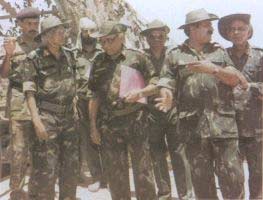 |
| Key scientists and engineers on 10 May 1998. Abdul Kalam is on left (silver hair); R. Chidambaram is holding file; Anil Kakodkar is behind Chidambaram wearing glasses; K. Santhanam is at extreme right. |
There would perhaps be nothing new about the controversy, as India's claims that the tests had indeed met the benchmarks set for them was hotly contested within a few days of the tests itself by foreign governments and monitoring agencies, which pointed out discrepancies between the Indian claims and the seismic 'readings' of their monitoring machines.
The thermonuclear (Hydrogen bomb) test was said to have yielded 45 kilotons (KT) but the claim was challenged by Western experts who said it was not more than 20-25 KT.
Santhanam, who was director for 1998 test site preparations, apparently made the admission, at a semi-public seminar on the Comprehensive Test Ban Treaty at the Institute of Defence Studies and Analyses (IDSA) on Tuesday. The seminar followed the Chatham House Rule, under which the identity of the speaker is not revealed, though what he or she said is freely quoted.
Santhanam apparently stressed at the seminar that India needed to conduct more tests to improve its nuclear weapons programme. "There is no country in the world," he emphasised, "which managed to get its thermonuclear weapon right in just one test."

























