China deploys converted fighter jets as drones near Taiwan Strait, report says
By Cygnus | 27 Mar 2026
Summary
China has deployed converted J-6 fighter jets as drones near the Taiwan Strait, according to a report.
The move highlights evolving tactics aimed at overwhelming air defense systems.
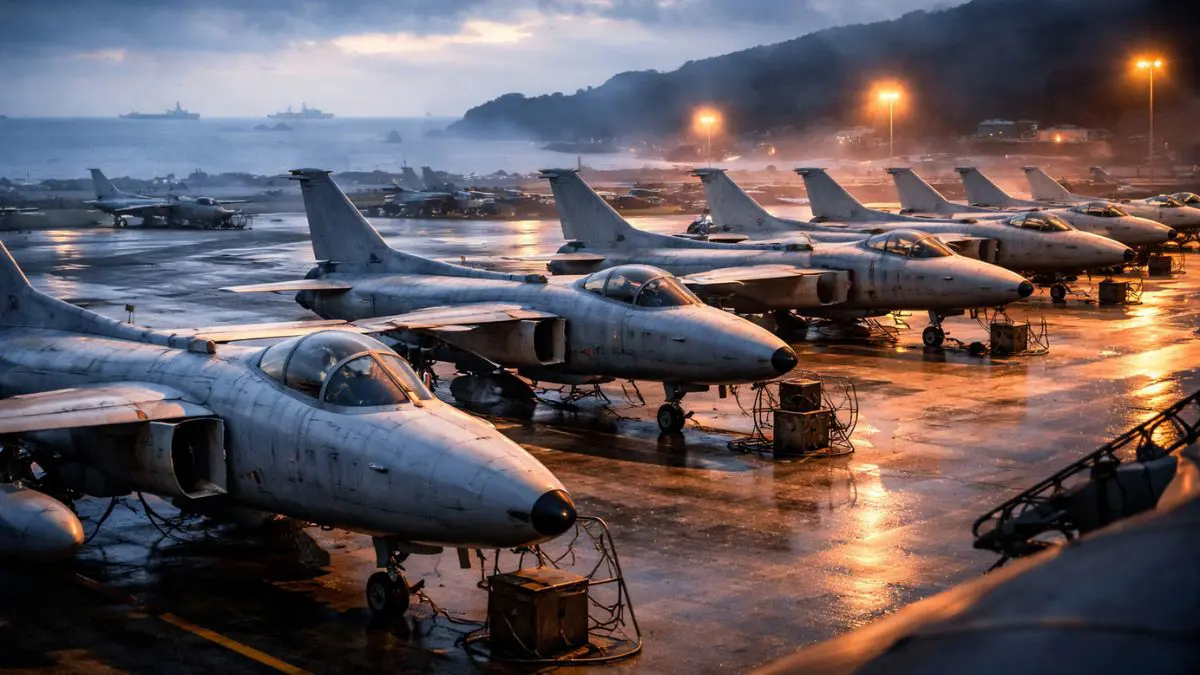
HONG KONG, March 27, 2026 — China has deployed converted fighter jets as attack drones at multiple air bases near the Taiwan Strait, according to a new report, signaling a shift in military tactics toward high-volume drone operations.
The report by the Mitchell Institute for Aerospace Studies identified modified Shenyang J-6 aircraft at six airfields—five in Fujian province and one in Guangdong—based on satellite imagery analysis.
According to analyst J. Michael Dahm, China’s People’s Liberation Army has deployed an estimated 200 or more of these older jets, which have been converted into drones near the strategic region.
These aircraft are designed to be used in large numbers during the early stages of a potential conflict, functioning more like cruise missiles than traditional unmanned aerial vehicles. Their role would be to strike targets or saturate air defense systems.
Military experts say such deployments could complicate defensive strategies. By launching large volumes of drones simultaneously, China could force Taiwan and its allies to use high-cost interceptor missiles against relatively lower-cost systems.
A senior Taiwanese security official said the primary objective of these drones would be to exhaust air defense capabilities early in a confrontation. In response, Taiwan is accelerating efforts to acquire next-generation counter-drone systems, according to its defense ministry.
The development reflects a broader shift in modern warfare, where drones—from low-cost platforms to advanced unmanned systems—are playing an increasingly central role in military planning.
China continues to expand its aerial capabilities by combining legacy systems with modern technologies, including advanced fighter jets, missile platforms, and unmanned systems. The converted J-6 drones form part of this layered approach.
Beijing maintains that Taiwan is part of its territory and has not ruled out the use of force. Taiwan rejects these claims, stating that its future should be determined by its people.
Recent assessments from the United States intelligence community indicate China is not currently planning an invasion of Taiwan in 2027. However, earlier Pentagon analysis suggested China aims to develop the capability for such an operation by that timeframe.
Why this matters
- Highlights evolving drone-based military strategies using scale and cost efficiency
- Signals increased pressure on Taiwan’s air defense systems
- Reflects broader global shift toward drone-centric warfare
- Raises cost challenges for missile-based defense systems
FAQs
Q1: What are the J-6 drones?
They are older Chinese fighter jets converted into unmanned attack drones.
Q2: Why is China deploying these drones?
They are intended to overwhelm air defenses during the early stages of a potential conflict.
Q3: How is Taiwan responding?
Taiwan is accelerating plans to acquire advanced counter-drone systems.
Q4: Are these drones advanced systems?
No, they are older platforms but can be effective when deployed in large numbers.
Q5: What is the broader significance?
It reflects the growing importance of drones in modern military strategies.