Nirma institute selected for Tokyo contest
By Our Corporate Bureau | 22 Jul 2002
Mumbai: The Nirma Institute of Technology (NIT) has been selected as one of the three colleges in the nation to participate in the prestigious robotics contest of the Asia-Pacific region ABU Robocon 2002, the finals of which will be held in Tokyo from 28 to 31 August 2002.
 Under a
common set of rules, the best brains from 21 colleges and
universities of 20 Asia-Pacific countries will participate in the
open competition on the basis of robotic technology and artificial
intelligence on a theme game named Reach the top of Mount Fuji
with the help of manual and automatic robots.
Under a
common set of rules, the best brains from 21 colleges and
universities of 20 Asia-Pacific countries will participate in the
open competition on the basis of robotic technology and artificial
intelligence on a theme game named Reach the top of Mount Fuji
with the help of manual and automatic robots.
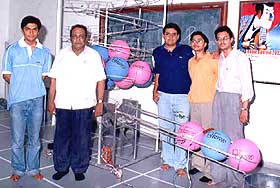
To participate in the preliminary round of the international contest, a team of four final year students of NIT Savan Chhaniyara, Chintan Shah, Purvag Nanavati (BE (mechanical) and Jay Thakore (BE [IC]) led by Professor B B Kadam of the electrical engineering department of NIT are leaving for IIT-Kanpur on 16 July 2002. Based on their national (preliminary) performance on 21 July, one of these, or possibly a composite Indian team from among three colleges, would be chosen to represent India in the final competition in Tokyo.
 Of the three
institutes in the country, besides VESIT, Mumbai, and IIT-Kanpur
(the nodal centre for the contest), the NIT team was identified on
the basis of inputs received from a number of contests held in the
country within the last year. In the case of NIT their Unnati
Yantra
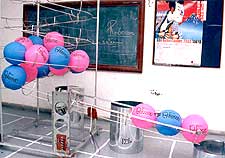
The Stair Climber project, prepared and presented by
Chhaniyara, Shah and Nanavati impressed the committee, during Techkriti-2002,
the mechanical students annual national fair in February 2002.
Of the three
institutes in the country, besides VESIT, Mumbai, and IIT-Kanpur
(the nodal centre for the contest), the NIT team was identified on
the basis of inputs received from a number of contests held in the
country within the last year. In the case of NIT their Unnati
Yantra
The Stair Climber project, prepared and presented by
Chhaniyara, Shah and Nanavati impressed the committee, during Techkriti-2002,
the mechanical students annual national fair in February 2002.
In March 2002 after a very tough five-hour-long interview and presentation by the Team NIT at IIT Kanpur, against a jury of the IITK director, head of robotics departments senior research engineers and other senior professors, the final selection took place.
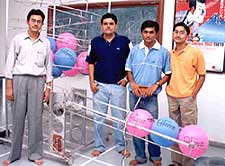 The team,
with technical assistance of Parag Taktawala and helped by
Dharmendra Chhatralia, came up with a promising design for the
final theme project on the basis of a smart combination of
technology and strategy in the sharp contrast of time (three
minutes), weight (total of 40 kgs only) and space constraints.
The team,
with technical assistance of Parag Taktawala and helped by
Dharmendra Chhatralia, came up with a promising design for the
final theme project on the basis of a smart combination of
technology and strategy in the sharp contrast of time (three
minutes), weight (total of 40 kgs only) and space constraints.
Abiding by the rules of the game, the team has arrived at a design mechanism of four automatic robots and one manual robot with a strategy that increases the possibility of getting more points in a game that needs to be finished in three minutes, to achieve the target.
To take care of the weight constraints, all the components have been made of polypropylene and aluminum base avoiding the clutter in design and further reducing the overall weight. Lightweight, high-powered Swiss-made Maxon motors (15) have been used. To take care of the space, the wheels of the robots have been specially designed for the typical vinyl flooring being used in the contest.
 The project
funded in India by the ministry of human resource development is
for the first time set up by the Asia Pacific Broadcasting Union
to popularise robotics among the youth of the Asia-Pacific region.
The contest has gained a huge base of popularity by now in all the
participating countries.
The project
funded in India by the ministry of human resource development is
for the first time set up by the Asia Pacific Broadcasting Union
to popularise robotics among the youth of the Asia-Pacific region.
The contest has gained a huge base of popularity by now in all the
participating countries.
Countries like Thailand, China, Indonesia and Vietnam have got widely publicised, with tickets sold to the general public and much song and dance preceding the show. In India DD1 being the ABU broadcast member country, shall telecast the national and the finals of the game live on 21 July and 31 August 2002.
NIT is emerging as one of the premium technology institutes in the nation. The institute has undergone for accreditation of its courses and its electrical course has acquired credit A and the other two courses of mechanical and chemical engineering have acquired the credit B from the National Accreditation Board.
Nirma, a Rs 2,428-crore company, offering employment to over 15,000 people, was established in 1969. Today, 33 years later, Nirma is a household name. It is a brand with a leadership presence in detergents, soaps and personal care products.
Nirma is a vibrant, proactive and widely admired ethical corporate citizen. To fulfil its role as a responsible corporate citizen of the society and environment, Nirma has undertaken a host of activities in the educational and social development areas and have also founded institutions like Nirma Institute of Management, NIT and Nirma Institute of Diploma Studies.
Latest articles









Featured articles

The decoupling paradox: Why Wall Street keeps funding AI despite $100 oil
By Axel Miller | 11 May 2026
AI infrastructure stocks continue rallying despite $100 oil as investors bet on productivity gains and semiconductor demand in 2026.

Hybrid bonding gains attention as AI chip packaging demand grows
By Cygnus | 23 Apr 2026
Hybrid bonding is driving AI chip packaging demand as backend technologies gain importance in the semiconductor supply chain.

The agentic transition: how enterprises are scaling AI from pilot to profit
By Cygnus | 22 Apr 2026
AI has entered its execution era. Discover how companies like Valeo and Microsoft are scaling agentic AI systems—from copilots to autonomous workflows driving real business impact.

Post-splashdown: What Artemis II taught us about the ‘deep space wall’
By Axel Miller | 15 Apr 2026
Artemis II splashdown marks a breakthrough in deep space exploration. Discover AVATAR radiation data, Orion’s distance record, and insights shaping NASA’s 2028 Moon mission.

Can aviation go green? The multi-billion dollar race for sustainable fuel
By Cygnus | 10 Apr 2026
Airlines are racing to adopt sustainable aviation fuel, but limited supply and high costs challenge the future of green aviation.

The battery race: who will control the future of electric vehicles?
By Axel Miller | 08 Apr 2026
The global battery race is reshaping the electric vehicle industry, with China, the US, and Europe competing for control over supply chains and technology.

AI vs governments: Who controls the future of intelligence?
By Cygnus | 07 Apr 2026
Governments and AI companies like OpenAI and Anthropic are shaping the future of intelligence amid rising policy conflicts and global competition.

Strait of Hormuz: how one chokepoint controls the global economy
By Axel Miller | 06 Apr 2026
The Strait of Hormuz is a critical global chokepoint. Learn how disruptions impact oil prices, shipping, and the global economy.

The $2 trillion AI infrastructure race: Who will control global compute?
By Cygnus | 06 Apr 2026
AI spending is set to exceed $2 trillion in 2026, driving a global race in data centers, chips, and energy infrastructure.


Latest articles





