Starlink Enters Gujarat: Musk-Linked Satellite Internet Deal Targets Remote Connectivity
By Axel Miller | 09 Feb 2026
Summary
The Gujarat state government has signed a Letter of Intent (LoI) with SpaceX’s Starlink to deploy high-speed satellite internet across the state’s most remote regions. The strategic partnership aims to bridge the digital divide in areas where traditional fiber and cellular infrastructure are economically or geographically unviable.
AHMEDABAD, Feb 9 — In a major boost to India’s Digital Village ambitions, the Gujarat government announced on Monday that it has entered into a formal agreement with Starlink, the satellite internet constellation operated by SpaceX, to bring broadband connectivity to underserved communities.
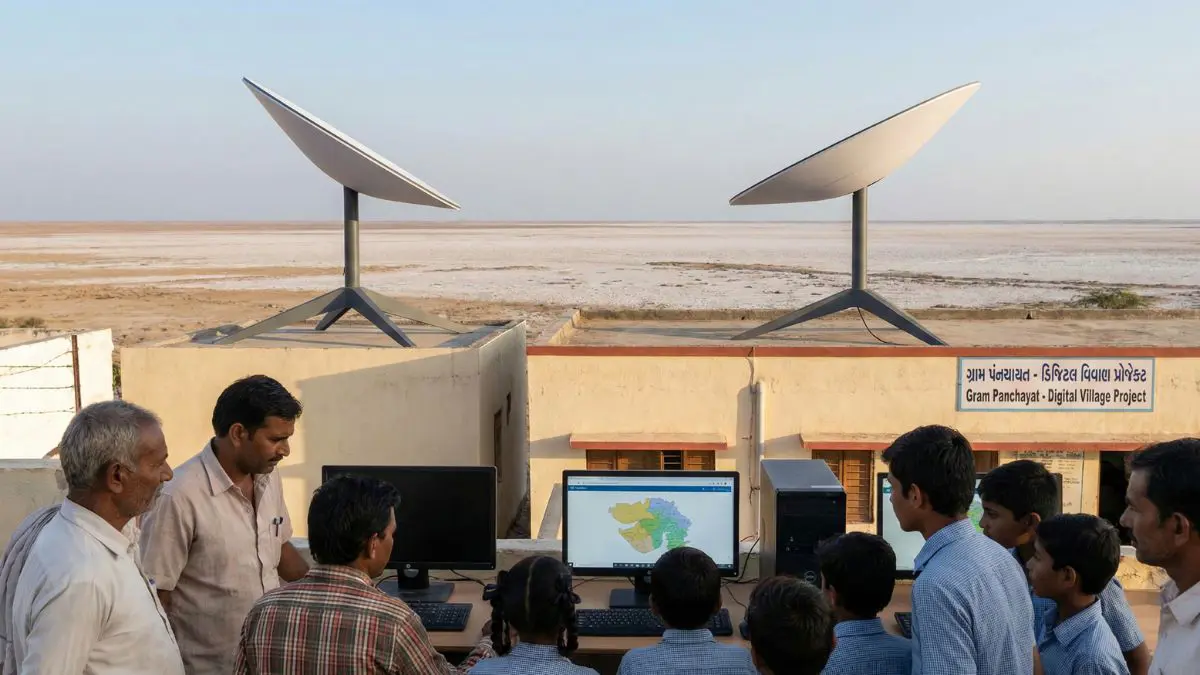
Signed during a high-level meeting in Gandhinagar, the LoI positions Gujarat as a first mover in adopting Low Earth Orbit (LEO) satellite technology to provide ubiquitous internet service. The initiative will prioritize the Rann of Kutch, tribal belts in eastern Gujarat, and isolated coastal fishing villages — areas that have historically struggled with inconsistent or absent broadband access.
Bridging the “Last Mile” with LEO Technology
Unlike traditional geostationary satellites that orbit at roughly 35,000 km above Earth, Starlink satellites orbit at about 550 km. This proximity drastically reduces latency, enabling real-time applications such as:
- Tele-education: Bringing virtual classrooms to rural schools.
- Digital healthcare: Enabling high-definition video consultations in remote primary health centers.
- Disaster response: Providing resilient communication during cyclones, floods and network outages.
Competitive Landscape: Satellite Internet in India
The Gujarat-Starlink agreement marks a turning point in India’s satellite broadband market, projected by industry analysts to reach around $1.9 billion by 2030. Starlink now competes against other satellite and hybrid providers:
| Provider | Technology | Focus | Regulatory Status (Feb 2026) |
|---|---|---|---|
| Starlink | LEO (~550 km) | Rural, consumer & border access | LoI with Gujarat; awaiting GMPCS license |
| OneWeb | LEO (~1,200 km) | B2B, enterprise, government | Fully licensed (GMPCS) |
| JioSpaceFiber | MEO (~8,000 km) | Mass market & backhaul | Fully licensed (GMPCS) |
Strategic Importance for Gujarat’s Economy
Officials emphasized the agreement’s broader significance beyond social welfare, highlighting economic empowerment. High-speed internet for salt pan workers (Agariyas) in Kutch and dairy cooperatives in interior districts is expected to integrate these micro-economies into the digital marketplace.
“Connectivity is the new electricity,” said a senior official from the Gujarat Department of Science & Technology. “This LoI with Starlink aims to ensure that a child in a far-flung border village has the same digital opportunities as a student in Ahmedabad.”
Why This Matters
- First-Mover Advantage: Gujarat is among the first Indian states to sign a state-level intent with Starlink, addressing connectivity gaps that traditional infrastructure can’t economically fill.
- Starlink’s Regulatory Progress: The LoI suggests momentum in Starlink’s efforts to secure nationwide approval under India’s Global Mobile Personal Communication by Satellite (GMPCS) framework.
- Resilience and Inclusivity: Satellite internet provides a robust communication layer resistant to cable cuts and peak network congestion — key for disaster-prone or underserved regions.
- Economic Integration: Improved connectivity can catalyze education, healthcare and microenterprise growth in regions previously left behind.
FAQs
Q1. What is a “Letter of Intent” (LoI) here?
It’s a formal preliminary agreement expressing the state’s intent to utilize Starlink’s service for public infrastructure and community access once full licensing is obtained.
Q2. How fast is Starlink’s internet?
Starlink typically offers download speeds of 100–200 Mbps and latency as low as ~20 ms — comparable to urban broadband.
Q3. Will individual citizens in Gujarat be able to subscribe?
Initially, the focus is on community access points — schools, health centers or local govt offices. Consumer availability will depend on Starlink securing its final license.
Q4. Is satellite service affected by weather?
Starlink is designed to operate in varied weather conditions, though heavy rain can occasionally affect performance.
Q5. How does this fit with Digital India?
It extends connectivity to rugged and underserved terrain, helping ensure that the final 10–15% of the population is not left behind in the digital economy.

























