Flies and vertebrates use similar process to split up optical information
11 Nov 2010
The eye is not just a lens that takes pictures and converts them into electrical signals. As with all vertebrates, nerve cells in the human eye separate an image into different image channels once it has been projected onto the retina. This pre-sorted information is then transmitted to the brain as parallel image sequences.
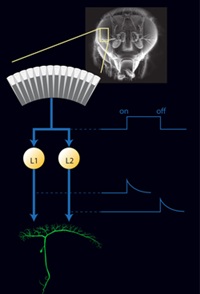 |
| Each individual eye in the fly's compound eye perceives ON and OFF contrast changes. This information is split up right behind each individual eye (blue arrow). The L1 cells only transmit information about ON edges ("light on"), the L2 cells only about OFF edges ("light off") to the output cells (green). Image: Max-Planck-Institut für Neurobiologie / Schorner |
Scientists from the Max Planck Institute of Neurobiology in Martinsried have now discovered that fruit flies process optical information in a similar way. The evidence suggests that this type of wiring is an effective energy-saving mechanism and is therefore deployed by a diverse range of animal species. (Nature, November 11, 2010)
Each individual eye in the fly's compound eye perceives ON and OFF contrast changes. This information is split up right behind each individual eye (blue arrow). The L1 cells only transmit information about ON edges ("light on"), the L2 cells only about OFF edges ("light off") to the output cells (green).
How does the mind perceive the world? This is not a trivial question: for many animal species, "seeing" is one of the most important senses. Every second, the eyes record a huge number of impressions which are converted by the photoreceptor cells into electrical signals.
In vertebrates, image processing begins in the retina of the eye. Here, the nerve cells separate out the visual information in images featuring different content before transmitting them to the brain.
Understanding seeing with fruit flies
To understand something as complex as "seeing", scientists examine a somewhat simpler but extremely efficient system - the fruit fly's brain. Despite their tiny size, fruit flies are ideal candidates for such research: they are masters of visual processing; the number of nerve cells involved is manageable, which means that each individual cell can be examined; and genetic tools make it possible to block individual cells and analyse their role in the system.
Scientists at the Max Planck Institute of Neurobiology have now discovered surprising parallels in the neuronal processing of fruit flies and vertebrates. The fly also transmits images directly from the sensory cells to various image channels.