Magnetic memory and logic could achieve ultimate energy efficiency
06 Jul 2011
Future computers may rely on magnetic microprocessors that consume the least amount of energy allowed by the laws of physics, according to an analysis by University of California, Berkeley, electrical engineers.
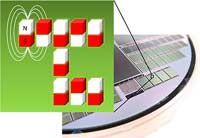 Today's silicon-based microprocessor chips rely on electric currents, or moving electrons, that generate a lot of waste heat. But microprocessors employing nanometer-sized bar magnets – like tiny refrigerator magnets – for memory, logic and switching operations theoretically would require no moving electrons.
Such chips would dissipate only 18 millielectron volts of energy per operation at room temperature, the minimum allowed by the second law of thermodynamics and called the Landauer limit. That's 1 million times less energy per operation than consumed by today's computers.
''Today, computers run on electricity; by moving electrons around a circuit, you can process information,'' said Brian Lambson, a UC Berkeley graduate student in the Department of Electrical Engineering and Computer Sciences. ''A magnetic computer, on the other hand, doesn't involve any moving electrons. You store and process information using magnets, and if you make these magnets really small, you can basically pack them very close together so that they interact with one another. This is how we are able to do computations, have memory and conduct all the functions of a computer.''
Lambson is working with Jeffrey Bokor, UC Berkeley professor of electrical engineering and computer sciences, to develop magnetic computers.
''In principle, one could, I think, build real circuits that would operate right at the Landauer limit,'' said Bokor, who is a codirector of the Center for Energy Efficient Electronics Science (E3S), a Science and Technology Center founded last year with a $25 million grant from the National Science Foundation. ''Even if we could get within one order of magnitude, a factor of 10, of the Landauer limit, it would represent a huge reduction in energy consumption for electronics. It would be absolutely revolutionary.''