Infotech

US to deploy robotic tuna to report fishy activities at harbours
24 Sep 2012
The BIOSwimmer robot, featuring fins and a flexible tail, will be able to inspect vessels including oil tankers, besides monitoring activities along American harbours to prevent terrorists or smugglers from sending in weapons and other contraband
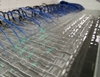
Intel finds hot oil helps servers keep their cool
11 Sep 2012
Intel recently completed a year-long test using a liquid cooling technique in which servers were placed in a custom-server rack filled with mineral oil
Researchers uncover the full scale and weaknesses of the monitoring of illegal file sharers
07 Sep 2012

Computing in the net of possibilities
23 Aug 2012
The complex network computer processes information in a fundamentally new way – and could one day rival today's computers
Networcsim hoping to broaden wireless revolution
01 Aug 2012
Stanford researchers produce first complete computer model of an organism
By By Max McClure | 24 Jul 2012
Molecule changes magnetism and conductance
23 Jul 2012

Chips with self-assembling rectangles
By By David L. Chandler, MIT News Office | 19 Jul 2012
Researchershave developed a new approach to creating the complex array of wires and connections on microchips, using a system of self-assembling polymers that could lead to a way of making more densely packed components on memory chips and other devices

New techniques for spintronics and quantum computing
10 Jul 2012
Researchers are working on techniques to sidestep the limits to miniaturisation, to encourage the creation of the next generation of faster and smaller electronic devices
Testing unbuilt chips
By By Larry Hardesty | 10 Mar 2012
Internet censorship revealed through the haze of malware pollution
By By Jan Zverina | 09 Mar 2012
A robot sketches portraits
13 Feb 2012

The blind codemaker: a boon to communications
10 Feb 2012
New error-correcting codes guarantee the fastest possible rate of data transmission, even over fluctuating wireless links.

Scientists develop biological computer to encrypt and decipher images
08 Feb 2012
US - Israeli scientists have developed a “biological computer” made entirely from biomolecules that is capable of deciphering images encrypted on DNA chips

Latest articles








Featured articles

The decoupling paradox: Why Wall Street keeps funding AI despite $100 oil
By Axel Miller | 11 May 2026
AI infrastructure stocks continue rallying despite $100 oil as investors bet on productivity gains and semiconductor demand in 2026.

Hybrid bonding gains attention as AI chip packaging demand grows
By Cygnus | 23 Apr 2026
Hybrid bonding is driving AI chip packaging demand as backend technologies gain importance in the semiconductor supply chain.

The agentic transition: how enterprises are scaling AI from pilot to profit
By Cygnus | 22 Apr 2026
AI has entered its execution era. Discover how companies like Valeo and Microsoft are scaling agentic AI systems—from copilots to autonomous workflows driving real business impact.

Post-splashdown: What Artemis II taught us about the ‘deep space wall’
By Axel Miller | 15 Apr 2026
Artemis II splashdown marks a breakthrough in deep space exploration. Discover AVATAR radiation data, Orion’s distance record, and insights shaping NASA’s 2028 Moon mission.

Can aviation go green? The multi-billion dollar race for sustainable fuel
By Cygnus | 10 Apr 2026
Airlines are racing to adopt sustainable aviation fuel, but limited supply and high costs challenge the future of green aviation.

The battery race: who will control the future of electric vehicles?
By Axel Miller | 08 Apr 2026
The global battery race is reshaping the electric vehicle industry, with China, the US, and Europe competing for control over supply chains and technology.

AI vs governments: Who controls the future of intelligence?
By Cygnus | 07 Apr 2026
Governments and AI companies like OpenAI and Anthropic are shaping the future of intelligence amid rising policy conflicts and global competition.

Strait of Hormuz: how one chokepoint controls the global economy
By Axel Miller | 06 Apr 2026
The Strait of Hormuz is a critical global chokepoint. Learn how disruptions impact oil prices, shipping, and the global economy.

The $2 trillion AI infrastructure race: Who will control global compute?
By Cygnus | 06 Apr 2026
AI spending is set to exceed $2 trillion in 2026, driving a global race in data centers, chips, and energy infrastructure.






