AI is No Bubble: Nvidia Supplier Wistron Sees Order Surge Through 2027
By Axel Miller | 06 Feb 2026
Summary
Wistron Chairman Simon Lin has dismissed fears of an artificial intelligence “bubble,” characterizing the current surge as the dawn of a new industrial era. The Taiwanese electronics giant, a primary assembly partner for Nvidia, reported order visibility extending into 2027, bolstered by a massive $500 billion domestic infrastructure push in the United States.
TAIPEI, Feb 6 — Artificial intelligence demand remains firmly grounded in a long-term industrial transformation rather than speculative hype, according to Simon Lin, Chairman of Wistron. Speaking at a media briefing in Taipei on Friday, Lin signaled that the hardware “super-cycle” is only just beginning.
“We believe AI truly benefits all sectors. I don’t see this as a bubble—I see it as the beginning of a new era,” Lin stated. His comments come as Wistron prepares for a “significant” expansion in 2026, with AI-related growth expected to outpace the record-breaking gains seen last year.
The $500 Billion U.S. Roadmap
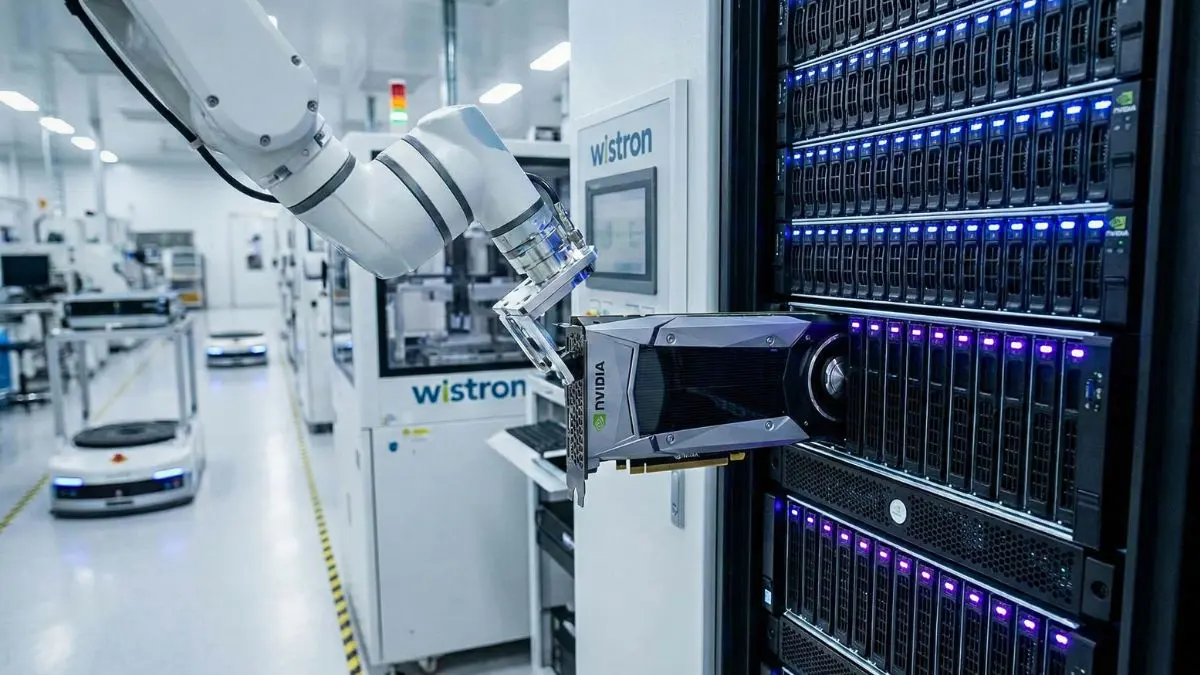
A key driver of Wistron’s multi-year outlook is the aggressive localization of AI server production. Wistron is currently ramping up its Dallas, Texas, manufacturing facility—a site dedicated to Nvidia-related workloads.
This move is part of a broader strategic alliance where Nvidia aims to help build $500 billion worth of AI server infrastructure in the U.S. over the next four years. Wistron, alongside partners like Foxconn (operating in Houston), will handle the complex integration of “AI factories”—data centers designed specifically for large-scale model training and autonomous agent orchestration.
Supply Chain Momentum through 2027
Wistron CEO Jeff Lin confirmed that volume production at the Dallas site is scheduled to commence in the first half of 2026. The company’s long-term planning is a direct response to the “persistent” demand from global hyperscalers and sovereign governments seeking to build independent AI capabilities.
For the electronics manufacturing services (EMS) sector, this shift represents a move from low-margin assembly to high-value systems integration. Wistron’s order books suggest that even as GPU availability stabilizes, the demand for the racks, liquid cooling systems, and networking switches that house these chips remains in a state of chronic undersupply.
Why This Matters
- De-Risking the Bubble Narrative: When the world’s largest server assemblers commit to 4-year capacity expansions, it suggests that the “capex” being spent by Big Tech has moved from experimentation to essential utility.
- Geopolitical Near-Shoring: The Wistron-Nvidia Dallas plant is a bellwether for the “China+1” strategy, proving that advanced electronics assembly can be successfully shifted to higher-cost regions like the U.S. if the technology is sufficiently complex.
- Industrial Resilience: Unlike software startups, hardware firms like Wistron require massive upfront capital. Their 2027 visibility provides a “floor” for semiconductor market sentiment.
FAQs
Q1. Why does Wistron believe AI is a “new era” rather than a bubble?
Chairman Simon Lin points to cross-industry adoption—from healthcare to automotive—where AI is providing measurable efficiency gains, unlike purely speculative financial bubbles.
Q2. What is the scale of the U.S. expansion?
Wistron is specifically scaling its Dallas facilities to support Nvidia’s $500 billion U.S. infrastructure goal. This involves producing the Blackwell and Vera Rubin (2026) server architectures locally.
Q3. How long is the current order visibility?
Wistron has confirmed firm order pipelines through the end of 2027, a rarity in the typically cyclical electronics assembly industry.
Q4. Who are Wistron’s primary partners?
While Nvidia is the anchor client for its AI server division, Wistron also manufactures for major cloud service providers (CSPs) and is in active talks with new entrants in the “Agentic AI” space.
Q5. When will the new U.S. capacity be online?
Volume production is slated for the first half of 2026, aligning with the rollout of next-generation AI networking standards.