Nexon Geochem plans ₹1,250 crore rare-earth magnet plant in Andhra Pradesh
By Axel Miller | 14 Oct 2026
Summary
- Proposed ₹1,250 crore investment: Nexon Geochem has announced plans to establish an integrated sintered rare-earth permanent magnet manufacturing facility in Thondangi, Kakinada district, Andhra Pradesh, through an MoU with the Andhra Pradesh Economic Development Board (APEDB).
- 600-tonne annual capacity: The proposed facility is designed to produce 600 tonnes per annum of sintered neodymium-iron-boron (NdFeB) magnets, with ₹750 crore planned for Phase 1 and ₹500 crore for Phase 2.
- Potential employment and supply-chain benefits: The project is expected to generate 886 jobs and could support domestic supply of magnets used in electric vehicles, wind turbines, industrial equipment and defence applications.
- Part of India’s critical-materials push: The proposal aligns with India’s wider efforts to reduce reliance on imported rare-earth permanent magnets and develop domestic manufacturing capabilities.
AMARAVATI, October 14, 2026 — Advanced materials company Nexon Geochem has announced a proposed investment of ₹1,250 crore to establish an integrated rare-earth permanent magnet manufacturing facility in Andhra Pradesh. The project is planned for Thondangi in Kakinada district and is being developed in partnership with the Andhra Pradesh Economic Development Board.
According to the company’s announcement, the facility will manufacture sintered neodymium-iron-boron (NdFeB) permanent magnets, high-performance components used in electric vehicle motors, wind turbines, industrial automation and defence systems. The proposal comes as India seeks to build domestic manufacturing capacity for critical materials and reduce its dependence on imported magnets.
Nexon Geochem has outlined a total investment of ₹1,250 crore across two phases. The first phase is allocated ₹750 crore, while a further ₹500 crore is planned for the second phase. The company has stated that the completed facility is designed to achieve annual production capacity of 600 tonnes of permanent magnets.
The project is expected to generate 886 jobs, according to reports on the announcement. However, the investment, production capacity and employment figures represent proposed project outcomes; they should not be interpreted as completed construction, operational output or employment already realised.
Praveen Kumar Choudhary, director of Nexon Geochem, said the company aims to establish an integrated NdFeB magnet manufacturing ecosystem to strengthen supply-chain security, reduce import dependence and support India’s ambitions in electric mobility, renewable energy and advanced manufacturing.
Reducing dependence on imported permanent magnets
Sintered NdFeB magnets are among the strongest commercially available permanent magnets. Their high magnetic performance relative to size makes them important in applications where compact components need to deliver substantial torque or magnetic force.
Key applications include:
Electric vehicle powertrains: Permanent magnets are used in many permanent-magnet synchronous motors and other electric motor designs. Their use varies by vehicle, motor architecture and manufacturer.
Wind turbine generators: NdFeB magnets are used in some permanent-magnet generators, including certain direct-drive designs. Not all wind turbines rely on this technology.
Industrial automation: Motors, robotics, actuators and precision equipment can use permanent magnets to deliver compact and efficient motion control.
Aerospace and defence: Certain actuators, motors, sensors and other specialised systems use high-performance permanent magnets.
India currently relies heavily on imports to meet demand for rare-earth permanent magnets. The Union Cabinet approved a ₹7,280 crore scheme in November 2025 to develop 6,000 metric tonnes per annum of integrated domestic manufacturing capacity. The scheme covers the production chain from rare-earth oxides to metals, alloys and finished magnets, and is intended to support domestic supply for automotive, renewable-energy, electronics, aerospace and defence industries.
Nexon Geochem’s proposed 600-tonne facility would represent a potential addition to this broader manufacturing effort. Its eventual contribution to import substitution will depend on the project’s commissioning, actual production, product quality, customer qualification and commercial competitiveness.
China remains a major force in the global rare-earth processing and permanent-magnet supply chain. Building additional manufacturing capacity in India could help diversify supply, although domestic production alone would not eliminate exposure to overseas feedstocks, specialised processing technologies or global price movements.
Manufacturing complexity and the role of local supply chains
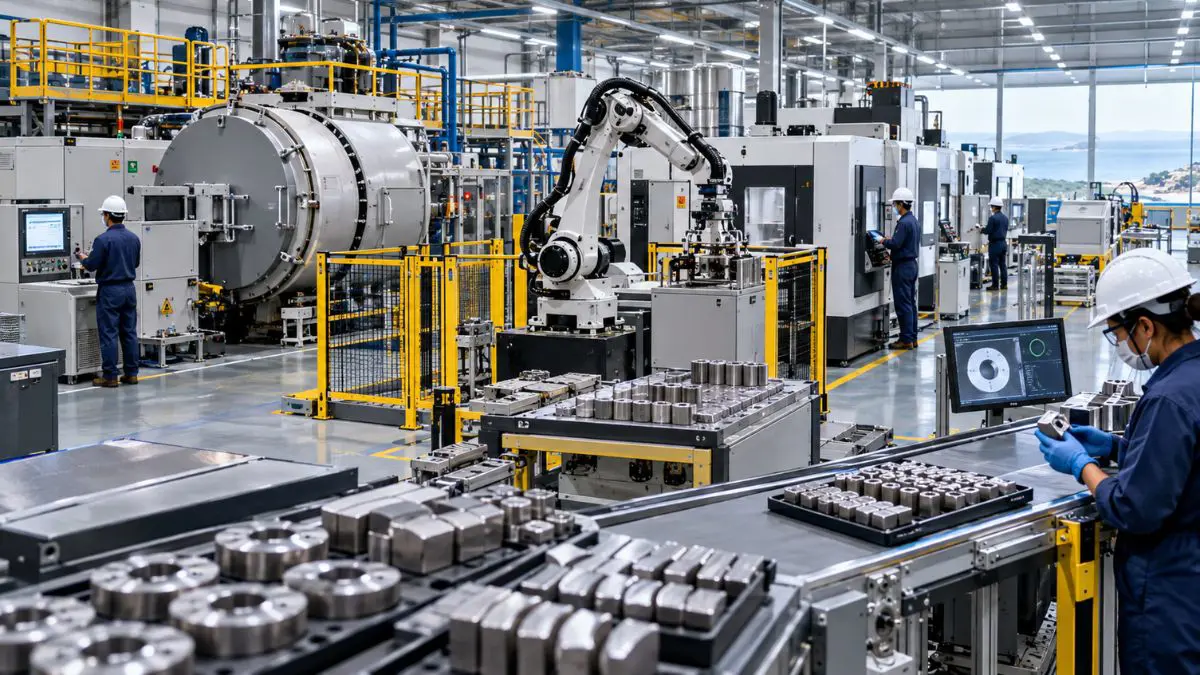
Producing sintered NdFeB magnets involves several specialised stages. Rare-earth feedstocks are processed into metals and alloys, which are then converted into carefully controlled powders, compacted, sintered and finished to meet required magnetic and mechanical specifications.
Manufacturers must manage oxidation, contamination, grain structure and thermal stability throughout production. Depending on the magnet grade and end use, additional treatments may be required to improve corrosion resistance or maintain magnetic performance at elevated temperatures.
For automotive and other demanding applications, customers typically require rigorous testing and qualification before a new magnet supplier can enter production supply chains. As a result, the proposed facility’s commercial success will depend not only on its nameplate capacity but also on manufacturing consistency, quality assurance and the ability to meet customer specifications.
Andhra Pradesh’s coastal mineral resources provide a wider regional context for the project. The state is among the Indian regions associated with rare-earth-bearing mineral deposits, including monazite in certain beach-sand deposits. However, the presence of these resources does not establish that Nexon Geochem’s facility will source its feedstock locally. That will depend on supply agreements, processing capabilities, regulatory requirements and the availability of suitable materials.
India is also pursuing dedicated rare-earth corridors in Andhra Pradesh, Odisha, Kerala and Tamil Nadu as part of its broader critical-materials strategy. These initiatives are intended to strengthen mining, processing, research and manufacturing links across the rare-earth value chain.
The Thondangi project could contribute to the development of an advanced-materials cluster in the Kakinada region if it progresses to construction and commercial operation. Its location alone, however, does not establish direct access to a dedicated deep-water terminal, a guaranteed local feedstock supply or a completed end-to-end supply chain.
Investment phases and project execution
Nexon Geochem has outlined the following capital structure for the proposed facility:
Phase 1 — ₹750 crore: The initial investment is intended to establish the first stage of manufacturing infrastructure.
Phase 2 — ₹500 crore: The subsequent allocation is intended to support expansion and additional manufacturing capabilities.
Planned capacity — 600 tonnes per annum: The company has stated that the facility is designed to produce 600 tonnes of sintered NdFeB magnets annually.
Expected employment — 886 jobs: The announced employment figure is a projection associated with the proposed project.
The company’s website also describes its broader ambition to develop an integrated rare-earth-to-magnet supply chain. It references pilot-plant development and a 600-tonne-per-year facility for converting rare-earth oxide into metal and alloy. Because this description concerns a different stage of the value chain, it should not be used alone to confirm that the entire 600-tonne finished-magnet capacity has already been built or commissioned.
The project’s next milestones will include progress from the MoU to implementation, confirmation of the site and production configuration, construction, equipment installation, qualification of magnet grades and commencement of commercial production. Until these milestones are documented, the project is best characterised as a proposed investment rather than an operating manufacturing facility.
Why this matters
- Import substitution in advanced manufacturing: Domestic NdFeB production could give Indian electric-mobility, industrial and renewable-energy companies another potential source of high-performance magnets.
- A stronger critical-materials ecosystem: The project could complement national efforts to build capacity across rare-earth processing, alloy production and finished magnets.
- Potential industrial development in Andhra Pradesh: If implemented, the investment and expected employment could support manufacturing activity in the Kakinada region.
- Opportunities for local suppliers: Construction and operation may create demand for industrial equipment, materials, engineering and specialised manufacturing services, subject to the project’s actual procurement and implementation.
- A strategic supply-chain opportunity: Domestic production could improve supply diversity, but the level of import substitution will depend on production volumes, pricing, quality and reliable access to feedstock.
FAQs
Q1: What is Nexon Geochem proposing to build in Andhra Pradesh?
The company has announced plans for a ₹1,250 crore integrated sintered NdFeB rare-earth permanent magnet manufacturing facility in Thondangi, Kakinada district, in partnership with the Andhra Pradesh Economic Development Board.
Q2: How will the ₹1,250 crore investment be phased?
The announced plan allocates ₹750 crore to Phase 1 and ₹500 crore to Phase 2. The project remains a proposal announced through an MoU, and the allocations should not be interpreted as proof that the full investment has already been spent.
Q3: What is the proposed production capacity and employment impact?
The facility is designed for 600 tonnes of finished permanent magnets annually. The project is also expected to generate 886 jobs, according to reports of the announcement. These are planned outcomes, not verified operating figures.
Q4: Why are NdFeB magnets important for electric vehicles and renewable energy?
Their high magnetic strength makes them useful in compact, high-performance electric motors and in some wind turbine generator designs. They are also used in industrial automation and selected aerospace and defence applications.
Q5: Will the plant use rare-earth minerals mined in Andhra Pradesh?
That has not been established by the announcement. Although Andhra Pradesh has rare-earth-bearing mineral resources, the plant’s actual feedstock sources will depend on supply agreements, processing arrangements and the availability of suitable materials.
6: Is the plant already operational?
The announcement describes a proposed investment and a planned manufacturing facility. The MoU and stated production target do not establish that construction is complete or commercial production has started.