India offers Sri Lanka $1.5-bn currency swap facility
14 Mar 2015
The Reserve Bank of India has entered into currency swap agreement with Sri Lankan central bank for $1.5 billion, a measure that will help keep the Sri Lankan rupee (SLR) stable, even as the two countries signed a host of other agreements to boost bilateral cooperation.
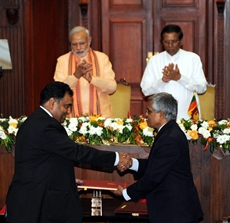 | |
| Sri Lankan President Maithripala Sirisena and Prime Minister Narendra Modi at the signing of agreements between India and Sri Lanka, in Colombo |
"This will help keep the Sri Lankan rupee stable," Modi told reporters.
Sri Lanka rupee has been under pressure since early January and fallen around 1.5 per cent so far this year despite the central bank defence of the currency by selling dollars.
India has committed further assistance of up to $318 million to Sri Lanka's railway sector, which will be over and above the figure of $1.6 billion which India has committed to the island nation in development assistance. This brings Indian financial assistance to Sri Lanka close to $2 billion.
As part of India's outreach programme to Indian Ocean states, including Sri Lanka, the two countries will cooperate in developing ocean resources.
Modi described ocean economy as a new frontier that holds enormous promise for both the sides. "It is a priority for our two countries. Our decision to set up a Joint Task Force on Ocean Economy is a significant step, especially because of our proximity," Modi said.
Energy security is another area of bilateral engagement for the two countries. Accordingly, Lanka IOC (a joint venture of Indian Oil Corporation) and Ceylon Petroleum Corporation on Friday agreed to jointly develop the Upper Tank Farm of the China Bay Installation in Trincomalee on mutually agreed terms. A joint task force will be constituted soon to work out the modalities.
India stands ready to help Trincomalee become a regional petroleum hub, Modi said.
Coal is another area of cooperation and India has hinted at early commencement of work on the ground in the Sampur Coal Power Project, which would meet Sri Lanka's energy needs.
Besides, the two sides took a slew of decisions on improving people-to-people contacts.
India will extend the facility of "Tourist Visa on Arrival - Electronic Travel Authorization'' scheme to Sri Lankan citizens from the Sinhala and Tamil New Year on 14 April 2015; Air India will soon start direct flights between New Delhi and Colombo; cooperate in developing a Ramayana Trail in Sri Lanka and a Buddhist Circuit in India and organise a Festival of India in Sri Lanka later this year.
Since Sri Lanka is where Buddhism has truly flourished, India will be organising an exhibition showcasing our Buddhist heritage as part of this festival.
Narendra Modi also landed in Jaffna today, becoming the first Indian prime minister to visit Sri Lanka's war-ravaged northern Tamil heartland.
The Indian leader flew in by helicopter a day after urging Sri Lanka to grant greater autonomy to its largest minority after a decades-long ethnic war that killed at least 100,000 people, mostly Tamils.

























