India's undersea nuclear missile test to trigger fresh arms race: Pakistan
27 Feb 2008
 Karachi: India's test of an early version of a nuclear-capable submarine launched ballistic missile (SLBM) has drawn a hostile reaction from Pakistan, its immediate neighbour to the west, which said Wednesday that the test would trigger a fresh arms race in the region.
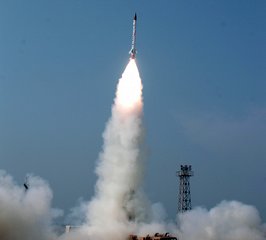
A day after India tested the new missile from a submerged pontoon in the waters off the port city and naval base of Vishakhapatnam, Pakistan navy chief, Admiral Muhammad Afzal Tahir, described the development as a "very serious issue." ( See: India conducts successful test of K-15 submarine launched ballistic missile)
Speaking to reporters on the sidelines of a function at the shipyard here, Adm Tahir said: "Well my reaction is that this is going to start a new arms race in the region. We are aware of these developments (which) are taking place with a view to putting nuclear weapons at sea and this is a very serious issue."
He also said that the testing of the new missile would impact the entire region. The admiral said that Pakistan was tracking India's missile development programme and would take steps to counter the impact of the testing of the undersea missile.
The Indian SLBM, variously referred to as the K-15 or the Sagarika, has a range of 700 km and its successful test allows India to complete the 'Triad' of nuclear weapons delivery platforms –land, air and sea.
The SLBM test was conducted from an immersed pontoon, as India is yet to field a submarine capable of hosting such a weapons system. Very likely a Russian Akula class nuclear powered submarine may join the Indian Navy next year.
India's own nuclear submarine programme, a 6,000 tonne displacement vessel being constructed under the codename Advanced Technology Vessel, will slip into the sea for trials next year. India hopes to eventually construct three such submarines, or ''baby boomers'' over a period of time.
India will be the sixth country after the US, Russia, France, UK and China to possess such a capability. The launch of the K-15 adds substance to India's nuclear deterrence, as sea-launched missiles are a critical component of any country's second-strike capability in the case of a nuclear showdown.