ISRO’s PSLV-C62 Launch Signals India’s Next Phase in Earth Observation and Orbital Innovation
By Axel Miller | 08 Jan 2026
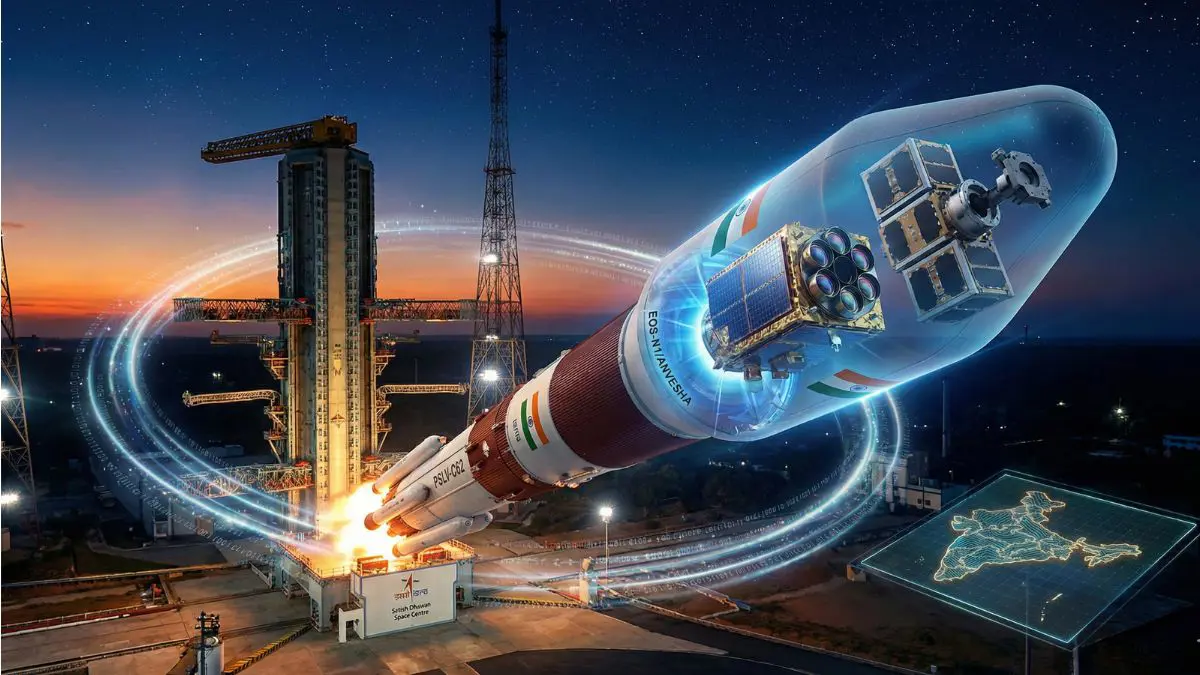
On Monday, January 12, 2026, India will mark its first orbital launch of the year when ISRO’s PSLV-C62 lifts off at 10:17 hrs IST from Sriharikota. The Polar Satellite Launch Vehicle will lift off from the First Launch Pad at Sriharikota, carrying one of the most strategically layered missions in recent years. The PSLV-C62 flight, operated by the Indian Space Research Organisation (ISRO), will place EOS-N1 (Anvesha) into orbit, alongside 18 co-passenger satellites, marking India’s first orbital launch of 2026.
Beyond the countdown clock, PSLV-C62 represents something more consequential: a convergence of national security priorities and private-sector innovation, signalling how India’s space programme is quietly transitioning from satellite deployment to capability validation across surveillance, sustainability, and commercial operations in Low Earth Orbit (LEO).
Mission at a Glance: Official Specifications
- Mission Name: PSLV-C62 / EOS-N1 (Anvesha)
- Launch Date: Monday, January 12, 2026
- Launch Time: 10:17 hrs IST
- Launch Site: First Launch Pad (FLP), SDSC SHAR, Sriharikota
- Launch Vehicle: PSLV-DL (64th flight of PSLV)
- Primary Payload: EOS-N1 (Anvesha) – Earth Observation Satellite
- Total Payloads: 19 (1 primary + 18 co-passengers)
A New Generation of Earth Observation
The primary payload, EOS-N1 (Anvesha), is an advanced Earth-observation satellite developed for strategic and civilian monitoring applications. While ISRO has not publicly disclosed detailed technical specifications, the mission is widely viewed as a step forward in high-fidelity imaging and analytical capability.
Defence and space analysts note that modern Earth-observation platforms increasingly rely on multi-band and hyperspectral sensing, allowing far greater discrimination of terrain features and surface changes than conventional optical imaging. Such systems improve monitoring across environmental assessment, disaster response, and strategic surveillance—without the need for public disclosure of sensitive operational details.
As is standard practice, ISRO and associated agencies have not released information regarding sensor resolution, orbital tasking, or specific mission use-cases.
Testing the Foundations of Orbital Servicing
Alongside the primary satellite, PSLV-C62 carries a diverse set of small payloads from India’s growing private space sector. Among them is AayulSAT, a technology-demonstration satellite developed by Bengaluru-based startup OrbitAID Aerospace.
Rather than attempting full satellite refuelling—an extremely complex operation—AayulSAT is designed to validate key building blocks relevant to future on-orbit servicing, including standardized interfaces, proximity operations, and docking-related subsystems.
Globally, satellite servicing and life-extension are emerging as critical capabilities, as operators seek to reduce space debris and maximize returns on high-value orbital assets. Demonstrations like AayulSAT represent early but essential steps toward that future.
Edge AI Moves into Orbit
PSLV-C62 also advances another emerging frontier: onboard data processing, often referred to as edge computing in space.
The mission includes MOI-1, a small satellite developed by Hyderabad-based TakeMe2Space in collaboration with EON Space Labs. Unlike traditional satellites that transmit large volumes of raw data to Earth, MOI-1 is designed to process imagery in orbit, flagging relevant events before downlinking selected outputs.
Industry experts say such architectures can significantly reduce bandwidth demands and response times, expanding the commercial viability of satellite-based intelligence for applications such as environmental monitoring, disaster alerts, and maritime awareness.
A Global Rideshare Mission
The remaining 18 co-passengers reflect PSLV’s enduring role as a global rideshare platform. The payload mix includes experimental satellites, academic missions, and commercial spacecraft from India and abroad, reinforcing India’s position as a dependable and cost-effective launch provider.
ISRO traditionally releases detailed payload manifests closer to liftoff, but the scale and diversity of PSLV-C62 underline the maturity of India’s launch ecosystem.
Looking Beyond the Launch
Former ISRO chairman A.S. Kiran Kumar has repeatedly emphasized that missions like PSLV-C62 are not isolated events but incremental building blocks toward India’s long-term space ambitions, including proposed space-station activities in the 2030s and more complex deep-space operations.
By validating advanced Earth-observation platforms, early orbital-servicing concepts, and AI-enabled satellites within a single mission, PSLV-C62 illustrates how India is integrating strategic, scientific, and commercial objectives into a unified space roadmap.
When the rocket’s upper stage completes its final deployment over the southern hemisphere, PSLV-C62 will stand not merely as another successful launch—but as evidence of a space programme evolving toward resilience, sustainability, and technological depth.
[Watch: ISRO’s 2026 Launch Calendar kicks off with PSLV-C62] (A 4K preview of the mission objectives and the strategic importance of the EOS-N1 satellite)
Summary
PSLV-C62, scheduled for launch on January 12, 2026, is ISRO’s first orbital mission of the year. Anchored by the EOS-N1 (Anvesha) Earth-observation satellite and supported by 18 co-passenger payloads, the mission highlights advances in surveillance, orbital-servicing concepts, and onboard AI processing—underscoring India’s growing role as both a strategic and commercial space power.
Frequently Asked Questions (FAQs)
Q1: What is EOS-N1 (Anvesha)?
EOS-N1 is an Earth-observation satellite designed to enhance monitoring and analytical capabilities across civilian and strategic domains.
Q2: Is India attempting satellite refuelling in orbit on this mission?
No full refuelling attempt has been announced. Current payloads are focused on testing interfaces and technologies relevant to future servicing missions.
Q3: What is “edge AI” in satellites?
It refers to processing data onboard a satellite before transmission, reducing bandwidth needs and enabling faster insights.
Q4: Why is PSLV important to India’s space programme?
PSLV is ISRO’s most reliable launch vehicle, enabling frequent missions, international rideshares, and technology validation at relatively low cost.

























