The 2026 Industrial Reset: From AI Hype to “Physical AI” Reality
By Cygnus | 06 Jan 2026
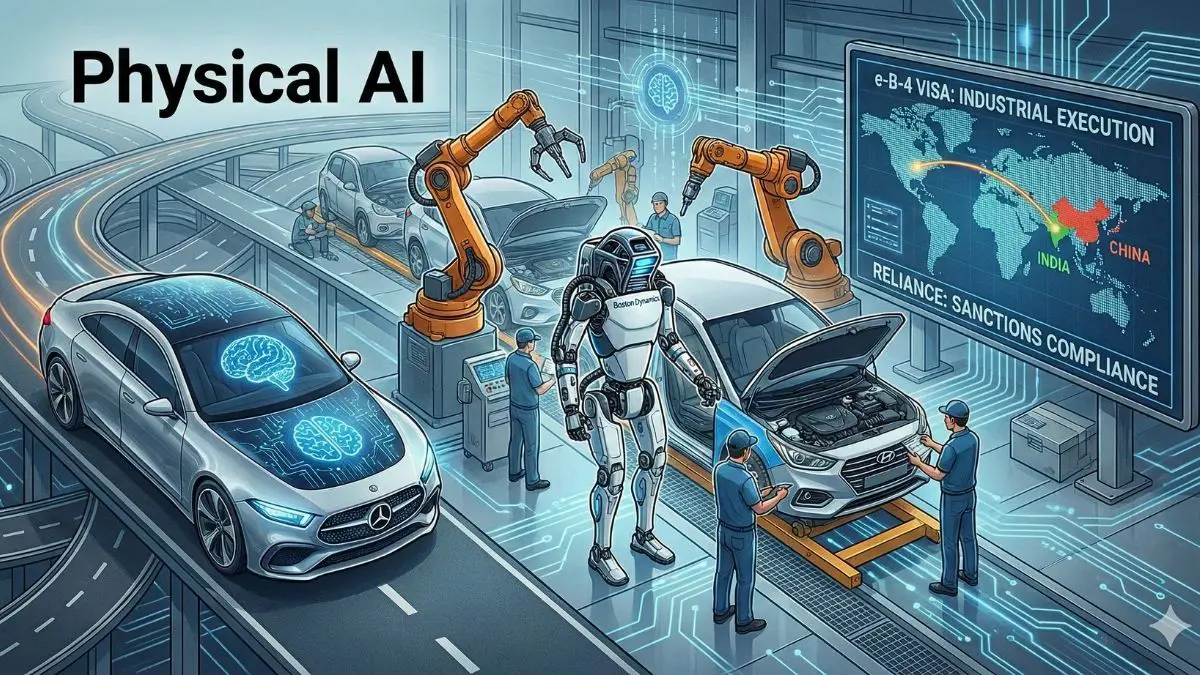
As the global business community settles into the first week of 2026, a profound transformation is visible across the industrial landscape. Yesterday’s Tech Outlook suggested that artificial intelligence was moving into the physical economy; today’s events at CES 2026 in Las Vegas and the financial hubs of Mumbai and Washington have confirmed it. The world is witnessing an “Industrial Reset,” where the speculative hype of generative AI is being replaced by the hard-hat reality of Physical AI—intelligence that doesn’t just process data, but manipulates the world.
Announcements and market reactions reported here are based on disclosures made at CES 2026 and regulatory filings on January 6.
1. Nvidia’s “ChatGPT Moment” for Mobility
The opening of CES 2026 today was dominated by Nvidia, which unveiled Alpamayo, what Nvidia describes as a new open-source, reasoning-based AI architecture for autonomous vehicles.
Unlike previous systems that relied on simple pattern recognition, Alpamayo uses multi-step reasoning to navigate rare and complex road scenarios, such as traffic light failures or unpredictable human movements. Nvidia CEO Jensen Huang officially dubbed this the “ChatGPT moment for physical AI,” announcing that the technology is expected to enter controlled pilot deployments on U.S. roads later this year, beginning with the Mercedes-Benz CLA.
Simultaneously, Nvidia introduced the Vera Rubin chip platform—designed to deliver five times the AI performance of its predecessor, Blackwell, at one-tenth the inference cost.
2. The Humanoid Workforce: Atlas Moves Toward Production
While Nvidia provides the “brain,” Hyundai and Boston Dynamics have provided the body. Today, the group unveiled an advanced, industrial-focused iteration of its all-electric Atlas humanoid robot. Hyundai said the system is being prepared for phased industrial deployment later this decade.
Designed specifically for industrial environments, the new Atlas is integrated with Google DeepMind’s foundation models, allowing it to perform autonomous tasks such as parts sequencing and heavy material-handling suitable for automotive manufacturing environments, with minimal supervision. Hyundai plans to deploy Atlas fleets at its Metaplant by 2028, marking the first large-scale commercialization of humanoid robots in the automotive value chain.
3. India’s Pragmatic Pivot: The e-B-4 Visa
While tech giants innovate, governments are adjusting their trade policies to keep pace. On January 1, 2026, India officially operationalized the e-B-4 Visa (Production Investment Business Visa), designed to ease the entry of foreign technical specialists, including those from China, acknowledging that India’s manufacturing growth depends on rapid access to global technical expertise.
The new visa regime allows Chinese professionals to travel to India for “installation, commissioning, and essential maintenance” of equipment in as little as 45 days. This move represents a pragmatic reset in India–China business ties, particularly for semiconductor and electronics manufacturing, where immediate access to experienced technical personnel remains critical.
4. Geopolitical Friction: The “Reliance/Russia” Fallout
The physical economy is also feeling the heat of global trade wars. Shares of Reliance Industries (RIL) fell nearly 5% today, wiping out over ₹1 lakh crore in market capitalization.
The sell-off was triggered by a sentiment shock following reports of fresh Russian crude bound for Jamnagar. Despite RIL issuing a forceful denial—labeling the reports “blatantly untrue”—the market remains jittery under the risk of steep U.S. tariff penalties on Russian energy under the Trump administration’s trade posture. Market participants treated the reports as a sentiment shock rather than a confirmed policy breach. RIL confirmed it has received zero Russian crude for three weeks, prioritizing compliance with Western sanctions to protect its fuel export margins.
This analysis reflects publicly available information and market reactions as of January 6, 2026.
Summary
The 2026 Industrial Reset is defined not by experimentation, but by execution at scale. In this phase, competitive advantage will favor firms that can integrate AI directly into physical operations—not just digital workflows. From the “reasoning” cars of Nvidia to Hyundai’s humanoid robots moving toward industrial deployment, and from India’s e-B-4 visa pragmatism to Reliance’s aggressive sanctions compliance, the global economy has moved past the era of digital experimentation. The competitive edge now belongs to those who can master the fusion of software intelligence and physical infrastructure at scale.
Frequently Asked Questions (FAQs)
Q1: What is “Physical AI”?
It refers to AI models, such as Nvidia’s Alpamayo, that go beyond generating text or images to perceive, reason, and act within physical systems like cars and robots.
Q2: Why is the e-B-4 visa important for India?
It allows Indian manufacturers to quickly bring in foreign technical experts, including Chinese specialists, to set up and maintain complex machinery required for PLI-backed industrial projects.
Q3: Why did Reliance stock fall today?
Despite denying any Russian oil imports, the market reacted to news volatility and the ongoing risk of steep U.S. tariff penalties, leading to a nearly 5% decline in RIL’s share price.
Q4: Is the Atlas robot available for home use?
No. The current version of Atlas is an enterprise-grade industrial robot designed for factories, warehouses, and material-handling environments.

























