The engine that powers short gamma-ray bursts
12 Apr 2011
A simulation of colliding neutron stars helps to explain what could lie behind these cosmic bursts of radiation
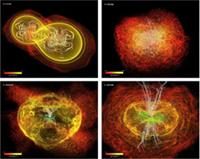 |
| Two neutron stars merge within milliseconds to form a black hole. A strong magnetic field is formed along the rotational axis, which creates a jet that shoots ultra-hot matter out into space. Gamma-ray bursts can occur in the jet.© L. Rezzolla (AEI) & M. Koppitz (AEI & Zuse Institute Berlin) |
These explosions have been puzzling scientists for years: those brief flashes of gamma light can in fact release more energy in a fraction of a second than what our entire galaxy releases in one year – even with its 200 billion stars.
What causes those explosions? Scientists working with Luciano Rezzolla at the Max Planck Institute for Gravitational Physics are now one step closer to solving the riddle.
In six-week-long computations they carried out on the Institute's supercomputer, the researchers simulated the merger of two neutron stars which have a small magnetic field and which, when merge, form a black hole surrounded by a hot torus.
In this process, an ultra-strong magnetic field with a jet-like structure is formed along the rotational axis.
And it was this magnetic field that could lie behind the generation of short gamma-ray bursts: out of the chaos that resulted from the collision, an ordered structure was formed – a jet in which short gamma-ray bursts can occur.

























