Teaching a microbe to make fuel
By By David L Chandler, MIT News Office | 22 Aug 2012
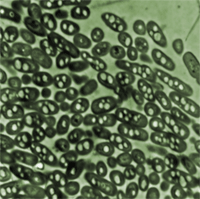 A humble soil bacterium called Ralstonia eutropha has a natural tendency, whenever it is stressed, to stop growing and put all its energy into making complex carbon compounds. Now scientists at MIT have taught this microbe a new trick: They've tinkered with its genes to persuade it to make fuel - specifically, a kind of alcohol called isobutanol that can be directly substituted for, or blended with, gasoline.
Christopher Brigham, a research scientist in MIT's biology department who has been working to develop this bioengineered bacterium, is currently trying to get the organism to use a stream of carbon dioxide as its source of carbon, so that it could be used to make fuel out of emissions. Brigham is co-author of a paper on this research published this month in the journal Applied Microbiology and Biotechnology.
Brigham explains that in the microbe's natural state, when its source of essential nutrients such as nitrate or phosphate is restricted, ''it will go into carbon-storage mode,'' essentially storing away food for later use when it senses that resources are limited.
''What it does is take whatever carbon is available, and stores it in the form of a polymer, which is similar in its properties to a lot of petroleum-based plastics,'' Brigham says. By knocking out a few genes, inserting a gene from another organism and tinkering with the expression of other genes, Brigham and his colleagues were able to redirect the microbe to make fuel instead of plastic.
While the team is focusing on getting the microbe to use CO2 as a carbon source, with slightly different modifications the same microbe could also potentially turn almost any source of carbon, including agricultural waste or municipal waste, into useful fuel. In the laboratory, the microbes have been using fructose, a sugar, as their carbon source.
At this point, the MIT team - which includes chemistry graduate student Jingnan Lu, biology postdoc Claudia Gai, and is led by Anthony Sinskey, professor of biology - have demonstrated success in modifying the microbe's genes so that it converts carbon into isobutanol in an ongoing process.

























