Pedestrian power: students engineer electricity-generating shoes
09 May 2013
A group of Rice University mechanical engineering students are getting a charge out of having the coolest new shoes on campus.
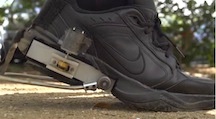 As their capstone project that is required for graduation, four seniors created a way to extract and store energy with every step. Their PediPower shoes turn motion into juice for portable electronics and, perhaps someday, for life-preserving medical devices.
Cameron, a Houston-based international company, approached the Rice engineering students with the project. The company primarily works on the macroscale as a provider of flow equipment, systems and services for the oil, gas and process industries, but it asked the students to look toward microscale green energy technologies.
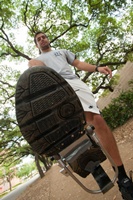 The Agitation Squad – Carlos Armada, Julian Castro, David Morilla and Tyler Wiest – decided last fall to focus their attention on where the rubber meets the road to create a shoe-mounted generator. Another device to draw energy from the motion of the knee had already been developed and patented and led them to analyse other sources of energy.
Working with the Motion Analysis Laboratory at Shriners Hospital for Children in Houston, the team determined the force at the heel delivered far more potential for power than any other part of the foot.
''We went to the lab and saw the force distribution across the bottom of your foot, to see where the most force is felt,'' Morilla said. ''We found it would be at the heel and at the balls of your toes, as you push off. We went with the heel because, unless you're sprinting, you're letting gravity do the work.''
Their devices as currently designed are admittedly too big for day-to-day wear, but the prototypes developed at Rice's Oshman Engineering Design Kitchen with the team's advisers, David McStravick and Omar Kabir, meet the benchmarks set by the company. McStravick is a professor in the practice of mechanical engineering and materials science; Kabir is a senior principle research engineer in corporate technology at Cameron.
The prototypes deliver an average of 400 milliwatts, enough to charge a battery, in benchtop tests (and a little less in walking tests, where the moving parts don't move as far). They send energy through wires to a belt-mounted battery pack. A voltage regulator keeps it flowing steadily to the battery.
The PediPower hits the ground before any other part of the prototype shoe. A lever arm strikes first. It is attached to a gearbox that replaces much of the shoe's sole and turns the gears a little with each step. The gears drive a motor mounted on the outside of the shoe that generates electricity to send up to the battery.
''It may be worth looking into having both the heel and the ball of the foot produce power, especially if this shoe could be used while running,'' Armada said.
The students expect the project to be picked up by another team at Rice in the fall, with the hope they can refine the materials, shrink the size and boost the power output, all of which will get PediPower closer to being a commercial product.
''If we could prove that we could produce some usable power, store it in a battery and discharge that battery on a mobile device or an MP3 player, then we could prove this device works,'' Armada said. ''Now the next team can come in and make it smaller and lighter without sacrificing power.''
For now, the team would like to provide enough dependable power for cellphones and other portable electronics. But they're aware that Cameron has partnered with the Texas Heart Institute to apply its expertise in moving fluids to a new generation of artificial heart pumps, and the students hope their work will contribute to that goal.
''Just the fact that you're relying on human movement to power something that's critical to your life is a little bit scary,'' Armada said. ''You sleep for eight hours a day and you're not moving. You want to make sure you're making enough power during the day to last. Realistically, this might be more of a device to charge your phone.
''Theoretically it would be something you just wear, and you don't notice it,'' he said. ''That's the end goal. If you showed someone the shoe while you're standing still, they wouldn't even see the device.''

























