Manchester University's graphene pioneers knighted
05 Jan 2012
1
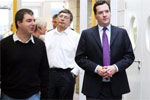 Professors Andre Geim and Kostya Novoselov, who demonstrated the remarkable properties of wonder material graphene, have been knighted in the New Year Honours list.
The scientists were awarded the Nobel Prize for Physics in 2010 and graphene - the world's thinnest, strongest and most conductive material - is considered as having the potential to revolutionise materials science.
Graphene is a novel two-dimensional material which can be seen as a monolayer of carbon atoms arranged in a hexagonal lattice.
Its remarkable properties could lead to bendy, touch screen phones and computers, lighter aircraft, wallpaper-thin HD TV sets, the next generation of computers and superfast internet connections, to name but a few.
Since the discovery, in 2004, Professors Geim and Novoselov have continued to carry out world-class research, including into the potential applications of graphene.
The latest honour, awarded to both for 'Services to Science', is a reflection of their growing stature in the scientific world.
Professor Novoselov first worked with Professor Geim as a PhD student in the Netherlands. He subsequently joined Geim in the United Kingdom.
Professor Geim said, ''In my life, I have got used to being called four-letter names. Going down to three is a completely new experience which I will hopefully enjoy.''
Professor Novoselov said, ''This is a fantastic recognition and a great honour. It is pleasing to see that science is not completely separated from the state, and gaining the acknowledgement it deserves.''
Professor Dame Nancy Rothwell, president and vice chancellor of The University of Manchester, added, ''I was thrilled to hear that Andre and Kostya have been knighted in the New Year Honours list. The honours are fantastic recognition for their outstanding contribution to science.
''I am hugely proud to have such eminent academics at The University of Manchester and I look forward to many years of their continuing excellence in scientific research.''
Elsewhere at the University, Professor Mel Ainscow, co-director of the Centre for Equity in Education in the School of Education, was awarded a CBE for services to Education.
Previously a head teacher and local education authority inspector, Professor Ainscow's work explores connections between inclusion, teacher development and school improvement.

























