Chemical analysis of vessels reveals cheesemaking 7,000 years ago
24 Dec 2012
The first unequivocal evidence that humans in prehistoric Northern Europe made cheese more than 7,000 years ago is described in research by an international team of scientists, led by the University of Bristol, published in Nature.
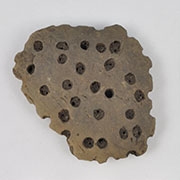 |
| A sieve fragment from a clay pit in north-central Poland which was submitted to lipid residue analyses, Image by Mélanie Salque |
By analysing fatty acids extracted from unglazed pottery pierced with small holes excavated from archaeological sites in Poland, the researchers showed that dairy products were processed in these ceramic vessels. Furthermore, the typology of the sieves, close in shape to modern cheese-strainers, provides compelling evidence that these specialised vessels have been used for cheese-making.
Before this study, milk residues had been detected in early sites in Northwestern Anatolia (8,000 years ago) and in Libya (nearly 7,000 years ago). Nevertheless, it had been impossible to detect if the milk was processed to cheese products.
Researchers from the Organic Geochemistry Unit at the University of Bristol, together with colleagues at Princeton (USA), Lodz, Gdánsk and Poznan (Poland) studied unglazed pottery from the region of Kuyavia (Poland) dating from around 7,000 years ago. These had been typologically interpreted as cheese-strainers by archaeologists for more than 30 years due to the peculiar presence of small sized holes on the surface of the sherds. In fact, these archaeological sherds looked like modern cheese-strainers.
Using lipid biomarker and stable isotope analysis, researchers examined preserved fatty acids trapped in the fabric of the pottery and showed that the sieves had indeed been used for processing dairy products. Milk residues were also detected in non-perforated bowls, which may have been used with the sieves.
Contrastingly, the analyses of non-perforated pottery (cooking pots or bottles) demonstrated that they were not used for processing milk. The presence of ruminant carcass fats in cooking pots showed that they were likely used to cook meat, while the presence of beeswax in bottles suggests the sealing of the pottery to store water.

























