Algae “see” a wide spectrum of light
05 May 2014
Aquatic algae can sense an unexpectedly wide range of colour, allowing them to sense and adapt to changing light conditions in lakes and oceans.
The study by researchers at UC Davis was published earlier this year in the journal Proceedings of the National Academy of Sciences.
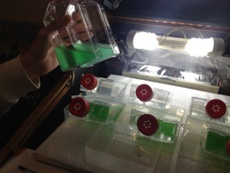 | |
| Freshwater-dwelling algae like these are among those able to sense a surprisingly wide spectrum of light. |
Typically about 20 per cent of a plant's genes are regulated by phytochromes, he said.
Phytochromes use bilin pigments that are structurally related to chlorophyll, the molecule that plants use to harvest light and use it to turn carbon dioxide and water into food.
Lagarias' laboratory in the Department of Molecular and Cellular Biology at University of California, Davis (UC Davis) studies these phytochromes and their properties. Phytochromes from land plants, Lagarias said, respond to red light - plants absorb red and reflect green light, which is why they look green.
Red light does not penetrate far into water, and some marine and shore-dwelling algae lack phytochrome genes. But others do not, so Lagarias and colleagues looked at the properties of phytochromes from a variety of algae.
They found that phytochromes from algae, unlike those of land plants, are able to perceive light across the visible spectrum - blue, green, yellow, orange, red and far-red.
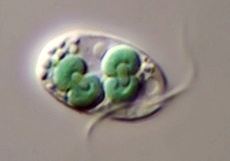 | |
| Cyanophora paradoxa, one of the algae with newly discovered phytochromes. |
This broad spectral coverage likely helps algae make use of whatever light they can in the ocean, Lagarias said - whether adjusting their light-harvesting chemistry for changing conditions, or rising and sinking in the water column as light levels at the surface change.
Because different colors of light penetrate to different depths in water, algae face challenges in light harvesting that land plants do not. This work from the Lagarias lab shows one way that algae can rise to the occasion.
Phytochromes themselves have a long evolutionary history and likely arose from the interaction between oxygen and bilins, pigment molecules closely tied to chlorophyll and the oxygen-carrying heme pigment in hemoglobin, Lagarias said.
The ancestral form appears to be sensitive to red light, similar to phytochromes of modern land plants. But between the origin and today, phytochromes went through a stage of massive diversity when they could detect a much wider range of wavelengths.
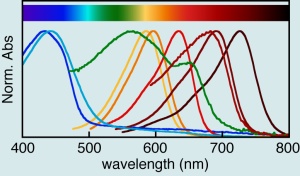 | |
| The broad colour palette of algal bilin-based light sensors found in nature. |
''It's a molecule that has been there and back again,'' Lagarias said.
The discoveries help researchers better understand the role of light and response to light in shaping ecology, as well as a model for how living cells react to light. They could also help in breeding of aquatic crops that could take advantage of different light conditions.
Coauthors on the paper are: at UC Davis, Nathan Rockwell, Deqiang Duanmu, and Shelley Martin; Alexandra Worden and Charles Bachy at the Monterey Bay Aquarium Research Institute and Canadian Institute for Advanced Research; Dana Price and Debashish Bhattacharya, Rutgers University. The work was supported by multiple agencies including the NIH, NSF, US Department of Agriculture, Department of Defense, the Packard Foundation and the Gordon and Betty Moore Foundation.

























