UK scientists develop world’s first prosthetic arm controlled by thought
08 Feb 2017
A newly-developd bionic arm controlled by a patient's thoughts has proved to be a radical improvement on existing artificial arms, researchers say.
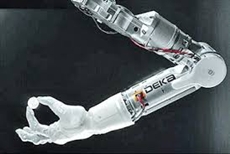 This is because existing prosthetic arms rely on patients twitching the muscles in the stump of their damaged arms. However, since muscles themselves are damaged, an amputee might only be able to carry out limited movements, such as one or two grasping actions.
The limited range of movements is one reason why up to 50 per cent of amputees abandon their electronic arms at present.
The new prosthetic arm was created by experts who linked the nerves from the spine into an intact piece.
Experts created the new prosthetic arm by linking the nerves from the spine into an intact piece of muscle that allows a patient to control the arm by directly thinking about actions.
With the linking the nerves from the spine into an intact piece of muscle, either in the patient's chest or biceps, patients were able to carry out a much wider range of movements, including opening and closing of the hand, rotating the wrist and moving the arms up and down.
To control the new prosthetic the patient simply had to think as though they were controlling a phantom arm.
By imagining the desired action, such as pinching two fingers together, the signal was carried by the nerves to the muscle.
"When an arm is amputated the nerve fibres and muscles are also severed, which means that it is very difficult to get meaningful signals from them to operate a prosthetic," explained Dario Farina, a professor of bioengineering at Imperial College London.
This limited the number of tasks the artificial limb could perform and explained why 50 per cent of users ended up dumping them in frustration, he claims.
Farina and his team developed a sensor that used the electrical signals sent from spinal motor neurons as commands and had six amputees test it.
In order to amplify the signals and make it easier for the sensor to detect them, the researchers surgically rerouted the nerves associated with hand and arm movements to healthy muscles in their chest or biceps.
The researchers then decoded and mapped the information in these signals against those of healthy patients. The idea here was that by decoding the meaning behind all the signals sent from these motor neurons, they would be able to create a full suite of commands for arm and hand functions in the prosthetic to make it function like a real arm.
For this study, the researchers encoded specific motor neuron signals as commands into the design of the prosthetic, after which they placed a sensor patch on the muscle that had been operated on, which was in turn connected to the prosthetic.
According to the researchers, the results were encouraging and after working with physiotherapists to learn how to control the device, which entailed picturing themselves controlling a phantom arm and imagining simple actions, the amputees were able to perform a wider range of movements.

























