Research may lead to new treatment for type of brain cancer
30 Jul 2012
Researchers at Columbia University Medical Center (CUMC) have discovered that some cases of glioblastoma, the most common and aggressive form of primary brain cancer, are caused by the fusion of two adjacent genes. The study also found that drugs that target the protein produced by this genetic aberration can dramatically slow the growth of glioblastomas in mice. The findings were published today in the online edition of the journal Science.
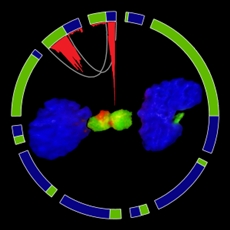 |
| Graphic representation of the collaboration between experimental and computational biology. The outer ring represents results of next-generation genetic sequencing of the glioblastoma genome, showing expression of the FGFR-TACC fusion gene (red peaks). In the center, FGFR-TACC fusion protein (red) can be seen disrupting tubulin bundles (green), structures that support cell division, or mitosis, at the point connecting the two daughter cells (whose nuclei are colored blue).Image credit: Antonio Iavarone, Joseph Chan, Oliver Elliott and Raul Rabadan/Columbia University Medical Center |
''Our findings are doubly important,'' said study leader Antonio Iavarone, MD, professor of pathology and neurology at CUMC, and a member of the Herbert Irving Comprehensive Cancer Center (HICCC) at NewYork-Presbyterian Hospital/Columbia University Medical Center. ''From a clinical perspective, we have identified a druggable target for a brain cancer with a particularly dismal outcome.
From a basic research perspective, we have found the first example of a tumour-initiating mutation that directly affects how cells divide, causing chromosomal instability. This discovery has implications for the understanding of glioblastoma as well as others types of solid tumors.''
The fusion of these two genes was observed in just three per cent of tumours studied, so any therapy based on this particular genetic aberration would apply to only a small subset of glioblastoma patients. ''It's unlikely that we will find a gene fusion responsible for most glioblastomas. But we may be able to discover a number of other gene fusions, each accounting for a small percentage of tumors, and each with its own specific therapy,'' said co-senior author Anna Lasorella, MD, associate professor of pathology and pediatrics at CUMC and a member of the Columbia Stem Cell Initiative and the HICCC.
''This is a very exciting advance in our understanding of cancer, and perhaps a first step toward a personalised, precision approach to the treatment of glioblastoma,'' said Stephen G. Emerson, MD, PhD, director of the HICCC and the Clyde '56 and Helen Wu Professorship in Immunology at the Columbia University College of Physicians and Surgeons.
Figure 2: Abnormal accumulation of the FGFR-TACC fusion protein (red) in glioblastoma stem cells isolated from a primary human glioblastoma with fused FGFR- TACC genes. Cellular nuclei are colored blue. Image credit: Anna Lasorella and Antonio Iavarone/Columbia University Medical Center

























