Indian scientists design drones for organ delivery
07 May 2016
For someone who is in need of an organ transplant, every second counts. With this in mind, a group of scientists in India have designed a new method of transportation that is much faster than hauling them in the back of an ambulance or even by regular flights.
 The Rs100-crore National Programme for Micro Air, is set to use unmanned aerial vehicles or drones to deliver hearts and other vital organs, cutting transport time by more than 50 per cent.
The heart can be stored for up to 10 hours, a kidney 24 and a liver 12 to 15, and the inventor of India's indigenous fighter Light Combat Aircraft wants to develop a method to deliver them sooner.
''The main focus will be on transporting hearts as other organs can be preserved for longer after harvesting,'' Kota Harinarayan, who was the vice-chancellor of the University of Hyderabad, told Times of India.
The traditional method is referred to as a 'green corridor', which was established two years by the Mumbai traffic police.
This initiation entails police escorting an ambulance, helping it to move around traffic – usually a specific traffic lane is chosen and all signals on the route stay green.
Kota and Dr K Ramachandra from the National Design and Research Forum are leading the project along with the help of other experts in the US to iron out all the details.
''Once the specifications from doctors and engineers are finalised - the first leg of the process is expected to be complete this week - we will take the project to the government for funding and clearance,'' Kota said.
Kota's expertise lies in aerospace science, but he has reached out to doctors in India and the US to discuss the kind of facilities organs need in order to be delivered safely.
As of right now the team has two options - design a drone with technology to preserve organs or variants that are able to carry the organ in a special box.
''We have demonstrated several technologies as part of the NP-Micav programme that was funded by the Centre,'' said Ramachandra.
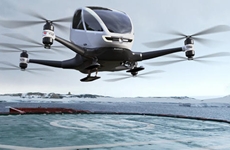
The fully ready-to-fly 184 is a manned drone capable of automatically carrying a passenger through the air, simply by entering a destination into its accompanying smartphone app.
The 184 uses multiple independent flight control systems to automatically navigate passengers from point A to point B.
These systems combine real-time data collected from sensors throughout the flight and automatically plot the fastest and safest route to carry passengers to their destinations.
The EHang 184 has built in reinforcements for all flight systems, so that in the unlikely event that a component does fail, multiple backups are already in place to seamlessly take over.
''For this project, we are looking at a vehicle of the regular UAV size and not the micro size.''
The initial design will be able to carry up to 250 grams of weight, but the team hopes to reach a 100-km range.
India not alone
India isn't the only country looking to the skies for help with transporting organ.
A Chinese firm recently unveiled a self-flying 'passenger drone' that they say can be used to deliver human organs.
EHang revealed a collaboration with Lung Biotechnology PBC to develop and purchase up to 1,000 units of an evolved version of the 184, the world's first autonomous drone for humans, to automate organ transplant delivery.
The two companies have agreed to work together over the course of the next 15 years to optimize the 184 for organ deliveries, a program which they are calling the Manufactured Organ Transport Helicopter (MOTH) system.
Lung Biotechnology specialises in manufacturing lungs and other organs for transplant using a variety of technologies, including pig-to-human xenotransplantation, as well as regenerating them from stem cells.

























