Cholesterol sets off chaotic blood vessel growth
30 May 2013
A study at the University of California San Diego School of Medicine, has identified a protein that is responsible for regulating blood vessel growth by mediating the efficient removal of cholesterol from the cells. Unregulated development of blood vessels can feed the growth of tumours.
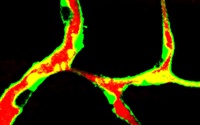 |
| Disorganized blood vessels shown in AIBP knockdown zebrafish. Green, endothelial cells; red, fluorescent dextran injected to visualize the blood vessel lumen |
The work, led by Yury Miller, MD, PhD, associate professor of medicine at UC San Diego, was published in the advance online edition of the journal Nature on 29 May.
Cholesterol is a structural component of the cell and is indispensable for normal cellular function, although its excess often leads to abnormal proliferation, migration, inflammatory responses or cell death.
The researchers studied how the removal of cholesterol from endothelial cells (cells that line the blood vessels) impacts the development of new blood vessels, the process called angiogenesis.
According to Miller, removal of excess cholesterol from endothelial cells is essential for restraining excessive growth of blood vessels.
''Too much cholesterol increases the abundance of lipid rafts, areas in the plasma membrane where surface receptors initiate signaling events leading to angiogenesis,'' Miller said. VEGFR2 is such a receptor, playing a central role in the development of blood vessels. Research into the process of angiogenesis suggests that VEGF-induced signaling within endothelial cells is important to tumor growth.
In this study, the scientists show that apoA-I binding protein (AIBP) is secreted by surrounding tissues and facilitates cholesterol removal from endothelial cells. This process interferes with the VEGFR2 receptor function, in turn inhibiting angiogenesis.
''Studying the process in zebrafish, we found that the timing and the pattern of AIBP expression is such that it helps guide segmental arteries to grow strictly in the dorsal direction, instead of an aberrant sideways direction,'' said first author Longhou Fang, who added that future studies will explore if AIBP or its derivatives can be used to inhibit pathologic angiogenesis in tumors. Alternatively, blocking AIBP activity in the heart may, in principle, stimulate re-growth of blood vessels after a heart attack.
Additional contributors to the study include Soo-Ho Choi, Ji Sun Baek, Chao Liu, Felicidad Almazan, Philipp Wiesner, Adam Taleb, Elena Deer, Jennifer Pattison and Andrew C. Li, UCSD Department of Medicine; and Florian Ulrich and Jesús Torres-Vázquez, Skirball Institute of Biomolecular Medicine at New York University Langone Medical Center.
The study was funded in part by National Institutes of Health grants HL093767, HL055798 and HL114734; a fellowship from the UC Tobacco-Related Disease Program; and a UCSD Neuroscience Microscopy Facility Grant.

























