A stroke or benign dizziness? A simple bedside test can tell
08 Mar 2013
A bedside electronic device that measures eye movements can successfully determine whether the cause of severe, continuous, disabling dizziness is a stroke or something benign, according to results of a small study led by Johns Hopkins Medicine researchers.
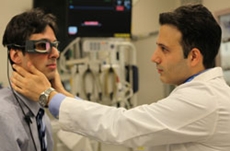 |
| Georgios Mantokoudis, left, and Ali Tehrani demonstrate the use of a video-oculography machine that detects minute eye movements that are difficult for most physicians to notice and can help diagnose stroke. (Credit: Johns Hopkins Medicine) |
"Using this device can directly predict who has had a stroke and who has not," says David Newman-Toker, MD, PhD., an associate professor of neurology and otolaryngology at the Johns Hopkins University School of Medicine and leader of the study described in the journal Stroke.
"We're spending hundreds of millions of dollars a year on expensive stroke work-ups that are unnecessary, and probably missing the chance to save tens of thousands of lives because we aren't properly diagnosing their dizziness or vertigo as stroke symptoms."
Newman-Toker says if additional larger studies confirm these results, the device could one day be the equivalent of an electrocardiogram (EKG), a simple non-invasive test routinely used to rule out heart attack in patients with chest pain. And, he adds, universal use of the device could "virtually eliminate deaths from misdiagnosis and save a lot of time and money."
To distinguish a stroke from a more benign condition, such as vertigo linked to an inner ear disturbance, specialists typically use three eye movement tests that are essentially a stress test for the balance system. In the hands of specialists, these bedside clinical tests (without the device) have been shown in several large research studies to be extremely accurate -- "nearly perfect, and even better than immediate MRI," says Newman-Toker.
One of those tests, known as the horizontal head impulse test, is the best predictor of stroke. To perform it, doctors or technicians ask patients to look at a target on the wall and keep their eyes on the target as doctors move the patients' heads from side to side. But, says Newman-Toker, it requires expertise to determine whether a patient is making the fast-corrective eye adjustments that would indicate a benign form of dizziness as opposed to a stroke.

























