Antibody evolution could guide HIV vaccine development
17 May 2013
Observing the evolution of a particular type of antibody in an infected HIV-1 patient, a study spearheaded by Duke University, supported by analysis from Los Alamos National Laboratory, has provided insights that will enable vaccination strategies that mimic the actual antibody development within the body.
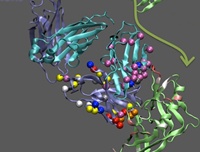 |
| Co-evolution of virus and antibody – The evolution of the viral protein (green) from 14 weeks through 100 weeks post-transmission is compared to the maturation of the human antibody. (Image courtesy Los Alamos National Laboratory.) |
The kind of antibody studied is called a broadly cross-reactive neutralising antibody, and details of its generation could provide a blueprint for effective vaccination, according to the study's authors. In a paper published online in Nature this week, the team reported on the isolation, evolution and structure of a broadly neutralising antibody from an African donor followed from the time of infection.
The observations trace the co-evolution of the virus and antibodies, ultimately leading to the development of a strain of the potent antibodies in this subject, and they could provide insights into strategies to elicit similar antibodies by vaccination.
Patients early in HIV-1 infection have primarily a single ''founder'' form of the virus that has been strong enough to infect the patient, even though the population in the originating patient is usually far more diverse and contains a wide variety of HIV mutations.
Once the founder virus is involved in the new patient's system, the surrounding environment stimulates the HIV to mutate and form a unique, tailored population of virus that is specific to the individual.
The team, including Bette Korber, Peter Hraber, and S Gnanakaran of Los Alamos National Laboratory, led by Barton Haynes of Duke University School of Medicine in Durham, North Carolina and with colleagues at Boston University, the National Institutes of Health and other institutions, as part of a large collaboration, showed that broadly neutralising antibodies developed only after the population of viruses in the individual had matured and become more diverse.
''Our hope is that a vaccine based on the series of HIV variants that evolved within this subject that were together capable of stimulating this potent broad antibody response in his natural infection may enable triggering similar protective antibody responses in vaccines,'' said Bette Korber, leader of the Los Alamos team.