Beijing curbs OpenClaw AI use in state firms amid data security fears
By Cygnus | 11 Mar 2026
Summary
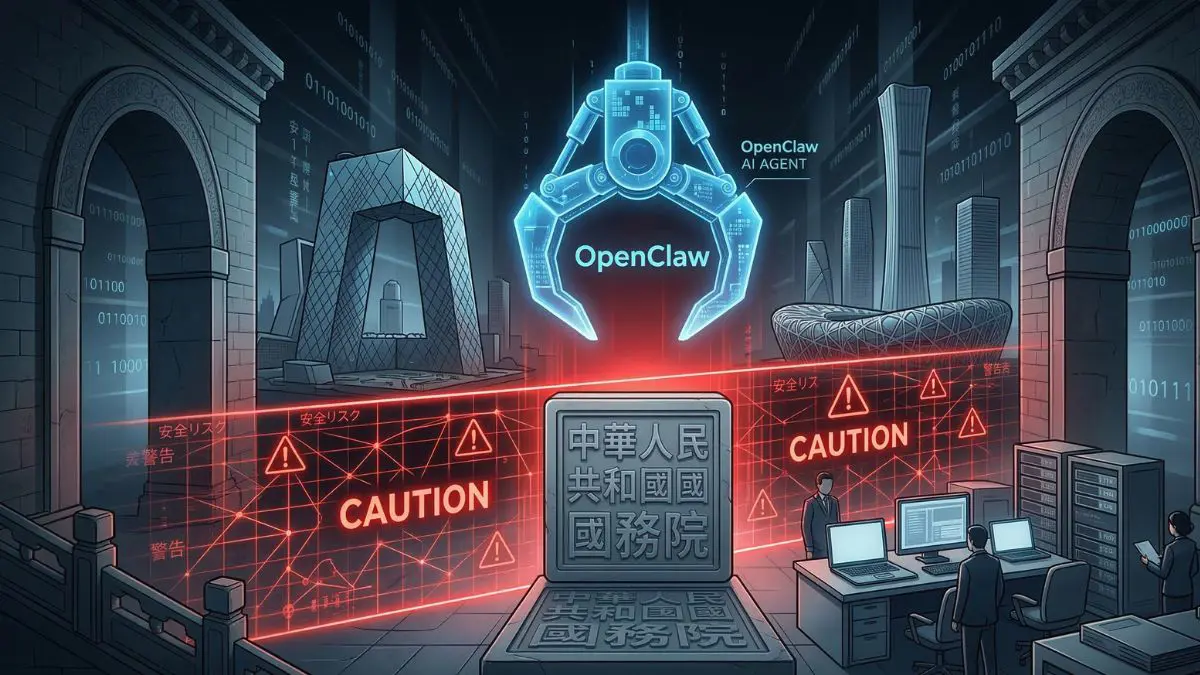
China’s central government has warned state-owned enterprises (SOEs) and government agencies against deploying the open-source AI agent OpenClaw on official systems, citing potential cybersecurity and data-leak risks. The move highlights growing tension between rapid AI adoption and tightening national security controls.
BEIJING, March 11, 2026 — Chinese authorities have begun restricting the use of the open-source AI agent OpenClaw across government departments and state-owned firms, reflecting rising concern about autonomous software operating inside sensitive digital infrastructure.
The warnings come despite strong recent adoption momentum for agent-based AI tools under Beijing’s broader push to accelerate technological development.
Security concerns drive the shift
OpenClaw — an autonomous AI agent capable of executing multi-step workflows across devices — has drawn attention for both its productivity gains and its security risks.
Officials are increasingly wary that such tools, once granted system-level permissions, could unintentionally expose confidential files, disrupt workflows, or transmit sensitive data externally.
Sources cited by Reuters said staff at some SOEs were advised to avoid installing OpenClaw on work systems and, in certain cases, to refrain from using it on personal devices connected to internal networks.
Local adoption vs. central caution
The warnings highlight growing friction between central regulators and local governments promoting AI adoption:
- Local push: Cities including Shenzhen have backed agentic AI deployment initiatives and offered incentives for companies adopting advanced automation tools.
- Central caution: Regulators are prioritizing cybersecurity oversight as autonomous systems gain deeper operational access.
This divergence has created uncertainty among Chinese developers and enterprise users about future policy direction.
Geopolitical context
The issue carries geopolitical undertones. OpenClaw’s creator, Austrian developer Peter Steinberger, recently joined OpenAI, adding sensitivity around foreign-linked technologies operating inside state networks.
As global competition in AI intensifies, Beijing increasingly views open-source tools through a national security lens.
Why this matters
- Policy balance: China is attempting to expand AI adoption while tightening control over critical digital infrastructure.
- Data sovereignty: The move reinforces Beijing’s priority on security over speed in sensitive sectors.
- Developer impact: Firms building products around OpenClaw could face reduced access to government and SOE markets.
Frequently asked questions (FAQs)
Q1. Is OpenClaw banned across China?
No. Current restrictions primarily apply to government agencies and SOEs rather than the general public.
Q2. What makes OpenClaw different from chatbots?
Unlike chat-based AI systems, OpenClaw functions as an autonomous agent capable of interacting with files, apps, and workflows directly.
Q3. Will local subsidies be withdrawn?
There is no confirmation yet. Policy alignment between central and local authorities remains unclear.