Uber to invest $100 million+ in autonomous charging hubs to accelerate robotaxi rollout
By Axel Miller | 18 Feb 2026
Summary
- Uber will invest over $100 million in autonomous-vehicle charging hubs.
- Initial rollout targets major U.S. cities before broader expansion.
- Partnerships with global charging networks will support hundreds of chargers.
- The move underscores Uber’s push to scale robotaxis amid rising competition.
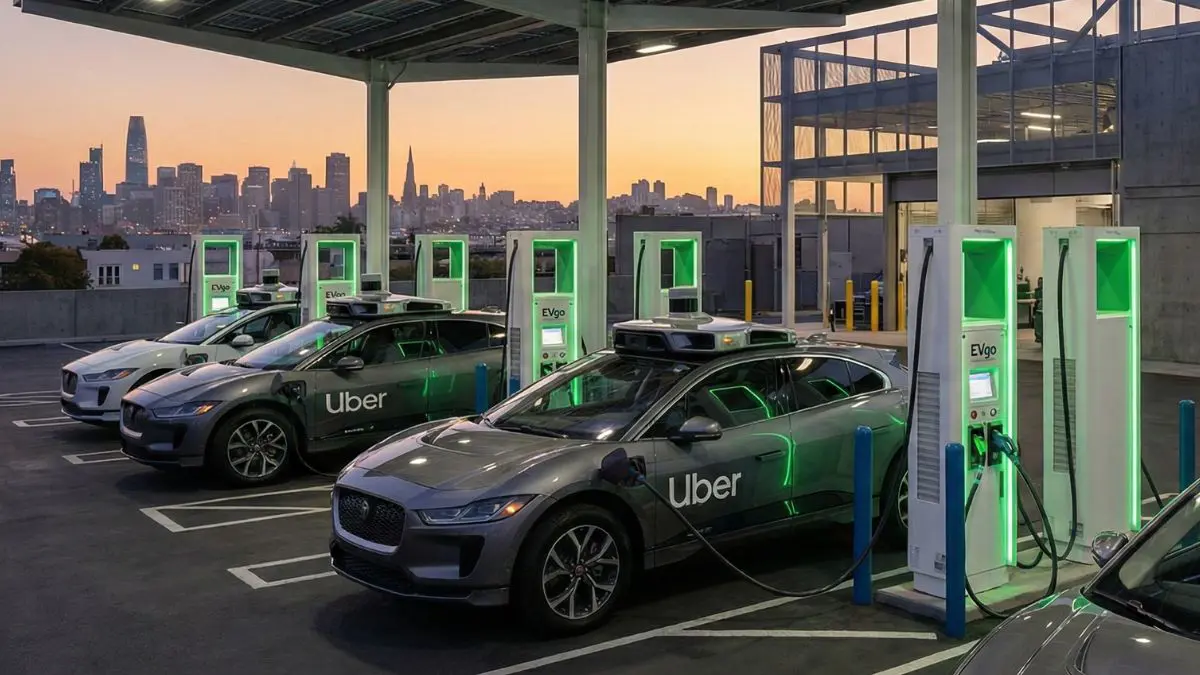
Ride-hailing giant Uber Technologies is committing more than $100 million to build charging infrastructure tailored for autonomous vehicles, reinforcing its strategy to scale robotaxi operations globally.
The investment will fund DC fast-charging hubs at autonomous fleet depots as well as additional charging “pit stops” across key cities, supporting broader deployment of self-driving services.
Building the backbone for robotaxis
Uber said the initial rollout will focus on major U.S. markets including the San Francisco Bay Area, Los Angeles, and Dallas, with expansion to additional cities planned over time.
The company aims to create dedicated charging ecosystems for autonomous fleets — a critical step as robotaxis require high utilization and rapid turnaround to achieve economic viability.
Partnerships across global charging networks
To accelerate deployment, Uber is working with multiple charging operators worldwide, including:
- EVgo — New York, Los Angeles, San Francisco, Boston
- Electra — Paris, Madrid
- IONITY — London
These utilization-guarantee agreements are expected to support hundreds of new chargers in high-demand locations.
Strategic push amid intensifying competition
Autonomous mobility has become a central pillar of Uber’s long-term strategy. The company has partnerships with more than 20 firms across robotaxi, freight, and delivery segments, as competition intensifies with rivals such as Tesla and other AV developers.
Uber currently offers robotaxi services in several markets, including four U.S. cities and Middle East hubs such as Dubai, Abu Dhabi, and Riyadh. Key collaborations include autonomous technology providers Waymo and WeRide.
Why charging infrastructure matters
Scaling robotaxis depends not only on vehicles but also on reliable, high-speed charging that can:
- Maximize fleet uptime
- Reduce operating costs
- Enable dense urban coverage
- Support rapid geographic expansion
By investing early in infrastructure, Uber is positioning itself to avoid operational bottlenecks as adoption grows.
Business implications
- Signals long-term commitment to autonomous mobility economics
- Strengthens Uber’s platform advantage through integrated infrastructure
- Raises competitive pressure on rival mobility and EV ecosystem players
- Highlights the capital intensity of the robotaxi race
Why this matters
Uber’s investment highlights a key shift in the autonomous mobility race: infrastructure is becoming as important as software. As companies move from pilot programs to scaled commercial fleets, reliable charging networks will determine which platforms can operate profitably and expand quickly. The move also signals confidence that robotaxis are approaching a more mature, deployment-focused phase.
FAQs
Q1. Why is Uber investing in charging hubs?
To support large-scale deployment of autonomous fleets that require fast, reliable charging.
Q2. How much is Uber investing?
More than $100 million in the initial phase.
Q3. Where will the rollout begin?
Major U.S. markets such as the Bay Area, Los Angeles, and Dallas.
Q4. Who are Uber’s autonomous partners?
Technology providers including Waymo and WeRide, along with other global collaborators.
Q5. What does this mean for the robotaxi market?
It signals intensifying competition and growing infrastructure investment as companies race to scale autonomous services.

























