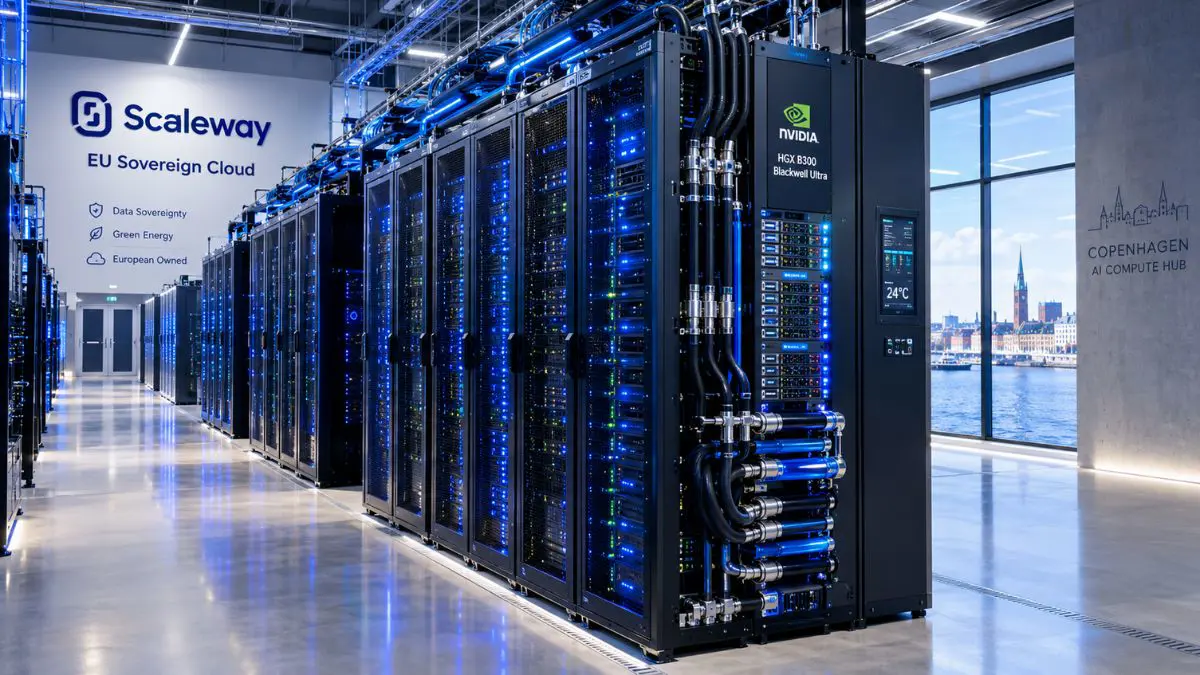
Scaleway plans Nvidia B300 AI computing hub in Copenhagen
By Cygnus | 13 Oct 2026
Summary
- New AI infrastructure: French cloud provider Scaleway has announced plans for a new AI computing site in Copenhagen, Denmark, powered by Nvidia HGX B300 systems.
- Expansion across northern Europe: The announcement follows a separate plan to build an AMD Instinct MI355X-powered AI supercomputer in Sweden, broadening Scaleway’s hardware options and regional computing capacity.
- European cloud sovereignty: The projects target businesses seeking high-performance AI computing within the European regulatory environment. However, data location, operational control and legal jurisdiction remain distinct aspects of cloud sovereignty.
- Energy considerations: Scaleway cited Copenhagen’s technology ecosystem, low-carbon electricity and cool climate as factors behind its location choice.
Scaleway expands its AI computing footprint in northern Europe
French cloud provider Scaleway plans to open a new AI computing site in Copenhagen using Nvidia HGX B300 systems. Announced on October 13, 2026, the project forms part of the company’s broader expansion of AI infrastructure across northern Europe.
The Nvidia HGX B300 platform is designed for demanding AI workloads, including large-model training and inference. The planned deployment is intended to provide European businesses with additional access to high-performance computing resources.
Scaleway selected Copenhagen for its established technology sector, access to low-carbon electricity and cool climate, which can help reduce the energy required for data-centre cooling. The company already serves Danish customers, including the City of Copenhagen and AI firm Corti, according to Reuters. Their existing customer relationships should not, however, be taken as confirmation that they will use the new facility.
Sweden project adds AMD-based computing capacity
The Copenhagen announcement came alongside Scaleway’s plan to build an AI supercomputer in Sweden powered by AMD Instinct MI355X accelerators. The Swedish project is intended to expand the company’s infrastructure beyond France and give customers another hardware platform for AI workloads.
Reuters reported that the system is intended to be Europe’s first commercial AI supercomputer based on AMD’s MI355X accelerators. The project is expected to involve Bull, with contributions from Giga Computing, HPE, VAST Data and Motul across server systems, networking, storage and cooling.
The Swedish deployment also highlights the role of AMD’s ROCm software ecosystem, which supports widely used AI development tools. Alongside Nvidia’s CUDA ecosystem, ROCm gives customers and developers another option for running and optimising AI applications, although software compatibility and performance depend on the workload.
Digital sovereignty remains a key consideration
The expansion comes as European organisations place greater emphasis on digital sovereignty: their ability to control data, infrastructure, technology and the legal arrangements governing digital services.
Scaleway was selected in April 2026 as one of four providers under the European Commission’s €180 million Cloud III procurement programme for sovereign cloud services for EU institutions. The programme uses the Commission’s Cloud Sovereignty Framework to assess providers against criteria spanning legal and jurisdictional factors, data and AI, operations, technology, security, supply chains and environmental sustainability.
The selection is a procurement outcome, not a blanket certification that every Scaleway service automatically meets every sovereignty requirement. Customers still need to assess the particular service, deployment and contractual protections relevant to their workloads.
Likewise, hosting data in Europe does not by itself settle every question about foreign legal jurisdiction, operational access or dependence on non-European technology. These considerations are particularly relevant for organisations handling sensitive public-sector, commercial or regulated information.
Why this matters
- Scaleway’s plans reflect growing demand for AI computing capacity in Europe and interest in alternatives to relying on a single hardware or cloud ecosystem. The Copenhagen and Sweden projects could broaden regional access to high-performance computing while giving businesses more choice between Nvidia- and AMD-based systems.
- The projects also demonstrate that digital sovereignty involves more than the location of a data centre. Organisations must consider who controls the infrastructure, which laws apply, how data is protected, and whether workloads can move between providers or technologies.
- The commercial impact will depend on the facilities’ eventual capacity, availability, pricing, energy performance and ability to meet customers’ technical and regulatory requirements.
Frequently asked questions
Q1: What has Scaleway announced in Copenhagen?
Scaleway plans to open an AI computing site in Copenhagen powered by Nvidia HGX B300 systems.
Q2: What is the purpose of Nvidia HGX B300 systems?
They are high-performance computing platforms designed for demanding AI workloads, including model training and inference.
Q3: What is Scaleway planning in Sweden?
The company plans to build an AI supercomputer powered by AMD Instinct MI355X accelerators, expanding its AI infrastructure beyond France.
Q4: Why did Scaleway choose Copenhagen?
The company cited the city’s technology sector, low-carbon electricity and cool climate, which can help reduce cooling energy requirements.
Q5: Does the European Commission’s Cloud III selection certify every Scaleway service as sovereign?
No. Scaleway’s selection makes it one of four eligible providers under the procurement programme. Sovereignty and compliance depend on the particular service, deployment and applicable requirements.
Q6: Does European data-centre hosting guarantee complete protection from foreign legal demands?
No. Data location is one factor. Legal jurisdiction, ownership, operational control, access arrangements and contractual safeguards also matter.