Google expands agricultural AI and backs $15 million MSME initiative
By Axel Miller | 15 Oct 2026
Summary
- Satellite-powered agricultural intelligence: Google DeepMind’s Agricultural Landscape Understanding (ALU) and Agricultural Monitoring and Event Detection (AMED) models use satellite imagery and machine learning to map agricultural fields, identify landscape features and monitor crop cycles. In August 2026, Google announced that the models were providing agricultural insights in six African countries, building on earlier expansion into Asia-Pacific.
- Separate MSME funding initiative: Google.org announced a $15 million funding commitment to The/Nudge Foundation on October 14, 2026, to support AI-powered solutions that help Indian micro, small and medium enterprises (MSMEs) access formal credit, find market opportunities and manage compliance.
- Crop-genomics claims remain unverified: The proposed Google DeepMind–ICRISAT sorghum pangenome atlas, the three-year postdoctoral fellowship and the quotation attributed to ICRISAT’s Dr. Stanford Blade could not be independently verified. These claims should not be presented as confirmed developments without an official announcement or other reliable primary evidence.
NEW DELHI, October 15, 2026 — Google is expanding the application of artificial intelligence across agricultural intelligence and small-business support, with satellite-based farming models reaching more countries and a separate $15 million philanthropic initiative targeting the needs of Indian micro, small and medium enterprises (MSMEs).
The two initiatives address different challenges. Google DeepMind’s Agricultural Landscape Understanding (ALU) and Agricultural Monitoring and Event Detection (AMED) models provide field-level information derived from satellite imagery. Separately, Google.org’s funding commitment to The/Nudge Foundation is intended to encourage the development of AI-powered solutions for small businesses.
In an update published on August 26, 2026, Google DeepMind said its agricultural models had begun providing insights in six African countries: Kenya, Uganda, Ghana, Rwanda, Nigeria and Zambia. This followed the earlier expansion of the models beyond India into Asia-Pacific markets, including Malaysia, Vietnam, Indonesia and Japan.
The models are designed to help agricultural organisations, public agencies, researchers and agritech companies understand how farmland is being used. Their outputs include field boundaries, estimates of field area, landscape features and information about crop seasons. Such data can help organisations make more targeted decisions about agricultural services, water resources and farm management.
Separately, Google.org announced a $15 million funding commitment to The/Nudge Foundation on October 14, 2026. The initiative aims to support the development of AI-based tools that help Indian MSMEs improve access to formal credit, identify market opportunities and manage regulatory requirements. The announcement also includes an open call for proposals to identify practical solutions to business challenges.
The agricultural models and the MSME funding programme are distinct initiatives. The former focuses on satellite-derived agricultural intelligence, while the latter supports the development of tools for small-business growth and digital adoption.
How Google’s agricultural AI models work
Google’s Agricultural Understanding platform combines two complementary systems to generate information about agricultural landscapes and farming activity.
Agricultural Landscape Understanding (ALU) uses high-resolution satellite imagery and machine learning to identify field boundaries and estimate field areas. It can also identify landscape features such as trees and water bodies. These insights can help agricultural planners assess land use and identify areas relevant to irrigation planning and water-resource management.
Google says ALU data generally refreshes every six to 12 months and includes historical landscape information. The model is also available through Google Earth and the Agricultural Understanding API, subject to the applicable access arrangements.
Agricultural Monitoring and Event Detection (AMED) builds on the field boundaries identified by ALU to monitor crop activity. It uses satellite observations to predict the likely crop grown in a field and estimate sowing and harvesting periods. Google’s documentation says AMED data is refreshed approximately every 15 days, providing more frequent information about seasonal agricultural activity.
Together, the systems can help build a detailed picture of agricultural activity without requiring every field to be surveyed manually. Their outputs can support agricultural research, farm advisory services, resource allocation and public-sector planning.
However, these models do not independently guarantee higher yields or determine the best crop-management decisions for every farm. Their outputs are data inputs that developers, researchers, public agencies and agricultural organisations can incorporate into wider services.
Google provides further information about the models, their coverage and access options through its Agricultural Understanding platform.
Google.org targets AI adoption among small businesses
The separate $15 million commitment to The/Nudge Foundation focuses on improving the ability of Indian MSMEs to use AI to address practical business challenges.
Small enterprises can face difficulties obtaining formal credit, maintaining financial records, complying with tax and other regulatory requirements, and reaching new customers. AI-powered applications may help reduce some of these administrative burdens, although their effectiveness will depend on implementation, data quality, affordability and adoption by businesses.
According to reporting on the October 14 announcement, the initiative is intended to support scalable AI solutions for credit access, market opportunities and compliance. An open call for proposals is expected to help identify practical tools and approaches that can address these challenges.
The funding is a philanthropic commitment to support solution development. It should not be interpreted as a direct $15 million credit facility for MSMEs or as evidence that all proposed tools are already operational.
The programme is also separate from Google DeepMind’s agricultural AI work. Although both initiatives use AI to address real-world challenges, they target different users and outcomes: agricultural intelligence for farming-related decisions and business tools for enterprise growth.
What remains unverified about the proposed crop-genomics partnership
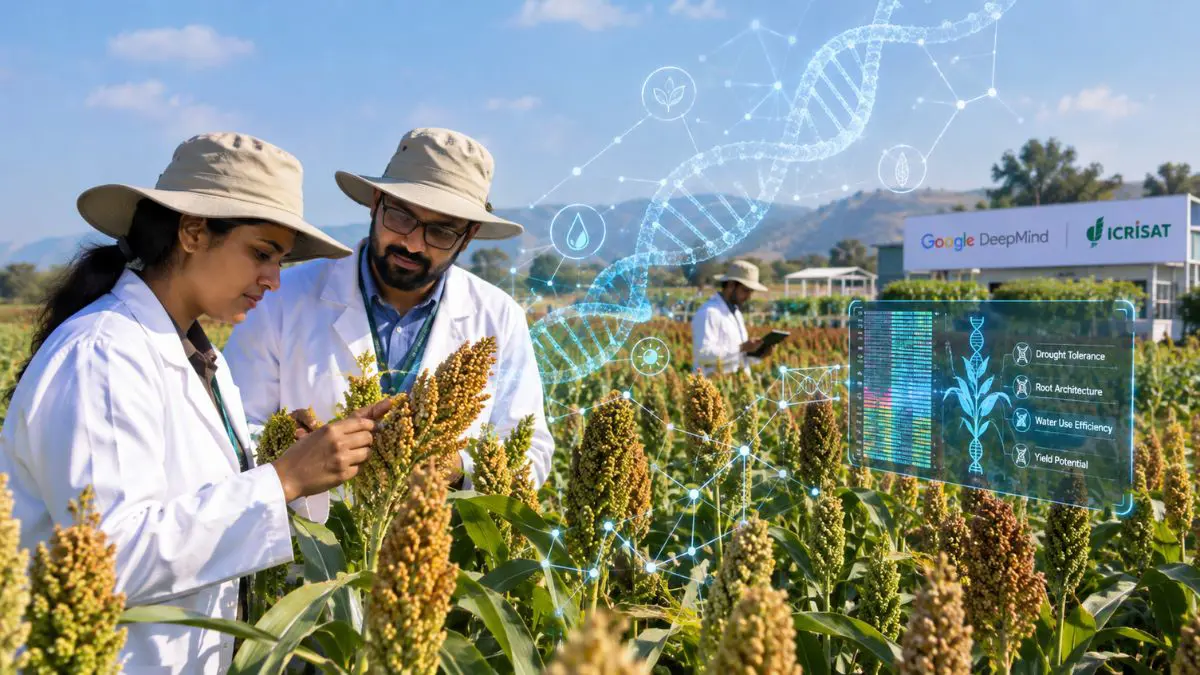
The original draft described a Google DeepMind and ICRISAT partnership to create an open-access pangenome atlas, beginning with sorghum and later expanding to chickpea, groundnut and pigeon pea. It also attributed a statement about the project to Dr. Stanford Blade, identified in the draft as ICRISAT’s Deputy Director General of Research and Innovation.
The specific partnership, three-year fellowship, crop roadmap and quotation could not be verified through reliable primary sources during this fact-check. These details should not be published as confirmed developments unless an official announcement, research publication or direct statement from the organisations becomes available.
This distinction is important because Google’s documented Agricultural Understanding work focuses on extracting field-level information from satellite imagery. That is different from sequencing crop genomes, mapping genetic variation or training models to predict inherited traits.
Both agricultural intelligence and crop-genomics research may contribute to climate resilience, but evidence for one does not establish a partnership in the other. Until the claimed collaboration is independently confirmed, the sorghum pangenome project should remain outside the confirmed news narrative.
Why this matters
- More detailed agricultural information: Satellite-based AI can help researchers, public agencies and agricultural service providers understand field boundaries, crop patterns and seasonal farming activity.
- Potential benefits beyond India: Extending agricultural models to additional countries creates opportunities to adapt field-level intelligence to different crops, landscapes and farming systems.
- AI support for smaller enterprises: The Google.org–The/Nudge initiative aims to encourage tools that address credit access, market discovery and compliance—areas that can place significant administrative burdens on small businesses.
- Clearer distinction between AI applications: Satellite-based agricultural mapping and crop-genomics research are different technical fields. Accurate reporting helps readers understand what each system can and cannot do.
FAQs
Q1. What are Google DeepMind’s Agricultural Understanding models?
They are AI models that use satellite imagery and machine learning to provide field-level agricultural information. ALU identifies field boundaries and other landscape features, while AMED monitors crop activity and estimates sowing and harvesting periods.
Q2. Which countries are covered by Google’s agricultural AI expansion?
Google’s August 2026 update identified six African countries—Kenya, Uganda, Ghana, Rwanda, Nigeria and Zambia—as receiving agricultural insights from the models. Google had previously expanded the models’ reach from India into Asia-Pacific markets, including Malaysia, Vietnam, Indonesia and Japan. Coverage differs by model and service. <Cite refs={["turn718699search0","turn718699search5"]}/>
Q3. What is the purpose of Google.org’s $15 million commitment to The/Nudge Foundation?
The funding is intended to support AI-powered solutions that help Indian MSMEs improve access to formal credit, discover market opportunities and manage compliance requirements. It is a separate initiative from Google DeepMind’s agricultural models.
Q4. Has Google DeepMind officially announced a sorghum genome atlas with ICRISAT?
The specific partnership, three-year fellowship and crop-genomics roadmap described in the original draft could not be verified through reliable primary sources. These claims should be treated as unconfirmed unless an official announcement or research publication becomes available.
Q5. Can satellite-based agricultural AI shorten crop-breeding cycles?
Not directly. ALU and AMED analyse agricultural landscapes and crop activity; they are not, by themselves, crop-genomics or plant-breeding systems. AI can support genomic research in other contexts, but claims about shorter breeding cycles require evidence from the relevant research programme.