Nvidia strikes $20 billion “acqui-hire” deal for Groq to dominate AI inference
By Cygnus | 26 Dec 2025
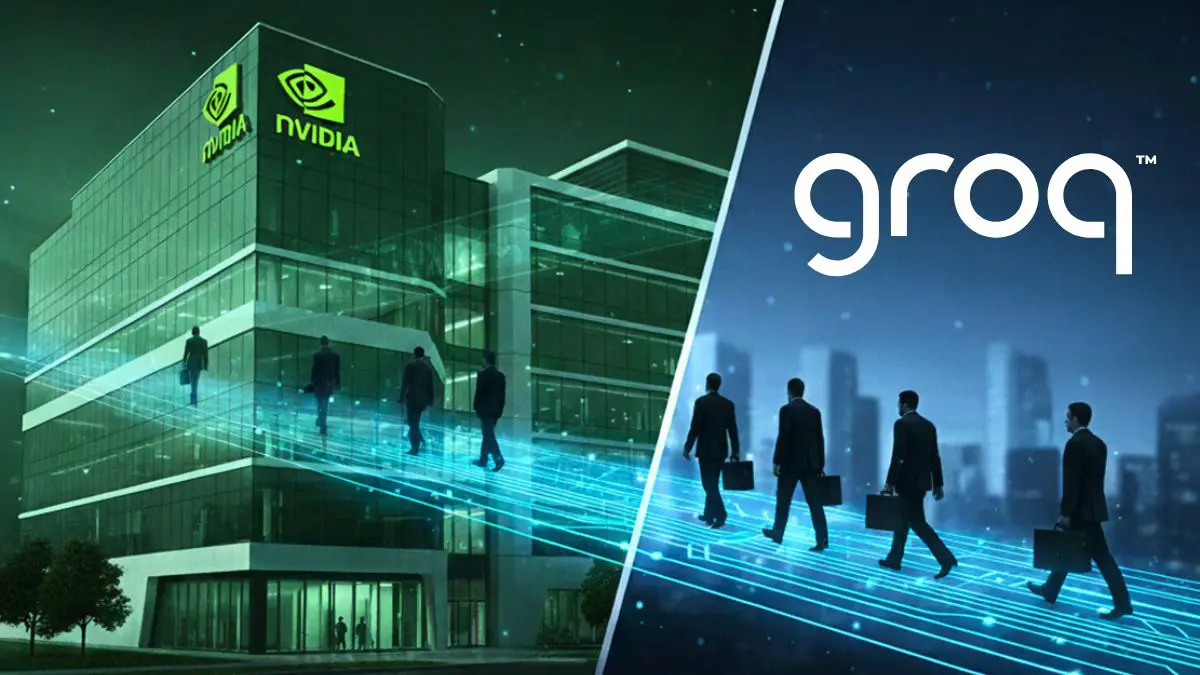
Nvidia has executed one of the most significant strategic maneuvers in the semiconductor industry this year, agreeing to a landmark deal to license technology from AI startup Groq while absorbing its entire executive leadership core.
The move, reportedly valued at $20 billion, signals a decisive shift in Nvidia’s strategy: as the “training” phase of the AI revolution matures, the $4.6 trillion giant is moving aggressively to lock down the market for “inference”—the real-time processing required by AI agents.
The “Acqui-hire” Strategy
While financial terms remained undisclosed in Groq’s Wednesday blog post, sources close to the transaction confirmed to CNBC and Reuters that the package is worth approximately $20 billion in cash and stock incentives.
Crucially, this is not a traditional merger. Structured as a non-exclusive license and talent transfer, the deal allows Nvidia to bypass the aggressive antitrust hurdles that have blocked recent tech mega-mergers. By licensing the IP and hiring the team rather than buying the corporate entity, Nvidia secures the innovation without triggering a mandatory monopoly review of the company itself.
Talent Transfer: The TPU Architect Joins Nvidia
Under the agreement, Groq founder Jonathan Ross—the former Google engineer famous for architecting the original Tensor Processing Unit (TPU)—will join Nvidia as a top executive. He brings with him Groq President Sunny Madra and the startup’s core engineering team.
Groq will continue to operate as an independent entity, pivoting to focus solely on its cloud service business. Simon Edwards, formerly Groq’s CFO, was officially named the new Chief Executive Officer of the standalone company on December 24.
“This partnership validates our LPU architecture,” Edwards said in a statement. “GroqCloud will continue to serve customers, now with a massive capital infusion to expand our data center footprint.”
The Battle for Real-Time Inference
The deal addresses the specific bottleneck facing the AI industry in late 2025: Latency. While Nvidia’s GPUs are the gold standard for training massive models (teaching them), Groq’s Language Processing Units (LPUs) are purpose-built for inference (running them).
Groq’s architecture eschews the industry-standard High-Bandwidth Memory (HBM)—which remains in short supply—in favor of on-chip SRAM. This allows for near-instantaneous response times, a requirement for the new wave of “voice-to-voice” AI agents and autonomous bots. By integrating this SRAM-based architecture, Nvidia aims to create a hybrid chip ecosystem that dominates both the training and the deployment of AI.
Pressure on Rivals: The Cerebras Factor
The consolidation places immense pressure on competitors. Nvidia’s primary rival in specialized hardware, Cerebras Systems, has also been forced to realign. After cancelling its highly anticipated IPO on October 3, 2025, Cerebras pivoted to a “private-for-longer” strategy, raising a $1.1 billion Series G round at an $8.1 billion valuation. With Nvidia now absorbing Groq’s brain trust, the window for alternative hardware makers to gain a foothold is narrowing rapidly.
Market Reaction
Nvidia (NASDAQ: NVDA) shares showed resilience in pre-market trading Friday following the Christmas holiday. The $20 billion price tag—a 3x premium over Groq’s last private valuation of $6.9 billion in September—is viewed by analysts as a “defensive moat” investment.
“Nvidia is paying a premium not just for the tech, but to take the smartest inference engineers off the market,” said semiconductor analyst Stacy Rasgon. “They are ensuring the next breakthrough happens inside Nvidia, not outside.”
Summary
Nvidia has entered a reported $20 billion non-exclusive licensing agreement with AI startup Groq, hiring its founder Jonathan Ross and key leadership to spearhead a new inference-scaling division. This “acqui-hire” allows Nvidia to integrate Groq’s ultra-fast, SRAM-based LPU technology into its ecosystem while avoiding the regulatory delays of a full acquisition. While Nvidia consolidates its lead in the cooling-down training market, it is now positioning itself to dominate the “inference chasm” as AI agents go mainstream.
Frequently Asked Questions (FAQs)
Q1: Did Nvidia buy Groq entirely?
No. This is a “licensing and talent” deal. Nvidia paid for the rights to use Groq’s chip designs and hired their leadership team. Groq remains a separate company focused only on cloud services.
Q2: Why is the deal valued at $20 billion?
The price reflects the strategic urgency of the “inference” market. Securing Jonathan Ross—the architect of the Google TPU—effectively prevents rivals from using his expertise to challenge Nvidia’s dominance.
Q3: What is the difference between Training and Inference?
Training is the “learning” phase of AI using massive data. Inference is the “acting” phase (e.g., a chatbot answering a question). Groq’s technology is optimized for the latter, which is predicted to be the largest segment of the chip market by 2027.
Q4: Is GroqCloud shutting down?
No. New CEO Simon Edwards has confirmed that GroqCloud remains operational and will serve its 2 million+ developers independently.
Q5: What happened to the Cerebras IPO?
Cerebras withdrew its IPO in October 2025 due to regulatory delays and opted for a $1.1 billion private funding round instead, valuing the company at $8.1 billion.

























