Brain function partly replicated by nanomaterials
14 Jul 2018
1
The brain requires surprisingly little energy to adapt to the environment to learn, make ambiguous recognitions, have high recognition ability and intelligence, and perform complex information processing.
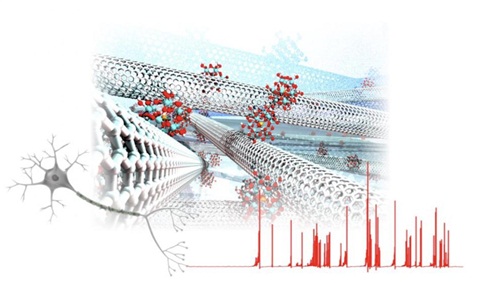
The two key features of neural circuits are "learning ability of synapses" and "nerve impulses or spikes." As brain science progresses, brain structure has been gradually clarified, but it is too complicated to completely emulate. Scientists have tried to replicate brain function by using simplified neuromorphic circuits and devices that emulate a part of the brain's mechanisms.
In developing neuromorphic chips to artificially replicate the circuits that mimic brain structure and function, the functions of generation and transmission of spontaneous spikes that mimic nerve impulses (spikes) have not yet been fully utilized.
A joint group of researchers from Kyushu Institute of Technology and Osaka University studied current rectification control in junctions of various molecules and particles absorbed on single-walled carbon nanotube (SWNT), using conductive atomic force microscopy (C-AFM), and discovered that a negative differential resistance was produced in polyoxometalate (POM) molecules absorbed on SWNT. This suggests that an unstable dynamic non-equilibrium state occurs in molecular junctions.
In addition, the researchers created extremely dense, random SWNT / POM network molecular neuromorphic devices, generating spontaneous spikes similar to nerve impulses of neurons.
POM consists of metal atoms and oxygen atoms to form a 3-dimensional framework. Unlike ordinary organic molecules, POM can store charges in a single molecule. In this study, it was thought that negative differential resistance and spike generation from the network were caused by non-equilibrium charge dynamics in molecular junctions in the network.
Thus, the joint research group led by Megumi Akai-Kasaya conducted simulation calculations of the random molecular network model complexed with POM molecules, which are able to store electric charges, replicating spikes generated from the random molecular network. They also demonstrated that this molecular model would very likely become a component of reservoir computing devices. Reservoir computing is anticipated as next-generation artificial intelligence (AI). Their research results were published in Nature Communications.
"The significance of our study is that a portion of brain function was replicated by nano-molecular materials. We demonstrated the possibility that the random molecular network itself can become neuromorphic AI," says lead author Hirofumi Tanaka.
It is expected that this group's achievements will greatly contribute to the development of neuromorphic devices of the future.