Brain tumours may be new victims of Ebola-like virus
18 Apr 2015
Brain tumours are notoriously difficult for most drugs to reach, but Yale researchers have found a promising but unlikely new ally against brain cancers - portions of a deadly virus similar to Ebola.
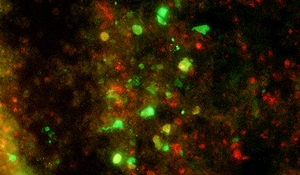 | |
| Glioma tumour cells (in red) and being destroyed in a rat brain by a chimeric virus (green) containing elements of the Lassa virus, an ebola-like pathogen |
A virus containing proteins found in the Lassa virus - like Ebola, a haemorrhagic fever virus found in some parts of Africa - not only passed through the formidable blood-brain barrier but destroyed brain tumours in mice, according to research released April 16 in the Journal of Virology.
''The chimeric virus turned out to be completely safe in animals and tended to specifically target cancer cells in the brain,'' said Tony van den Pol, professor of neurosurgery at the Yale School of Medicine, researcher at the Yale Cancer Center and senior author of the study.
Researchers have long been intrigued by the VSV virus, a relative of rabies, which can pass through membranes that protect the brain to infect brain tumours.
The unaltered virus, however, can cause serious neurological damage. The Yale team wanted to know if portions of VSV together with portions of unrelated viruses might be safely used to attack brain tumours in mice.
Some of the viruses tested, like the altered virus that contained Ebola genes, did reach the brain tumour, but did not effectively attack brain tumours.
The altered Lassa virus, however, safely and effectively targeted and destroyed cancer cells within the brain. The Lassa chimeric virus targeted both gliomas and melanoma, another type of cancer that can migrate into the brain.
''We are very excited about these new chimeric viruses that contain genes from multiple viruses. They work well in targeting cancer in animals, and we hope that they will also work effectively if tested in humans,'' said van den Pol.
Guido Wollmann, Eugene Drokhlyansky, and Connie Cepko are other authors of the paper.
The work was funded by the NIH National Cancer Institute.