Researchers develop artificial hand that performs precise movements
28 Mar 2015
An artificial hand developed by engineers from Saarland University in Germany has sensory properties and is capable of performing extremely precise movements.
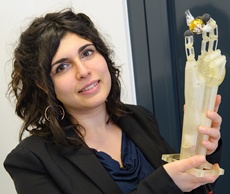 The research is being conducted by professor Stefan Seelecke from the university, using a new technology based on the shape memory properties of nickel-titanium alloy.
The new technology allows the fabrication of flexible and lightweight robot hands for industrial applications and novel prosthetic devices.
The muscle fibres are made up of bundles of ultra-fine wires that can tense and flex. The diameter of the ultra-fine nickel-titanium alloy wires is similar to that of a human hair.
According to Seelecke, shape-memory alloy (SMA) wires offered significant advantages over other techniques.
The term 'shape memory' referred to the fact that the wire could 'remember' its shape and was able to return to that original predetermined shape after it had been deformed.
Multiple strands of shape-memory wire connected the finger joints and acted as flexor muscles on the front-side of the finger and as extensor muscles on the rear.
Seelecke said, tools fabricated with artificial muscles from SMA wire could do without additional equipment, making them light, flexible and highly adaptable.
With the aim of achieving capability of rapid movements, the engineers copied the structure of natural human muscles by grouping the very fine wires into bundles to mimic muscle fibres.
The research is expected to spur development of flexible and lightweight robot hands for industrial applications and novel prosthetic devices.
Until now, artificial hands, such as those used in industrial production lines, had relied on complex background technology, rendering them dependent on other devices and equipment, such as electric motors or pneumatics. Such artificial limbs are heavy, relatively inflexible, noisy and also expensive.
Against this, tools fabricated with artificial muscles from shape-memory alloy wire could do without additional equipment, making them light, flexible and adaptable. They operated silently and were cheap to produce
Also the wires had the highest energy density of all known drive mechanisms, which enabled them to perform powerful movements in restricted spaces.
According to Seelecke, this property of nickel-titanium alloy was a result of phase changes that occured within the material. If the wire became warm, which happened, for instance, when it conducted electricity, the material transformed its lattice structure causing it to contract like a muscle.