Scientists isolate blood stem cells
11 Oct 2014
Blood stem cells are responsible for the production of blood in our bodies and are crucial for treating patients suffering from diseases related to blood cancer.
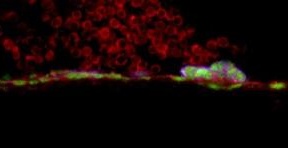 | |
| Image shows a cluster of blood stem cells on the ventral wall of a human embryonic aorta. Image by Daria Paruzina. |
Although some patients already benefit from stem cell transplants, not all patients survive, for example because of the limited availability of matching blood stem cell donors.
Therefore, many researchers around the world are exploring ways of generating blood stem cells in the laboratory, which to this date remains a significant challenge.
MRC Centre for Regenerative Medicine (CRM) researchers led by Prof Alexander Medvinsky are investigating how blood stem cells first emerge and develop in the early embryo. Better understanding of the natural process will bring us closer to developing novel protocols for the generation of blood stem cells in the laboratory.
In 2011, the Medvinsky group found that human blood stem cells emerge in a specific area of the early embryo called the aorta-gonad-mesonephros region (AoV domain). They also discovered that the early embryonic blood stem cells are much more potent than the blood stem cells currently used in the clinic.
Now, three years later, the group has established a method for separating human blood stem cells from other cells in the embryo using a combination of antibodies against cell surface proteins (anti-CD45 and anti-VE-cadherin) and a magnetic cell separation technique using beads (MACS).
Prof Alexander Medvinsky, who led the study, says, ''By using this method we have been able to show that, compared to the total population of cells composing the aorta-gonad-mesonephros region of the embryo, the VE-cadherin+CD45+ cell population provides up to 1000-fold enrichment for blood stem cells and that these cells are located exclusively in the AoV domain."
He continues,''We now know where to locate these potent blood stem cells cells and how to extract them, but in order to develop more effective treatments for blood cancer patients in the future, we still need to understand why these early embryonic blood stem cells possess significantly higher regenerative potential than the ones currently used to treat patients. This is going to be the next step in our research.''