Bioprinting a 3D liver-like device to detoxify the blood
10 May 2014
Nanoengineers at the University of California, San Diego, have developed a 3D-printed device inspired by the liver to remove dangerous toxins from the blood. The device, which is designed to be used outside the body -- much like dialysis – uses nanoparticles to trap pore-forming toxins that can damage cellular membranes and are a key factor in illnesses that result from animal bites and stings, and bacterial infections. Their findings were published May 8 in the journal Nature Communications.
 Nanoparticles have already been shown to be effective at neutralizing pore-forming toxins in the blood, but if those nanoparticles cannot be effectively digested, they can accumulate in the liver creating a risk of secondary poisoning, especially among patients who are already at risk of liver failure.
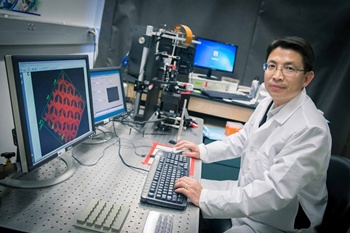
To solve this problem, a research team led by nanoengineering professor Shaochen Chen created a 3D-printed hydrogel matrix to house nanoparticles, forming a device that mimics the function of the liver by sensing, attracting and capturing toxins routed from the blood.
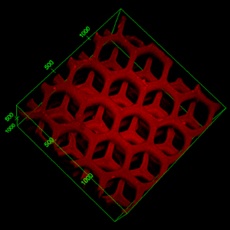
The device, which is in the proof-of-concept stage, mimics the structure of the liver but has a larger surface area designed to efficiently attract and trap toxins within the device. In an in vitro study, the device completely neutralized pore-forming toxins.
 | |
| Nanoengineers at the University of California, San Diego have developed a 3D-printed device inspired by the liver to remove dangerous toxins from the blood. The device, which is designed to be used outside the body like dialysis, uses nanoparticles to trap pore-forming toxins that can damage cellular membranes and are a key factor in illnesses that result from animal bites and stings, and bacterial infections. |
Chen's lab has already demonstrated the ability to print complex 3D microstructures, such as blood vessels, in mere seconds out of soft biocompatible hydrogels that contain living cells.
Chen's biofabrication technology, called dynamic optical projection stereolithography (DOPsL), can produce the micro- and nanoscale resolution required to print tissues that mimic nature's fine-grained details, including blood vessels, which are essential for distributing nutrients and oxygen throughout the body.
The biofabrication technique uses a computer projection system and precisely controlled micromirrors to shine light on a selected area of a solution containing photo-sensitive biopolymers and cells. This photo-induced solidification process forms one layer of solid structure at a time, but in a continuous fashion. The technology is part of a new biofabrication technology that Chen is developing under a four-year,$1.5 million grant from the National Institutes of Health (R01EB012597). The project is also supported in part by a grant (CMMI-1120795) from the National Science Foundation.